Robbie invited me to chat technique about my fashion drawings and portraits on her blog. I’m having a blast over there, so if you haven’t already pop over and enjoy the groove!
One day soon, I will draw Mademoiselle Emily!

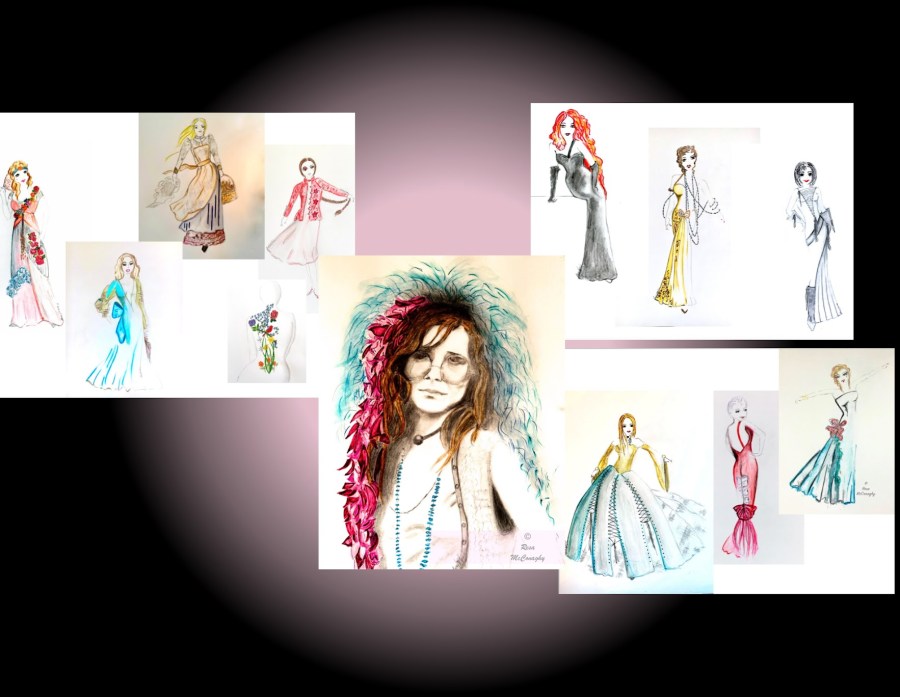
Robbie invited me to chat technique about my fashion drawings and portraits on her blog. I’m having a blast over there, so if you haven’t already pop over and enjoy the groove!
One day soon, I will draw Mademoiselle Emily!
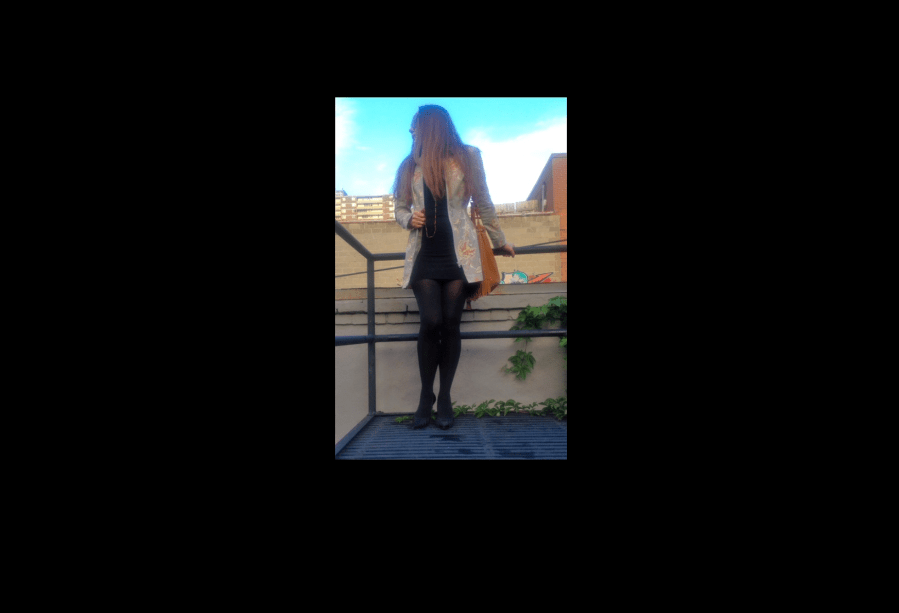
Dahlings, welcome to Teagan’s “Reinvention Series”! I am honoured to be her third guest.

One thing about gathering the reinvention pics is one does go back over a part of a life. Lots of reflecting ensues. For me this has been a positive experience. So head over to Teagan’s and check it all out!
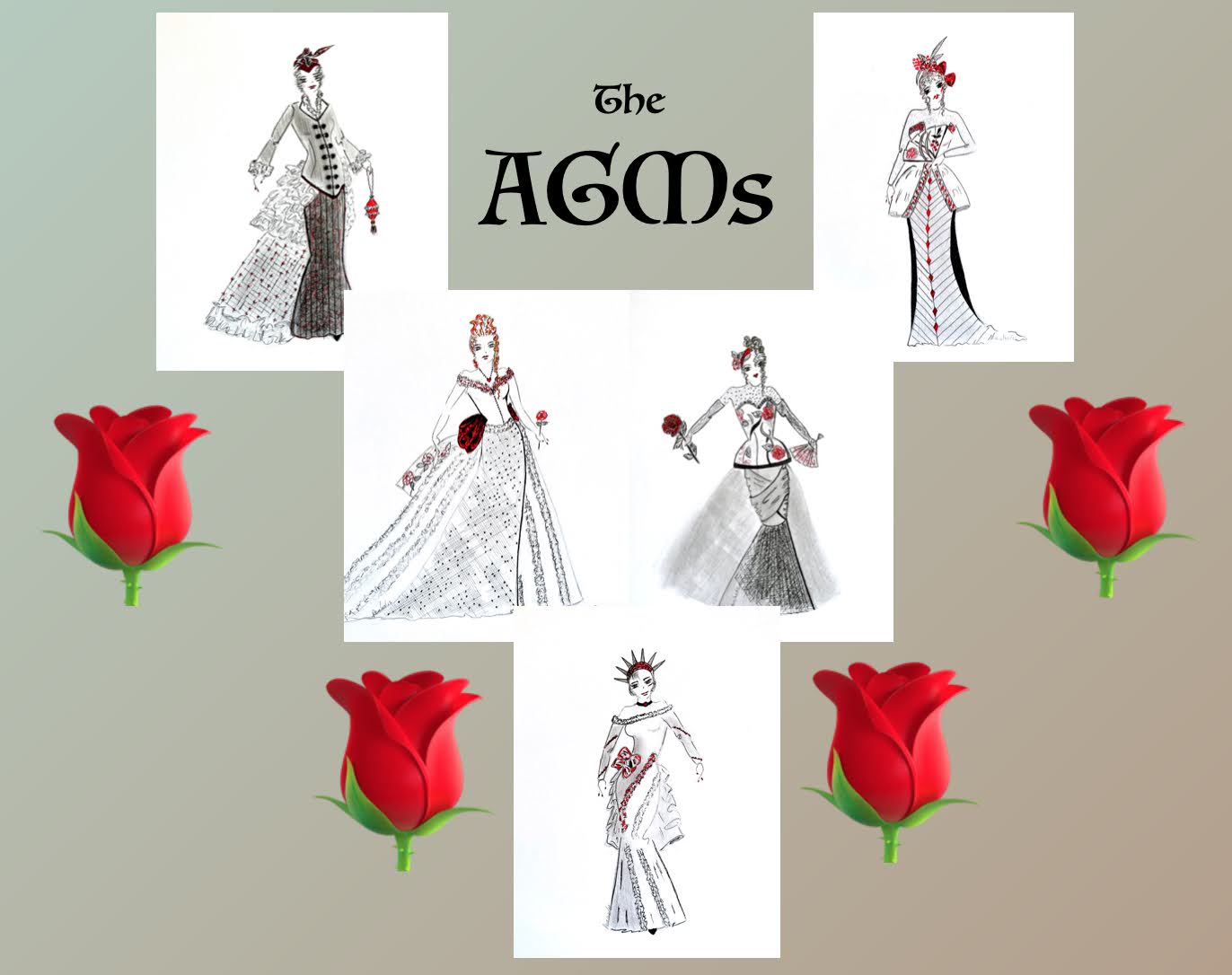
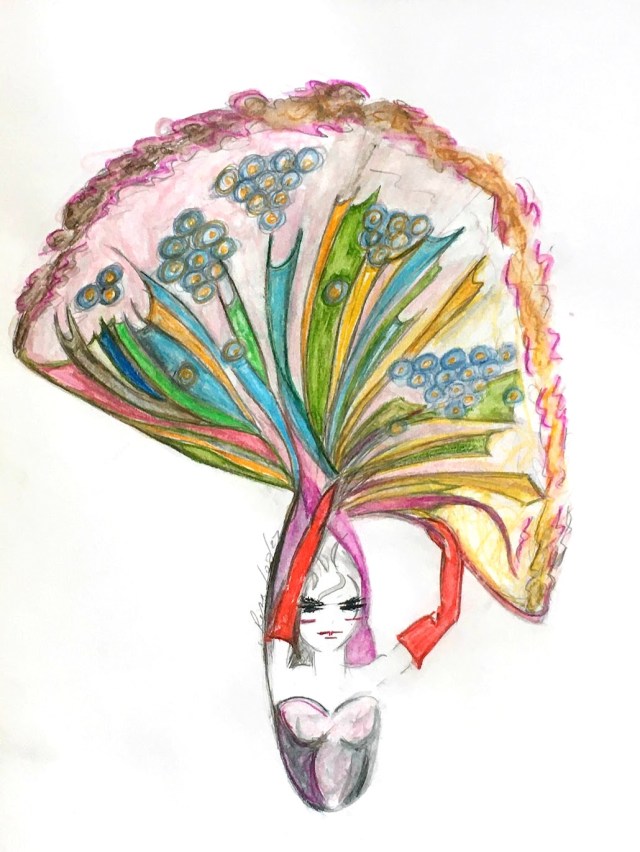
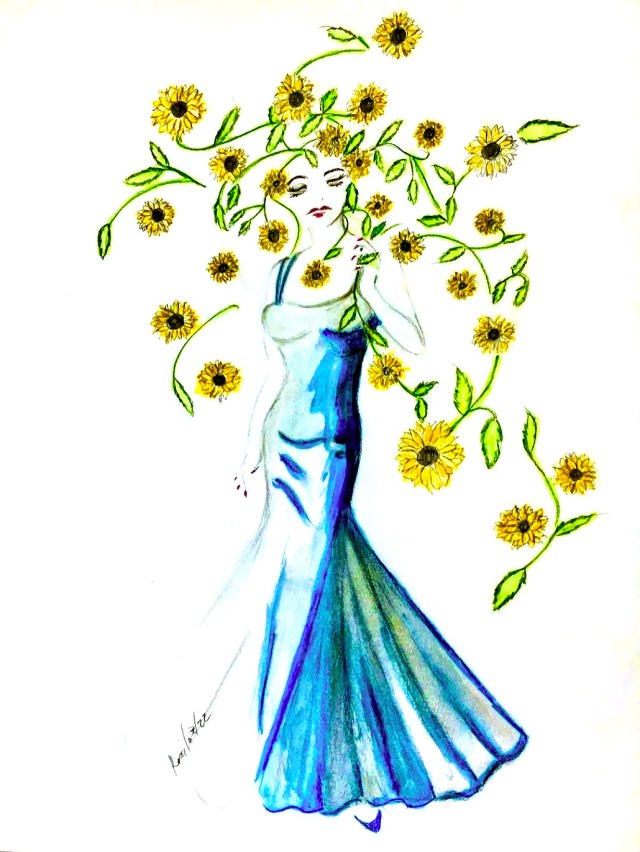
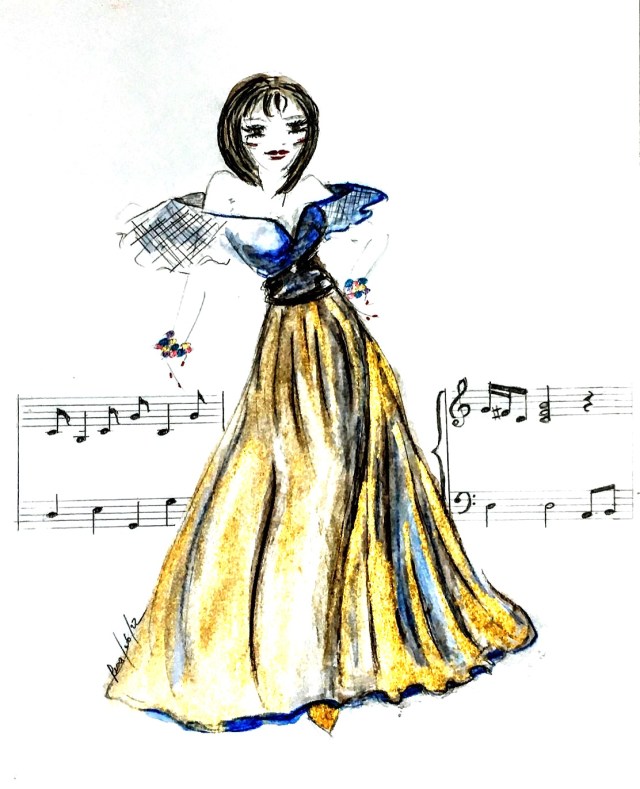
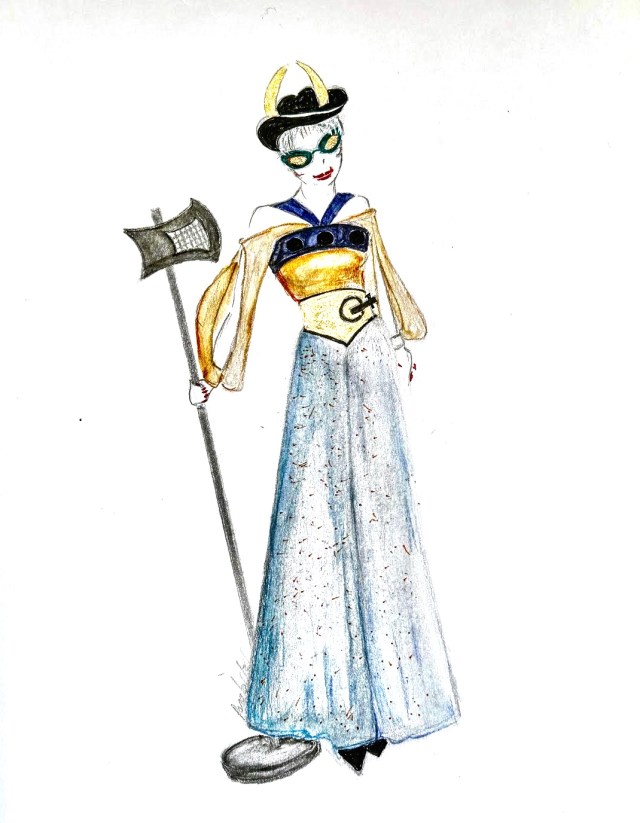
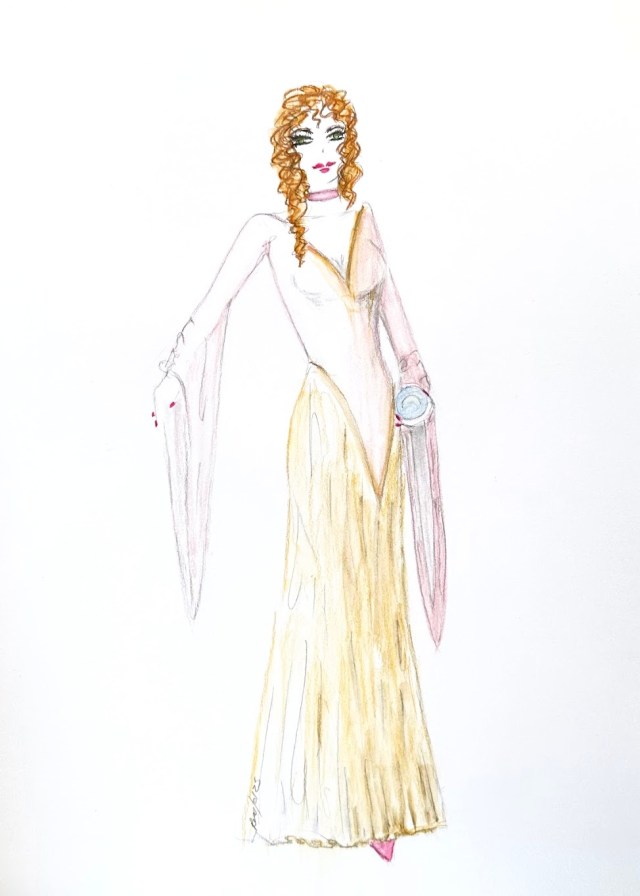
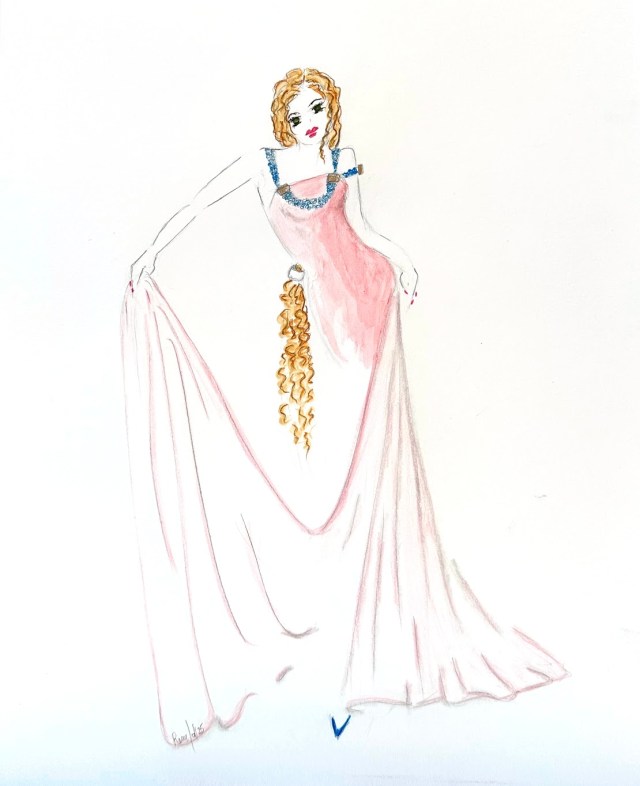
To kick things off, Teagan’s Reinvention Androids put on a fashion show for us. One good show deserves another! So, here’s a retro collection of Art Gowns drawings – just for fun!
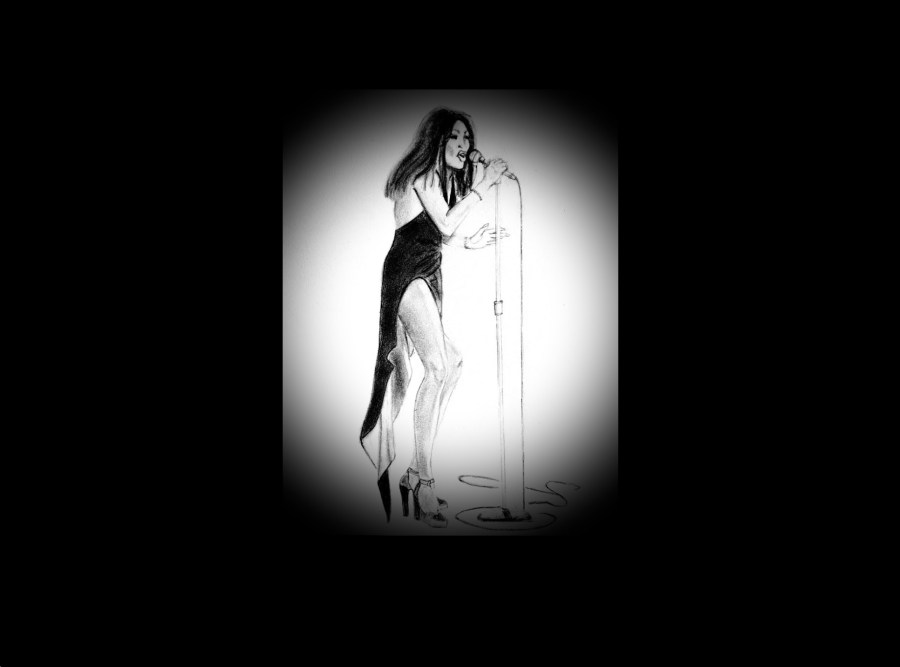
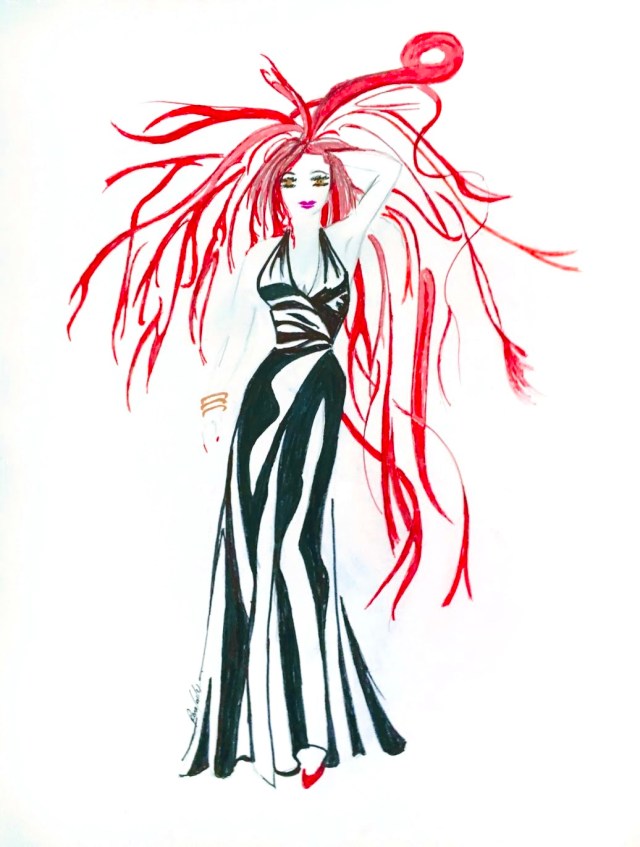
Holly has done another fab bio. This time it is on the late great Tina Turner. It is again an honour to provide the drawing for the article.
Head on over and give it a read!
What an inspirational person!

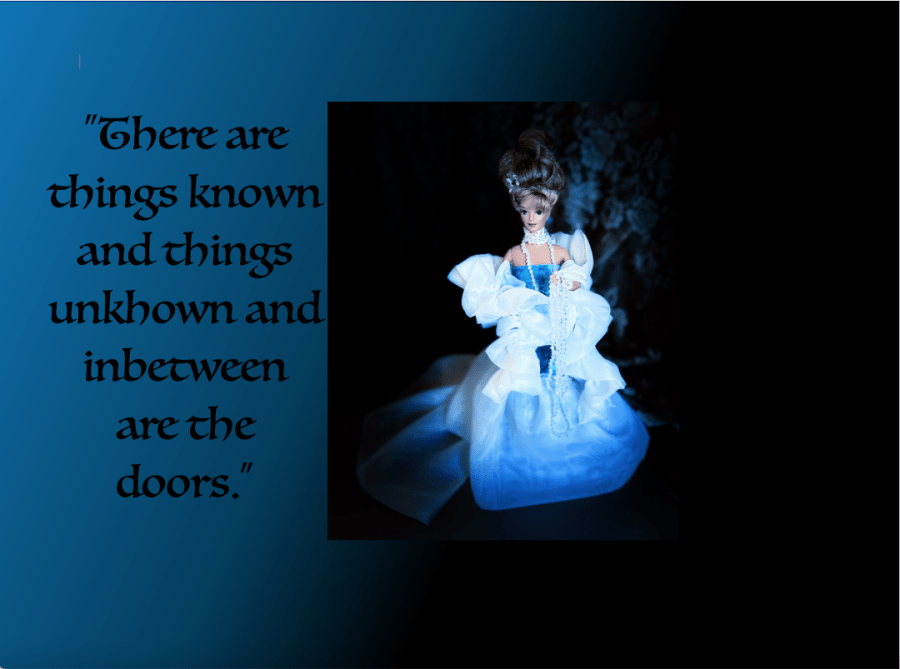
It was a nothing, no where, no how day. No one seemed to know who sent the invitation?
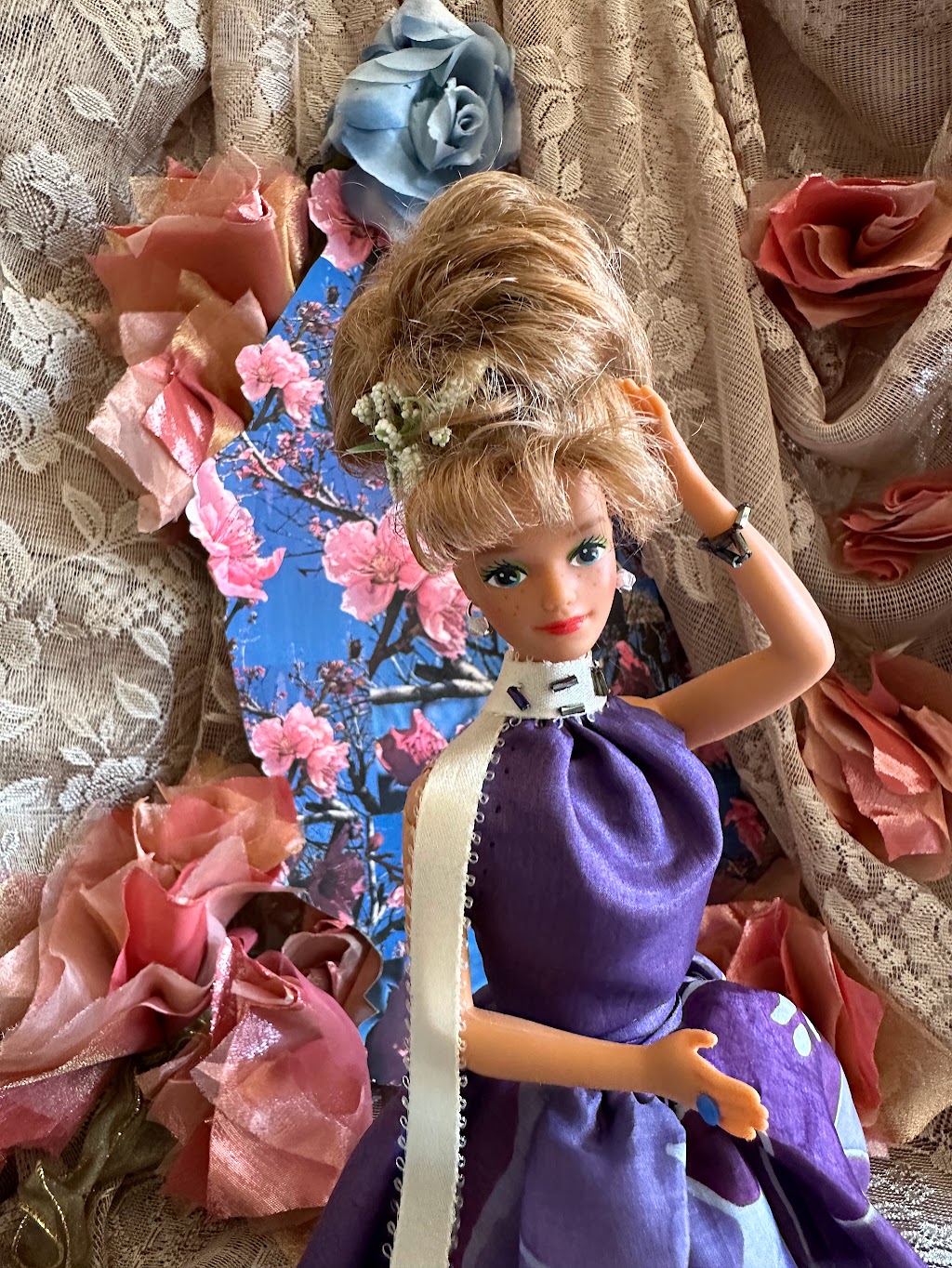


Up for adventure and treasure, Genevieve donned her favourite party dress. Arriving at the address on the back of the invite, she found herself in beautiful garden that lead to a porch with 2 cats on it.

She stood in front of the door on the left, and wondered if it was the right one to knock on? This One, or the Other?

Using the knocker, she rapped on the left door, the one she was standing in front of.

The door opened, she walked in and suddenly began to feel herself fade.
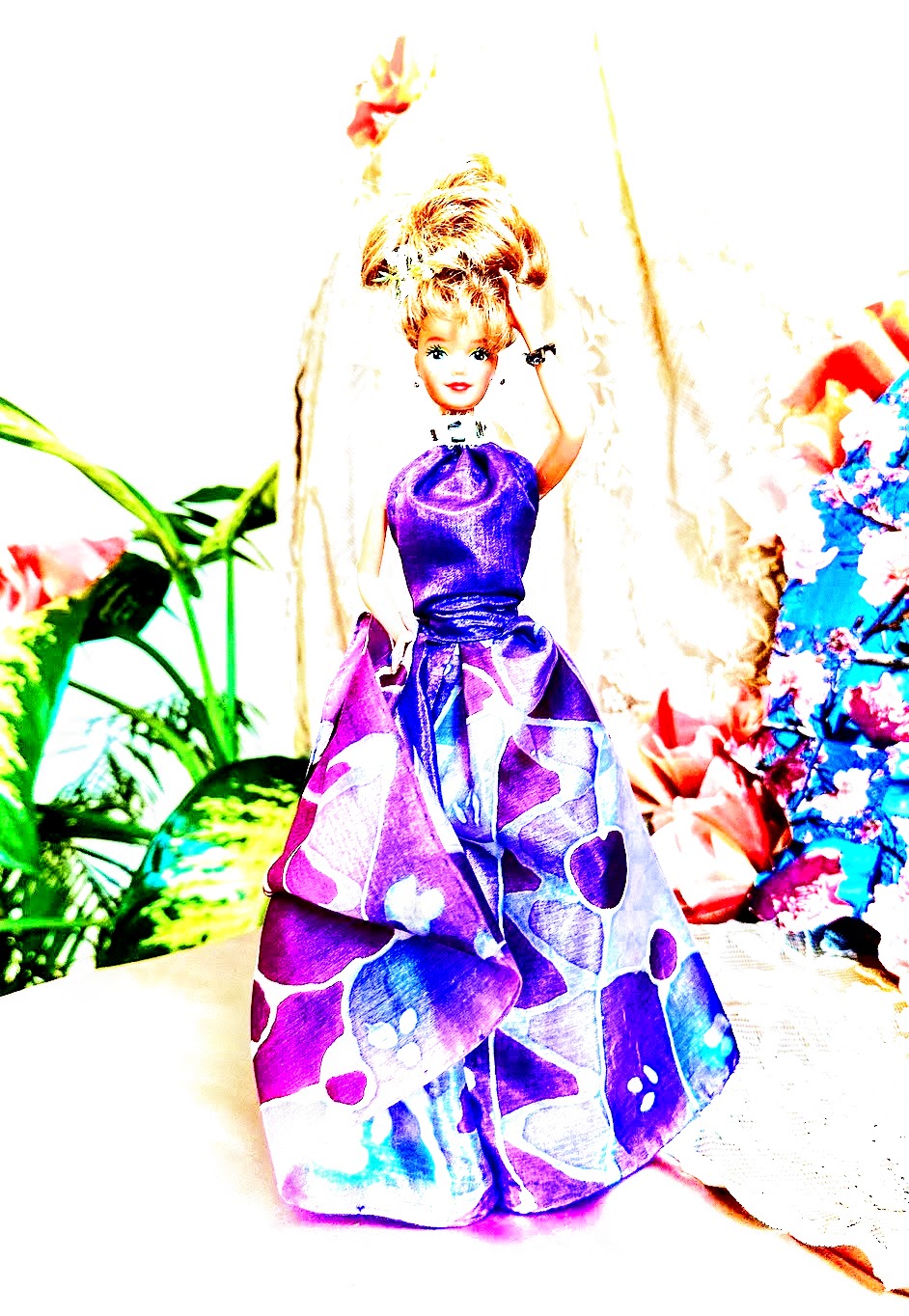
A few seconds passed, and Genevieve began to feel herself recover.
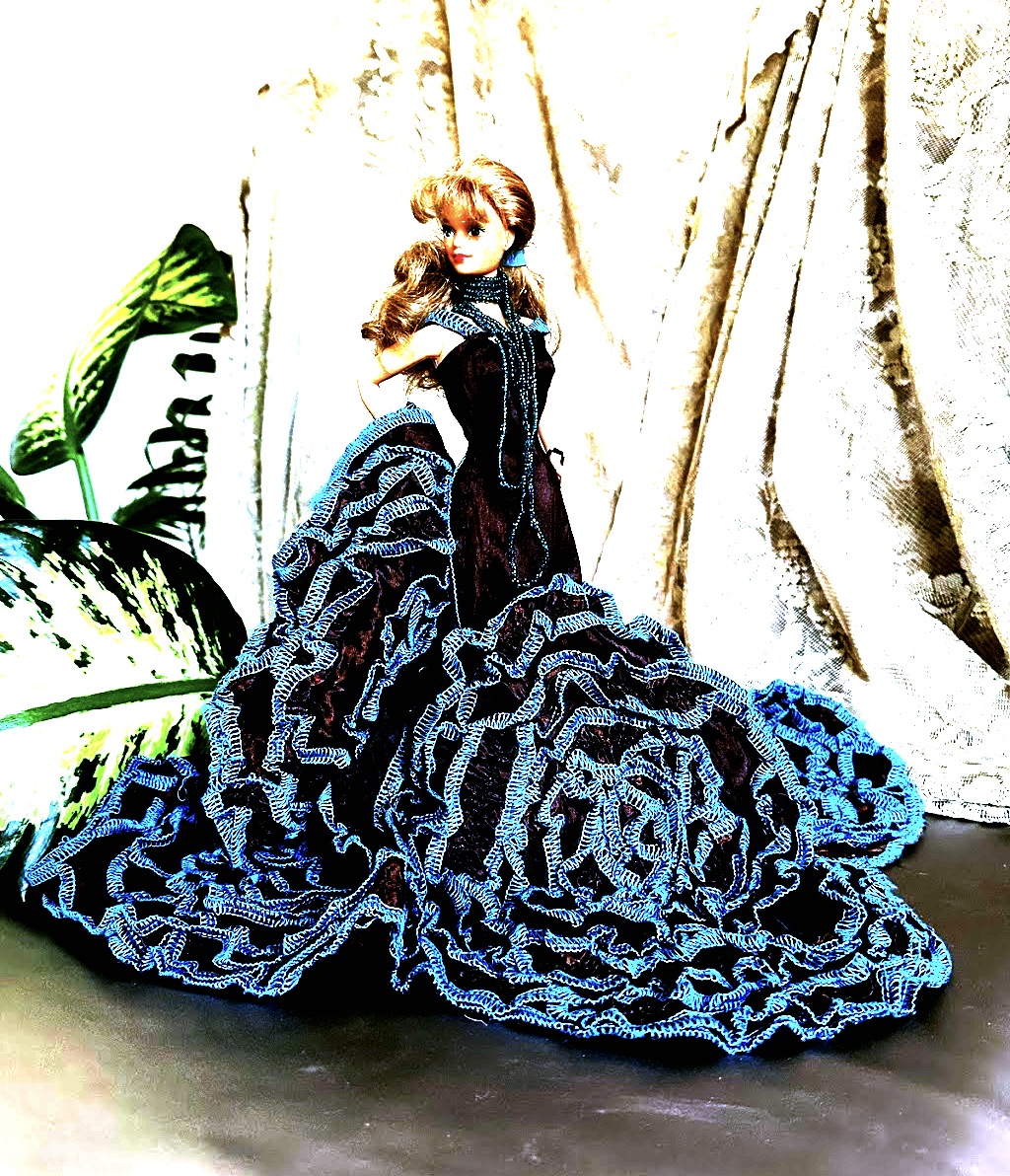
But where was she, and why was she in new gown?
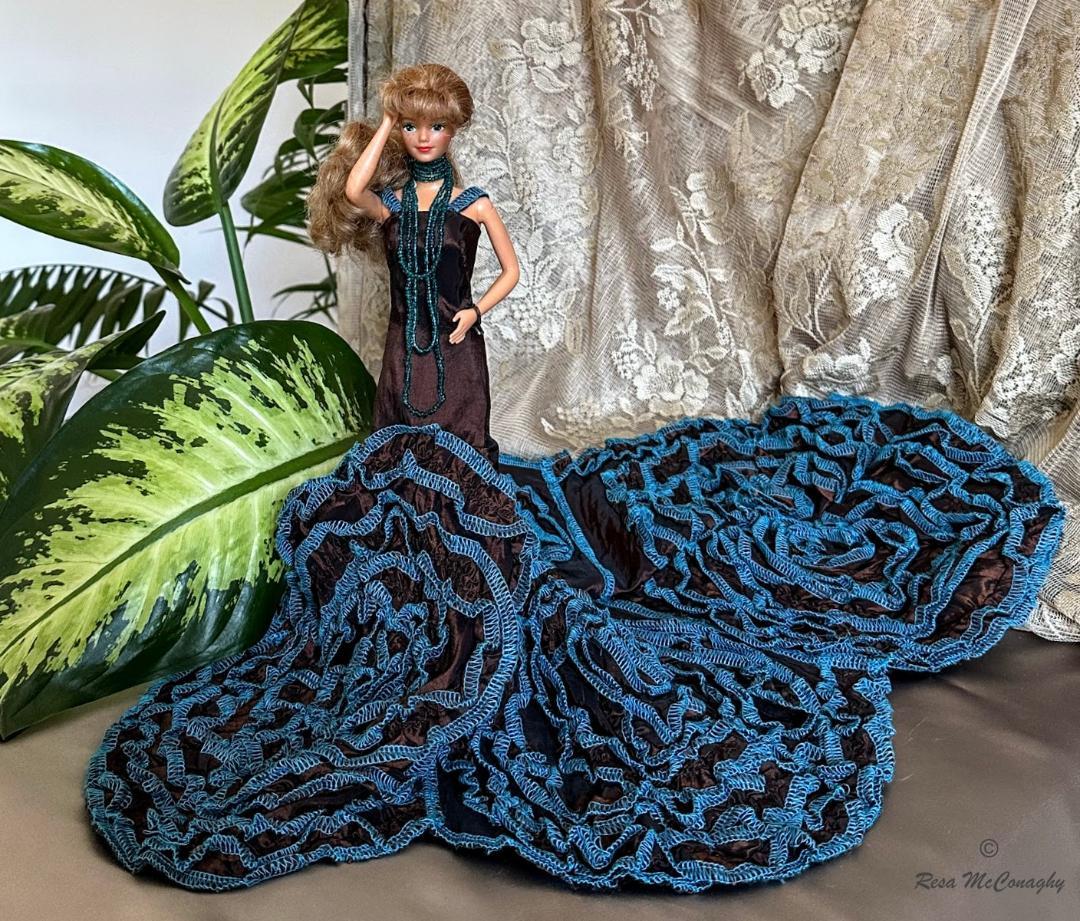
A beautiful woman in another fabulous gown informed Genevieve she was at a wedding, in South Africa. It was very special, and being held at….

She was gifted turquoise-blue glass beads made from left over bits of glass.
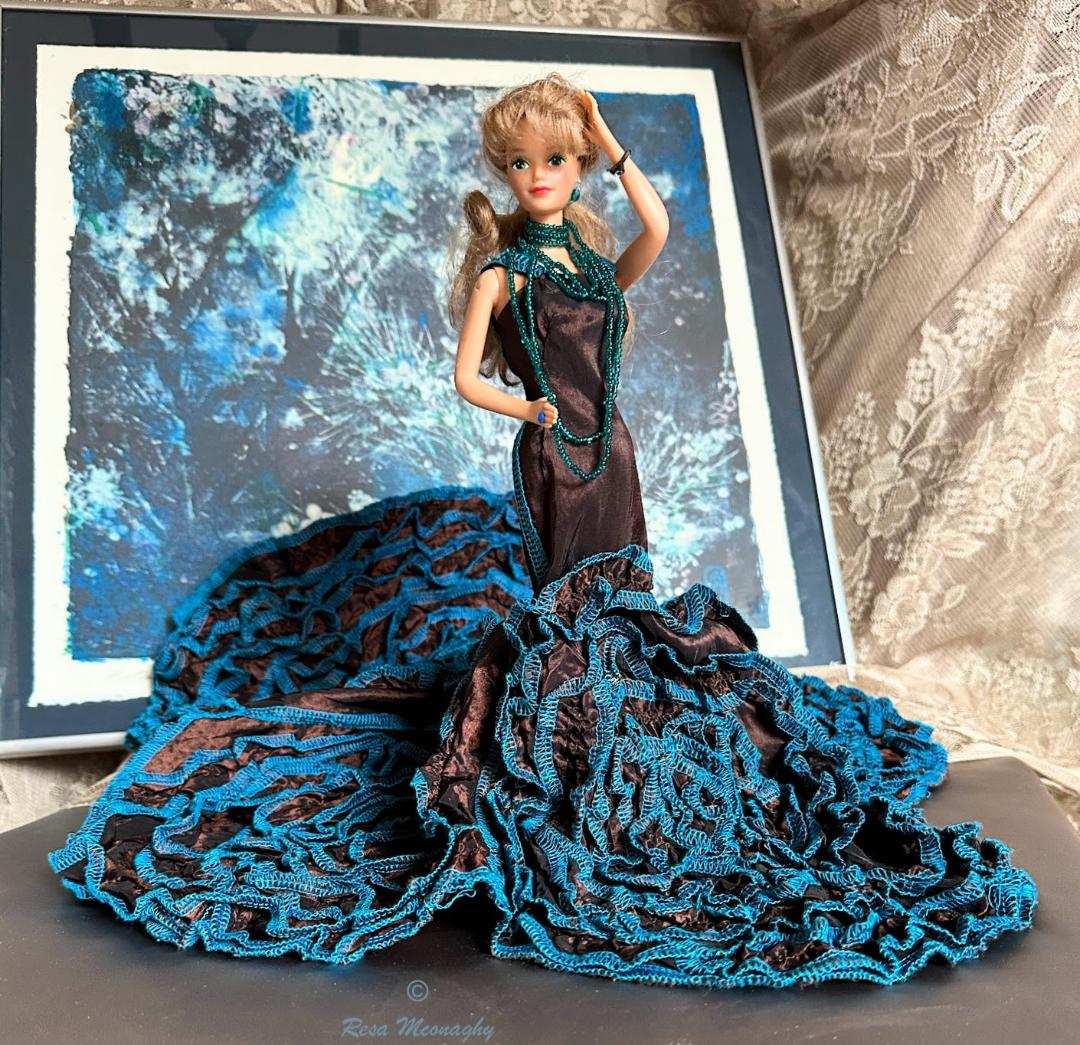
It was a wonderful party and she danced what seemed forever under the blue celebration sky. Then someone took her hand.

They said “come, come see”, and they walked through the door of the outside room.
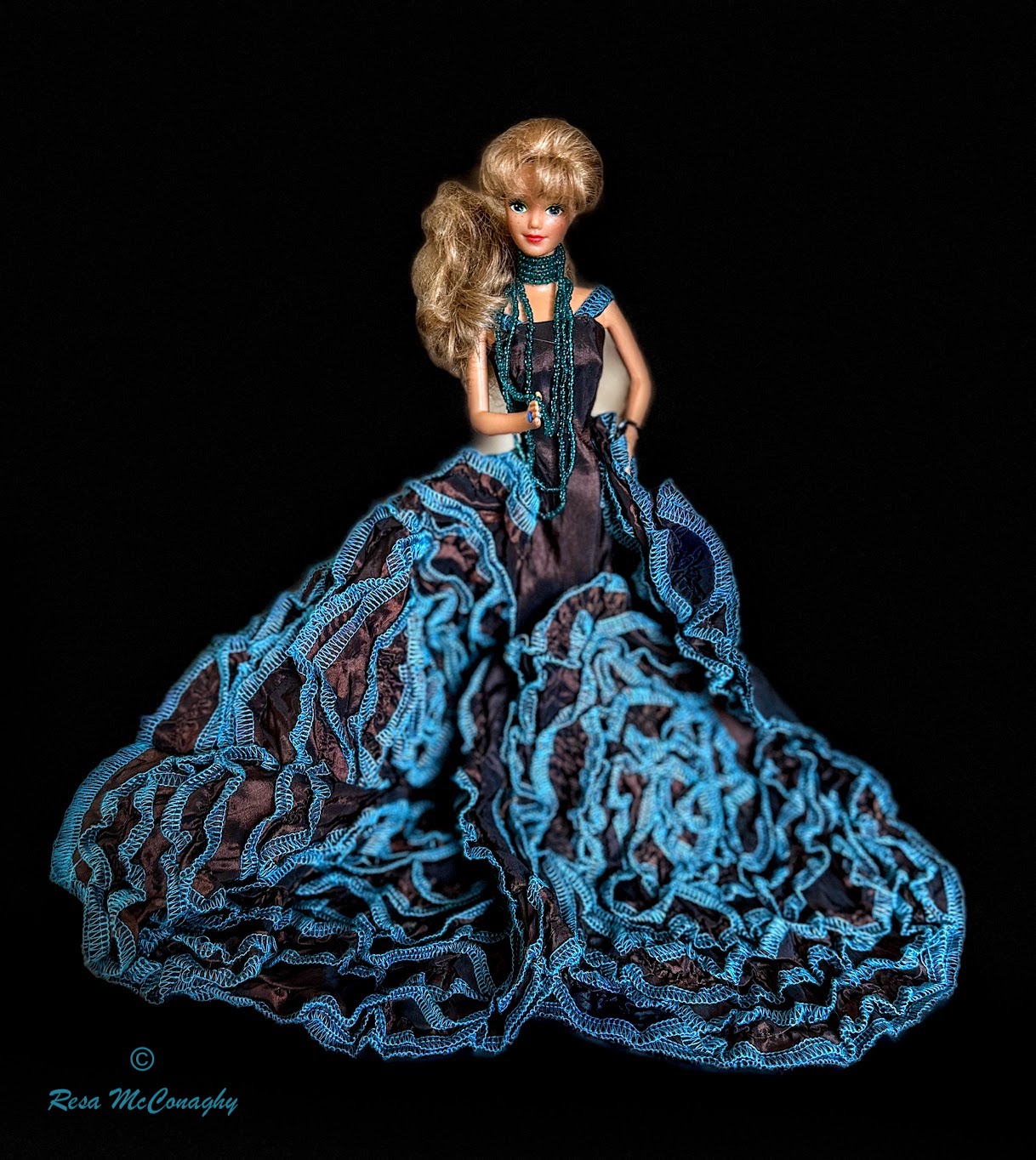
Whereupon Genevieve found herself in blackness.
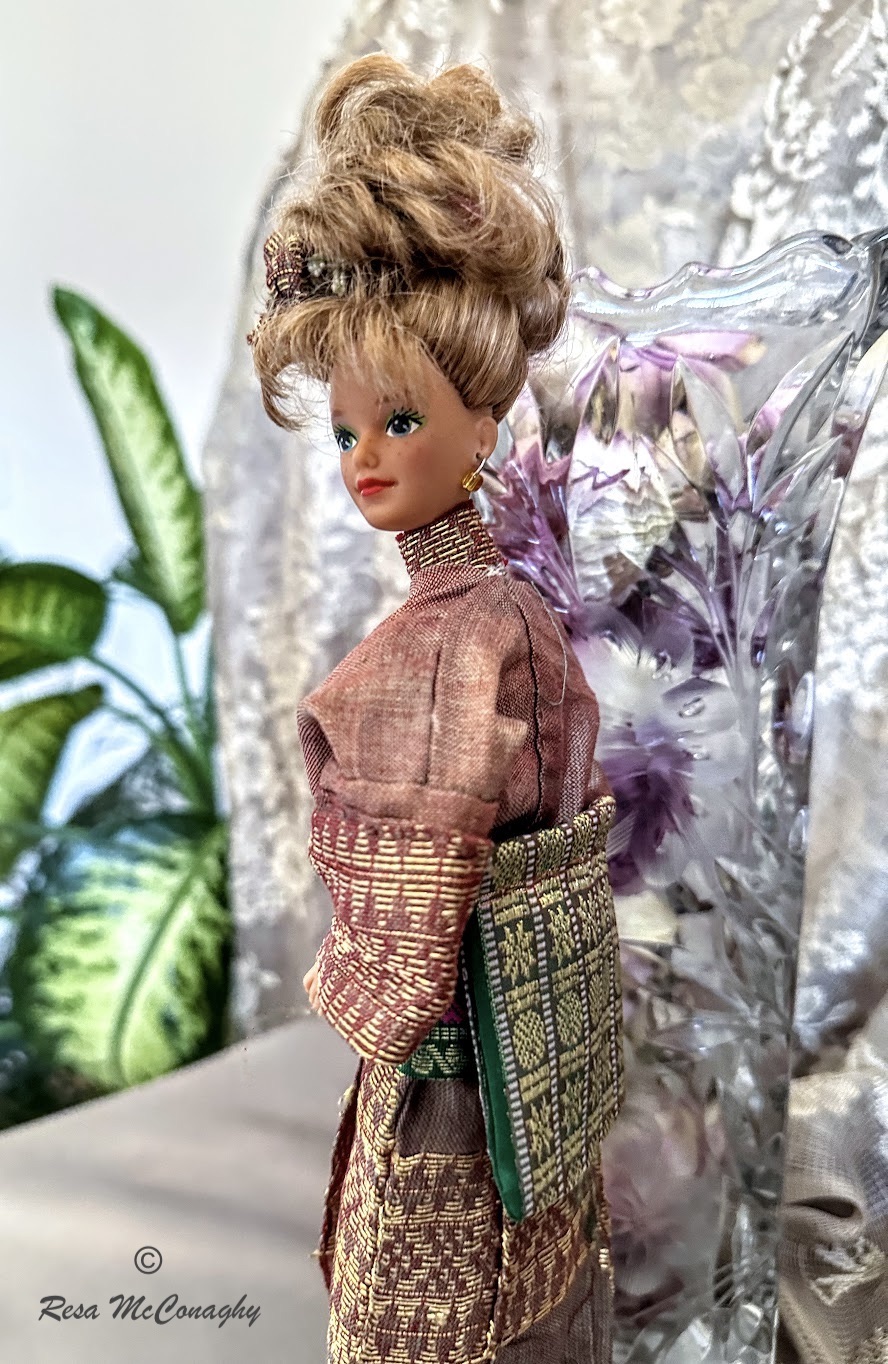
As darkness yielded to light, she found herself wearing an elegant kimono with obi.

It didn’t take long for her to realize that she was in …


Suddenly the giant creature came to life. Like a gargantuan thin, wiry Godzilla it began to attack, sending people fleeing out of the door.

Genevieve began fleeing, then espied a massive red net, just outside the door.

She grabbed the net, and deftly threw it over the spider.
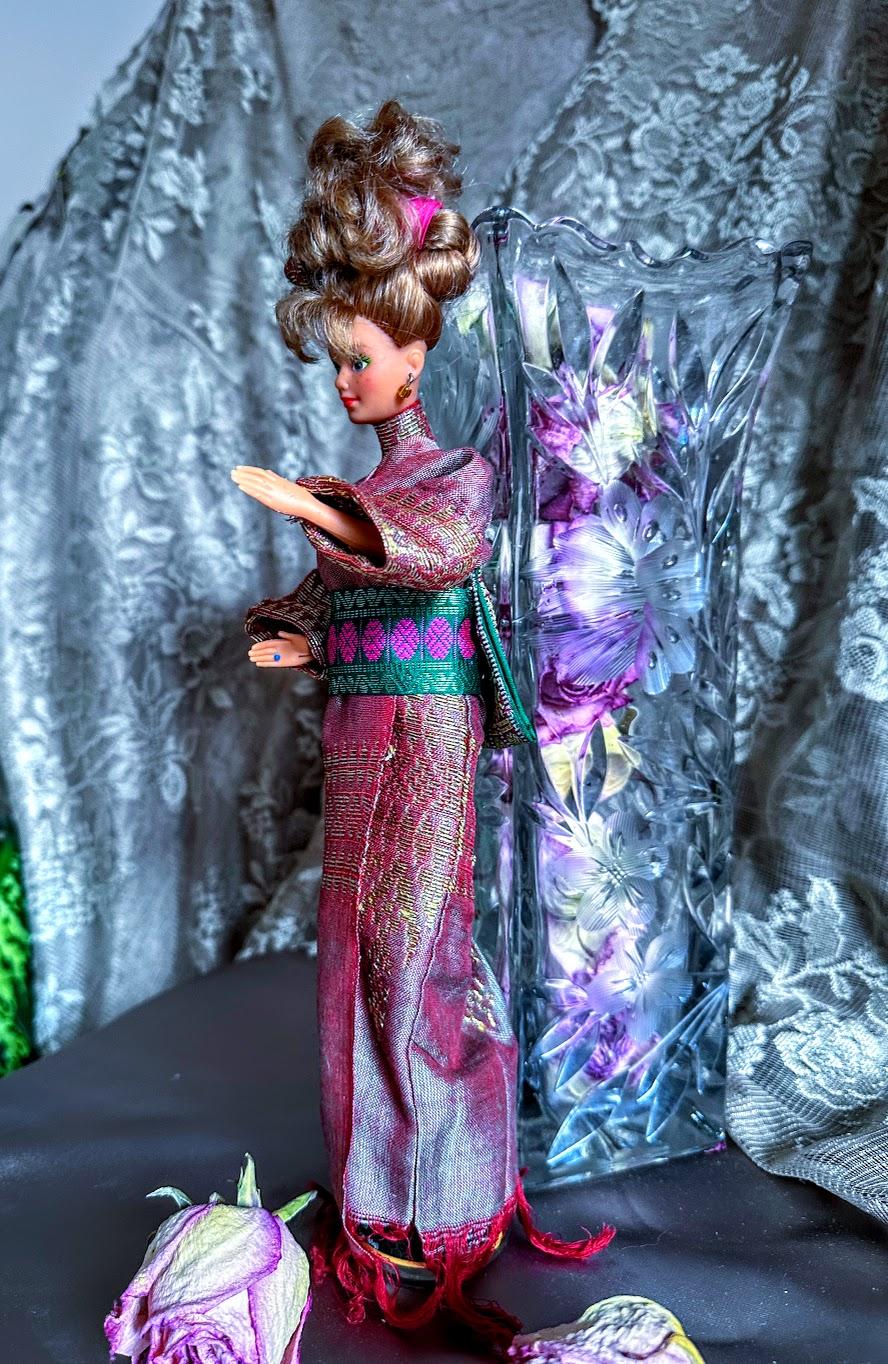
After finishing off the spider with a few martial arts moves, she began feeling cold. She became so cold, she began turning blue.
Genevieve was in a blue frozen land at the bottom of the earth.

She walked with 2 Pinguini through a door and into an ice manor.

She adored the Pinguini. She held them and hugged them and kissed them.

The Pinguini gave her an icy blue velvet gown, a boa made of snow and diamonds made of ice. Genevieve was made Principessa del Pinguini.
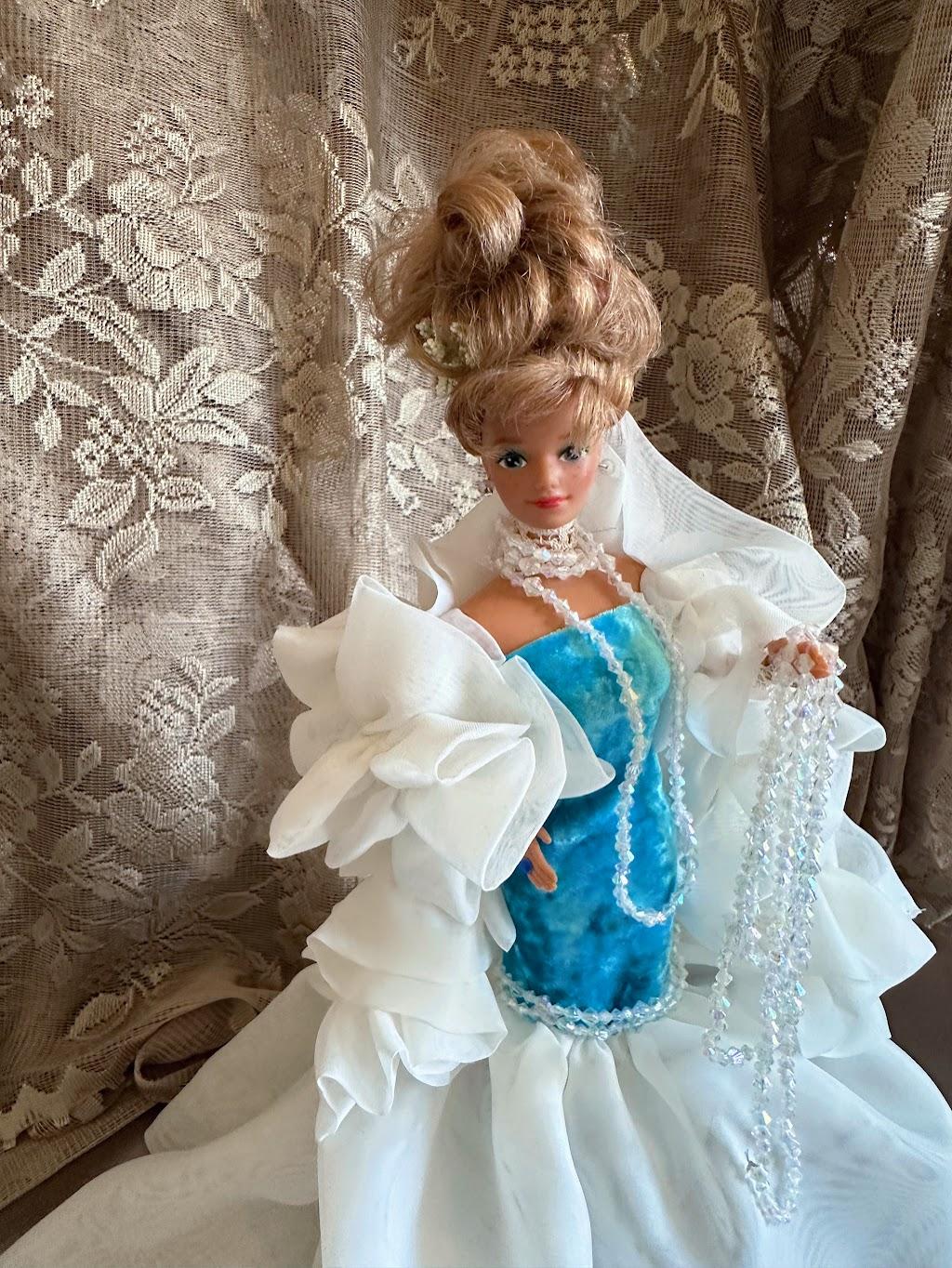
Principessa del Pinguini.
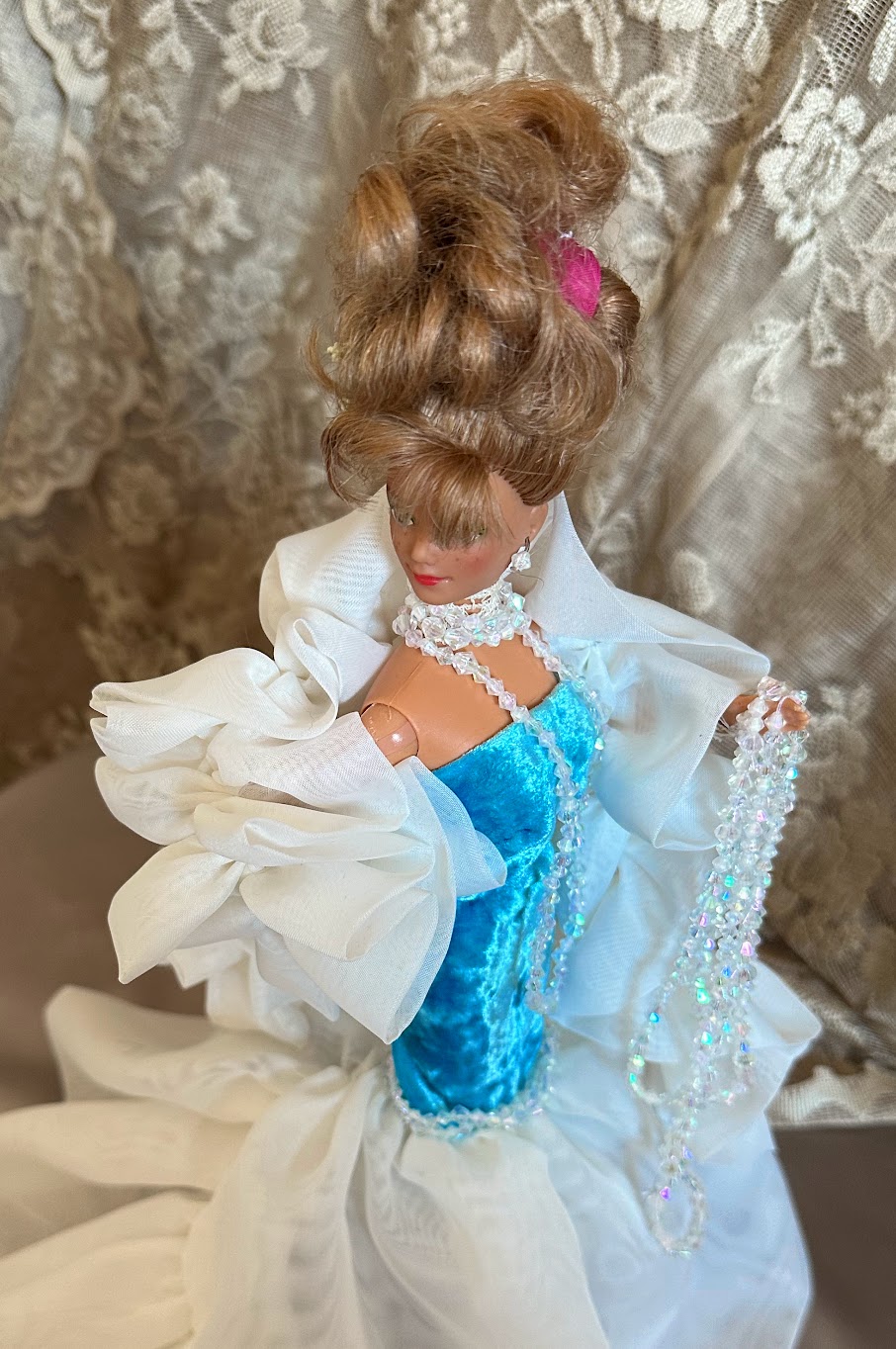
She never felt so warm.
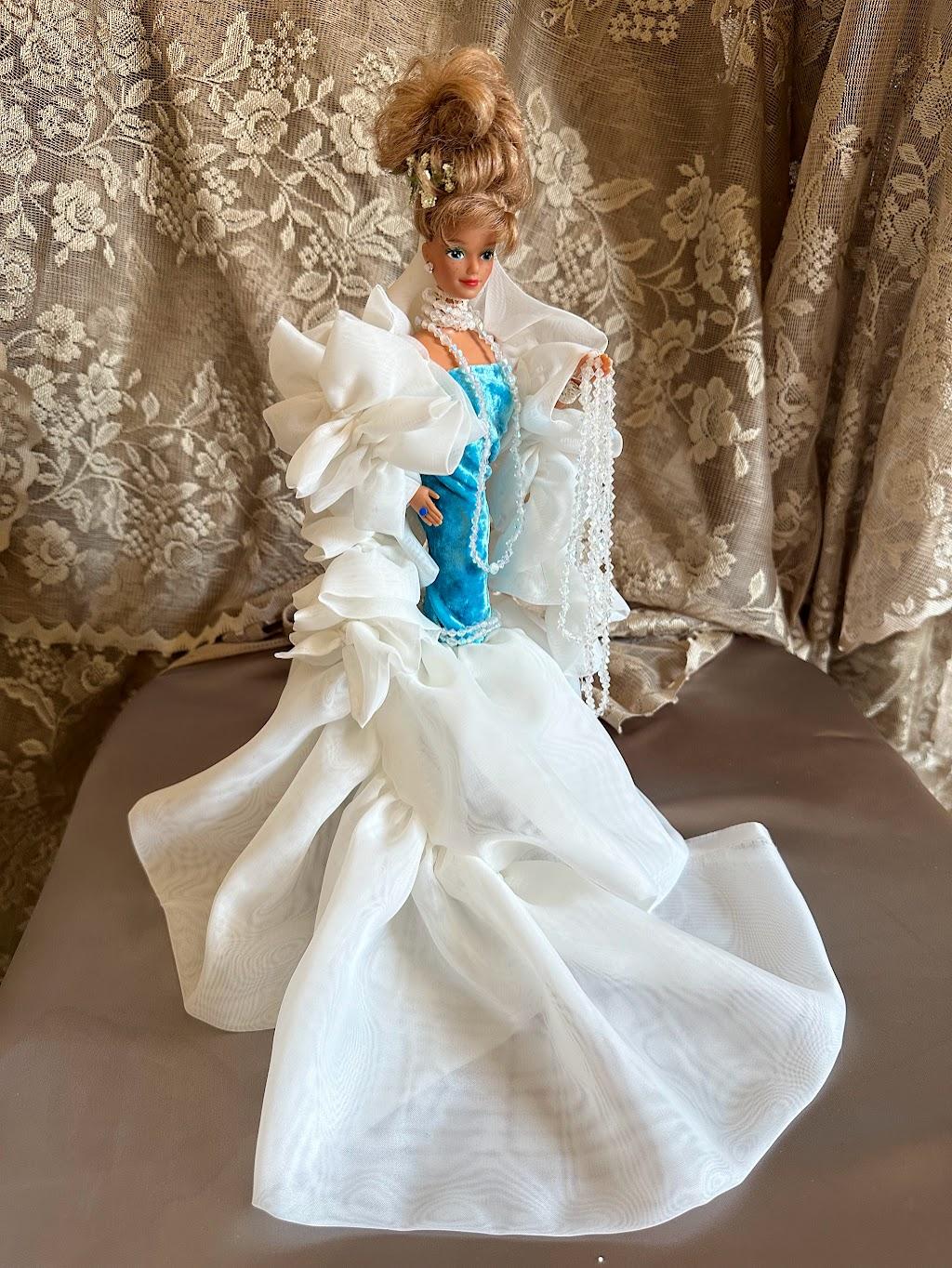
Through frozen tears, she told the Pinguini she could not live with them forever. She asked them if they could help her get home?

Sad as they were, the Pinguini told her to look up into the sun!
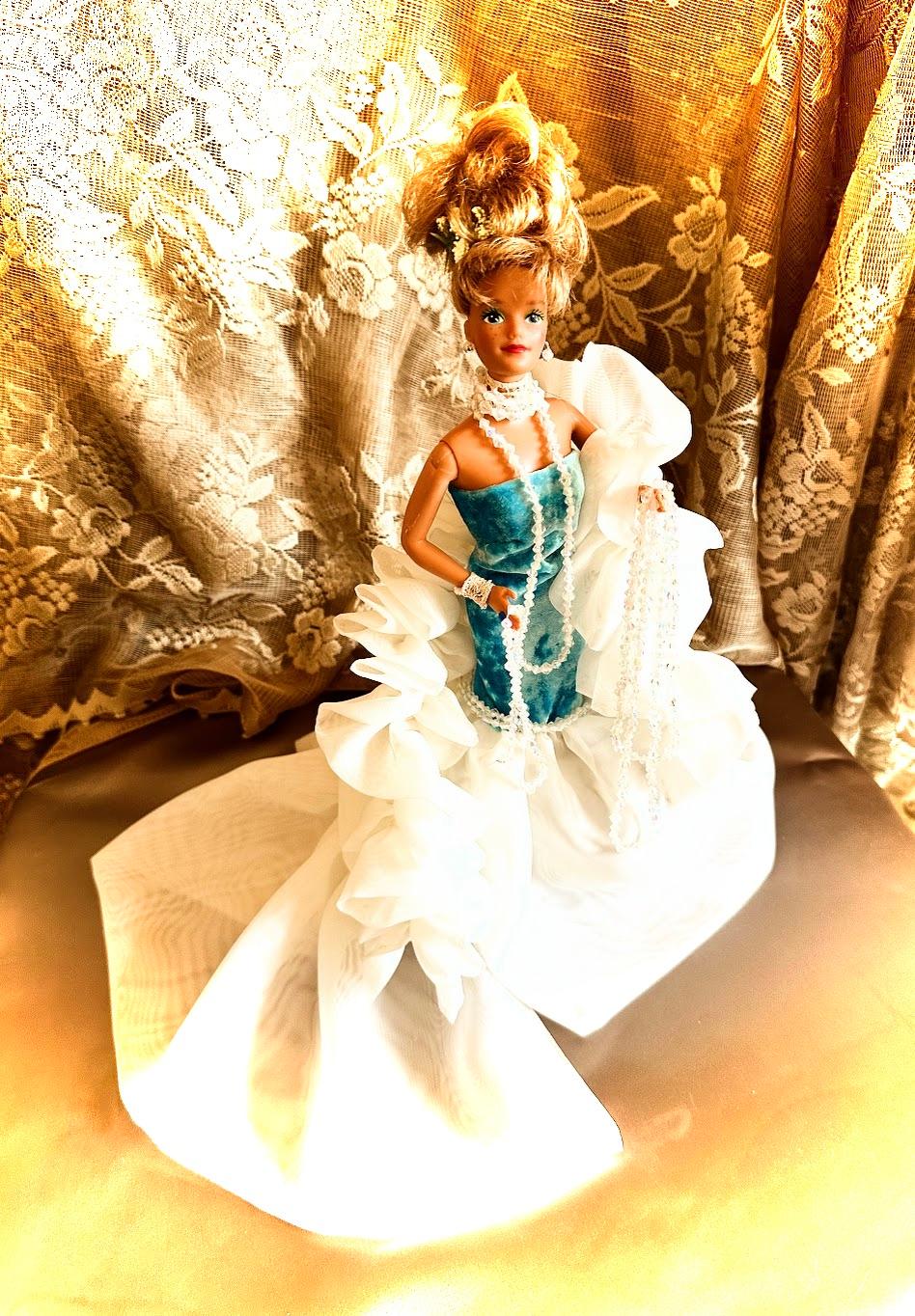
As she looked up, she felt a ray of sun capture her.
Next thing Genevieve knew, she was back on the porch, by the garden. Her treasures surrounded her: Ice diamonds, a snow boa, glass beads and an obi.

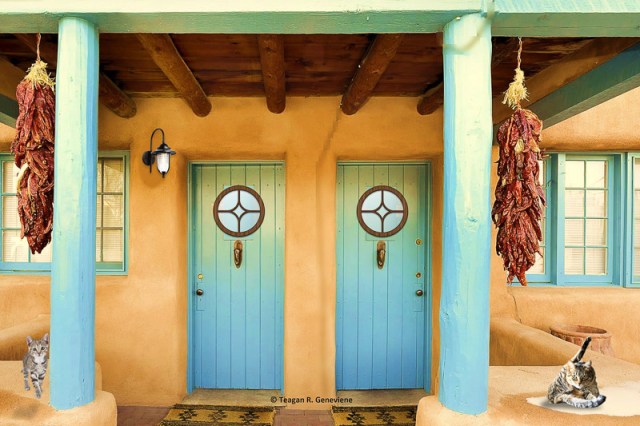
She had gone in One Door and come out of the Other Door. Genevieve was back where she had started. In the end, One door led to the Other.
The snow boa and Ice diamonds began to melt, yet she was happier than she had ever been.

It was evident that things were ephemeral, and that the only lasting treasures were inside her memories; inside her mind and heart.

Visit Dan at the Annual Doors 2025 Challenge! OR Check out his fab blog in general!

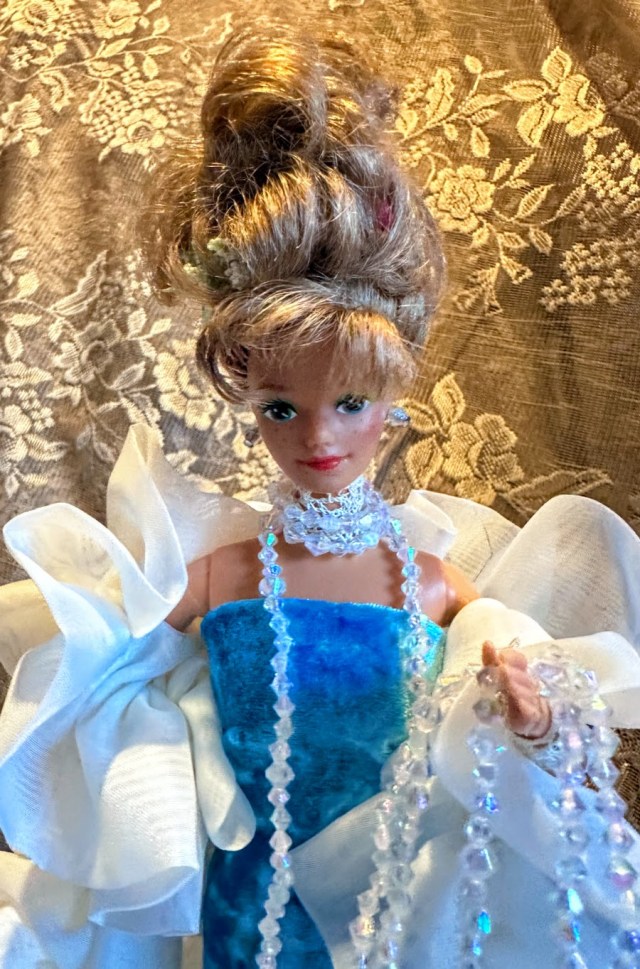
Teagan, thank you for your doors and the inspiration they fostered!
Thank you Robbie for your fab doors from your travels, and the ingenuity they delivered.
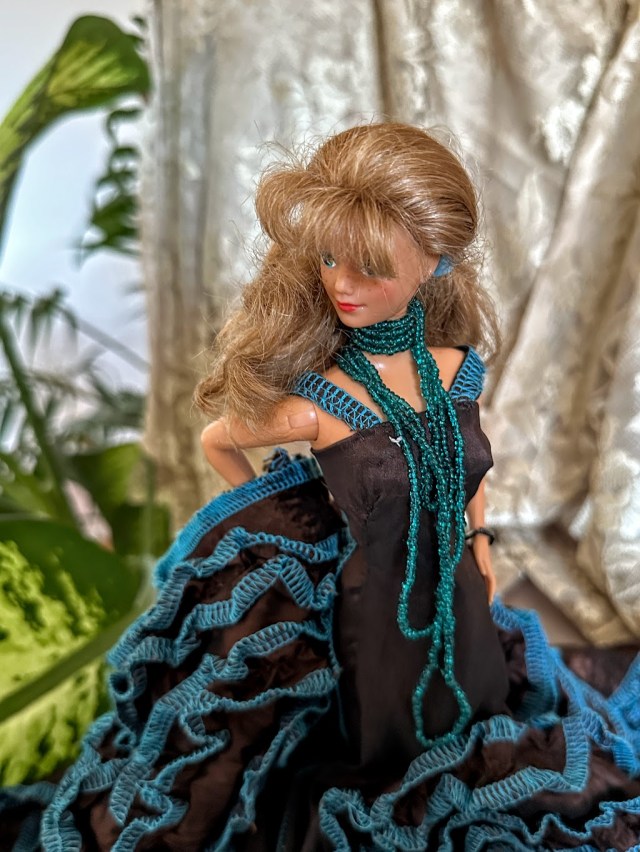

Quote by Jim Morrison
Helen Martins Owl house & Mori Art Gallery sentences are hot links.
All outfits are one-of a kind designs hand-made by Resa.
Except Doors images, all photos are © Resa McConaghy.
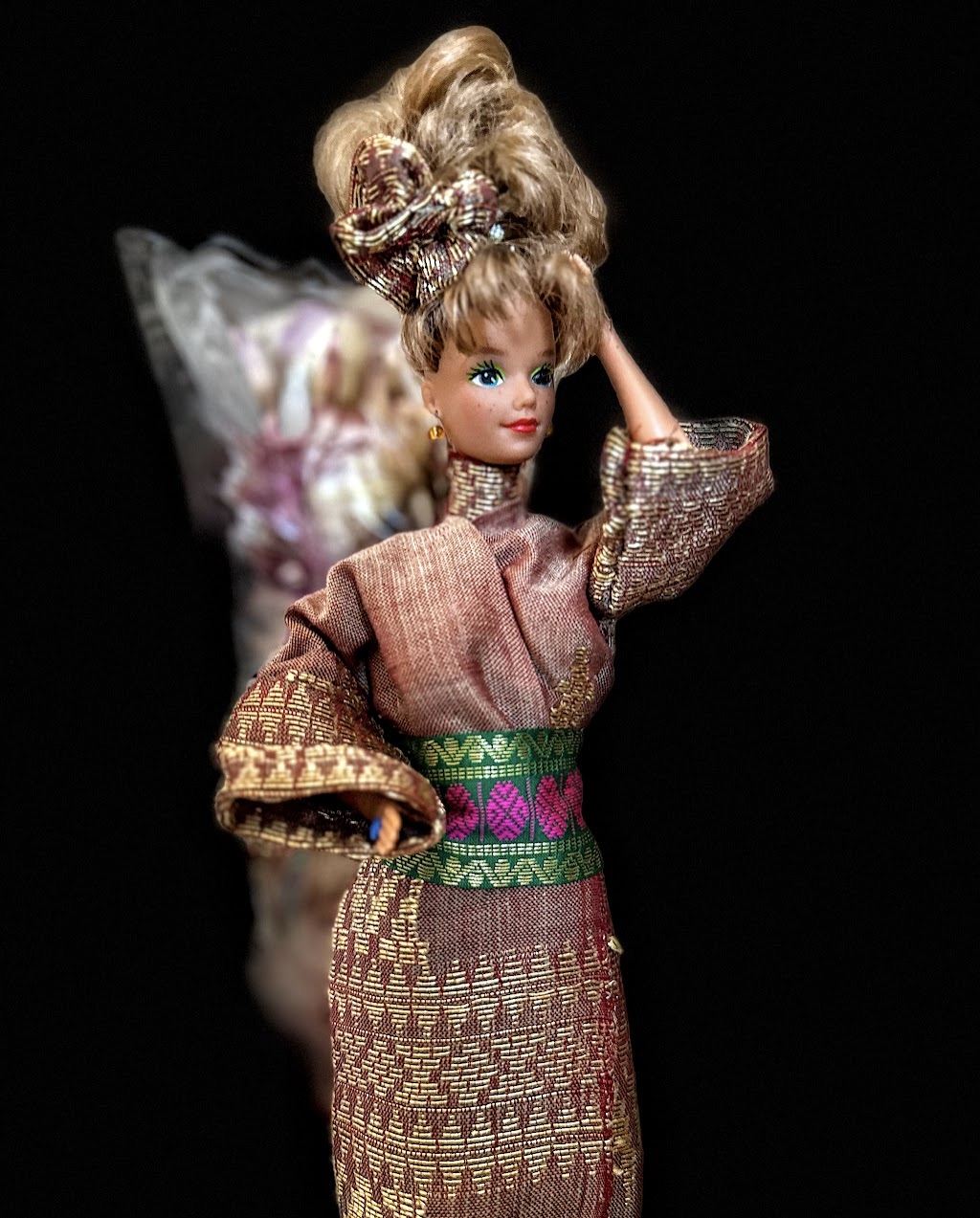
Of note: Opening party dress is made from a batik silk scarf made by my m-i-l, Yuki (RIP)
Kimono fabric is from a 100 year old piece made from pineapple strands – A gift from Diana (Myths of the Mirror)

In America it was the Gilded Age, in the United Kingdom it was the Victorian era and in France it was La Belle Époque.

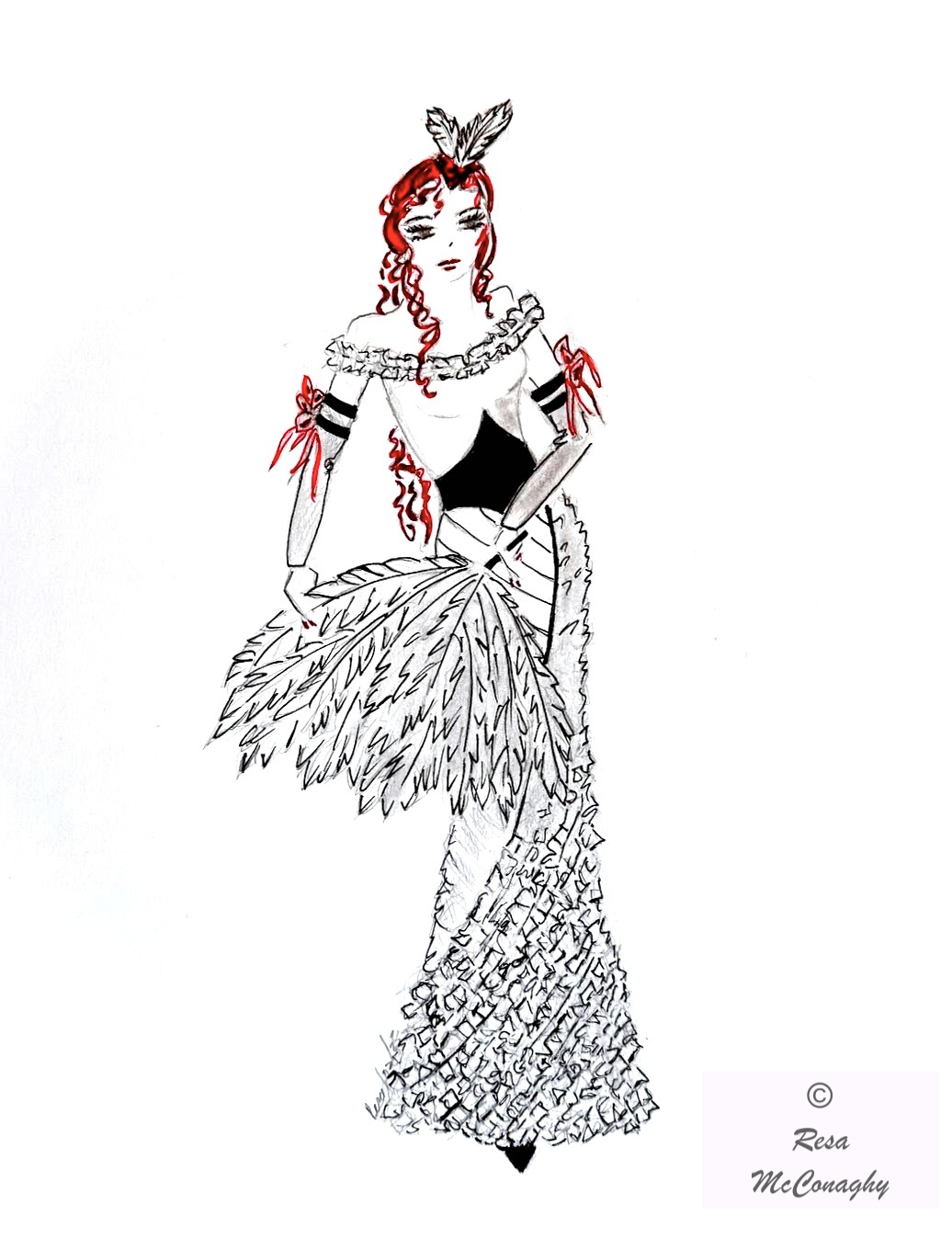
Inspired by Tissot’s fashion prints of the era, Art Gowns has designed its own gowns, and gone back in time to show them off. Made possible by Venus and the moon, we went through the the Tangle-Heart and moved backwards 137 years.

Rebecca, the first to land in 1888, went about setting up a fashion show at Le Chat Noir. Her palazzo pants, carefully hidden by the period’s draping fabrics, allowed her to move around without arousing suspicion.

The venue was a one night extravaganza at La Chat Noir in the Montmartre district of Paris.
Thought to be the first modern night club, it was opened on 18 November 1881 and closed in 1897.
NOW, Here’s Rebecca!
Thank you, Rene! We have a thrilling show tonight, so let me get right at it, and present les beaux modèles de la Belle Époque!
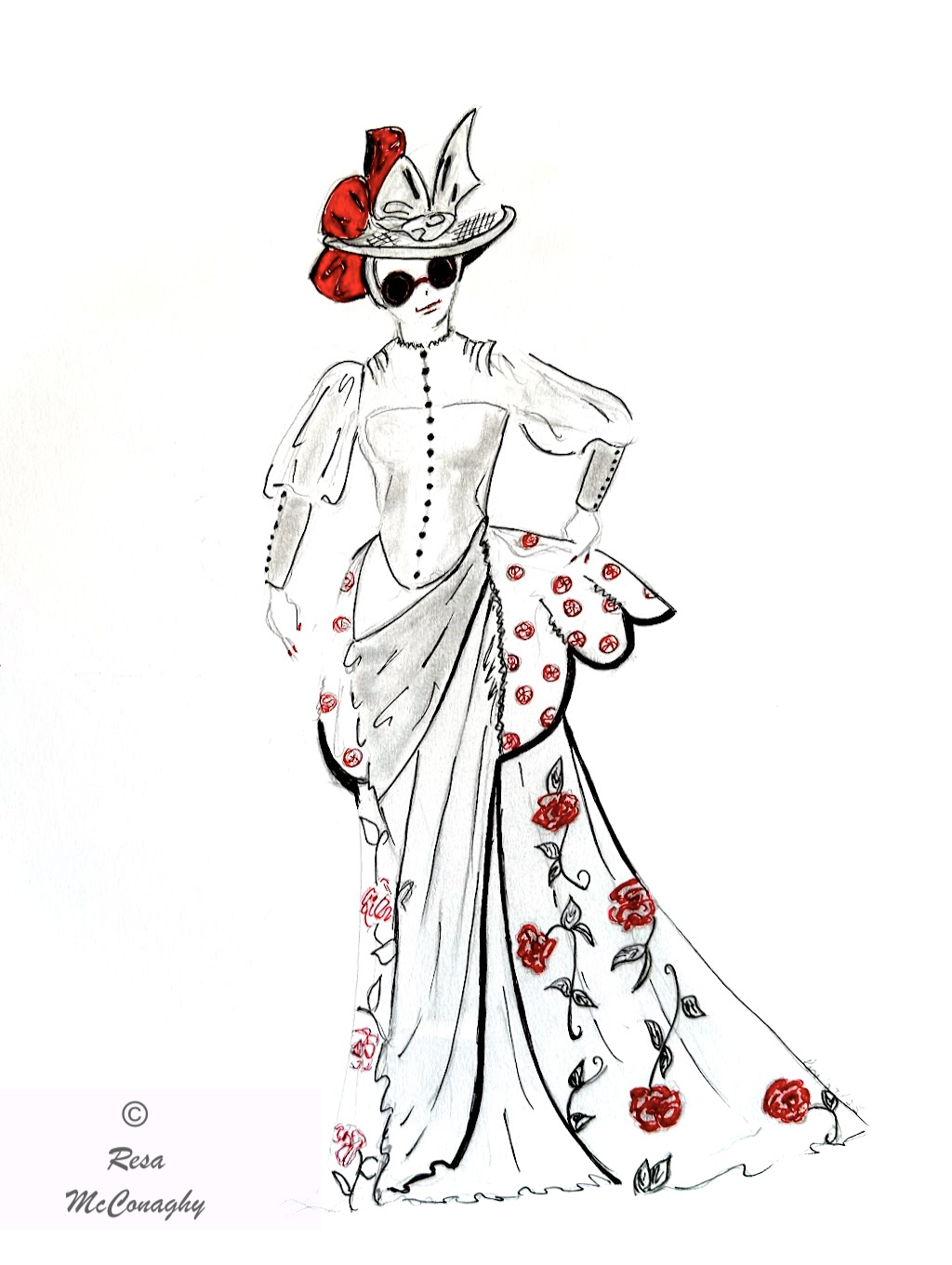
First out on the stage is Modèle de Robes d’Art, Shey. Shey is dressed for afternoon tea or “gouter” as known in Paris. Her fan’s print is inspired by the new Japanese aesthetics.

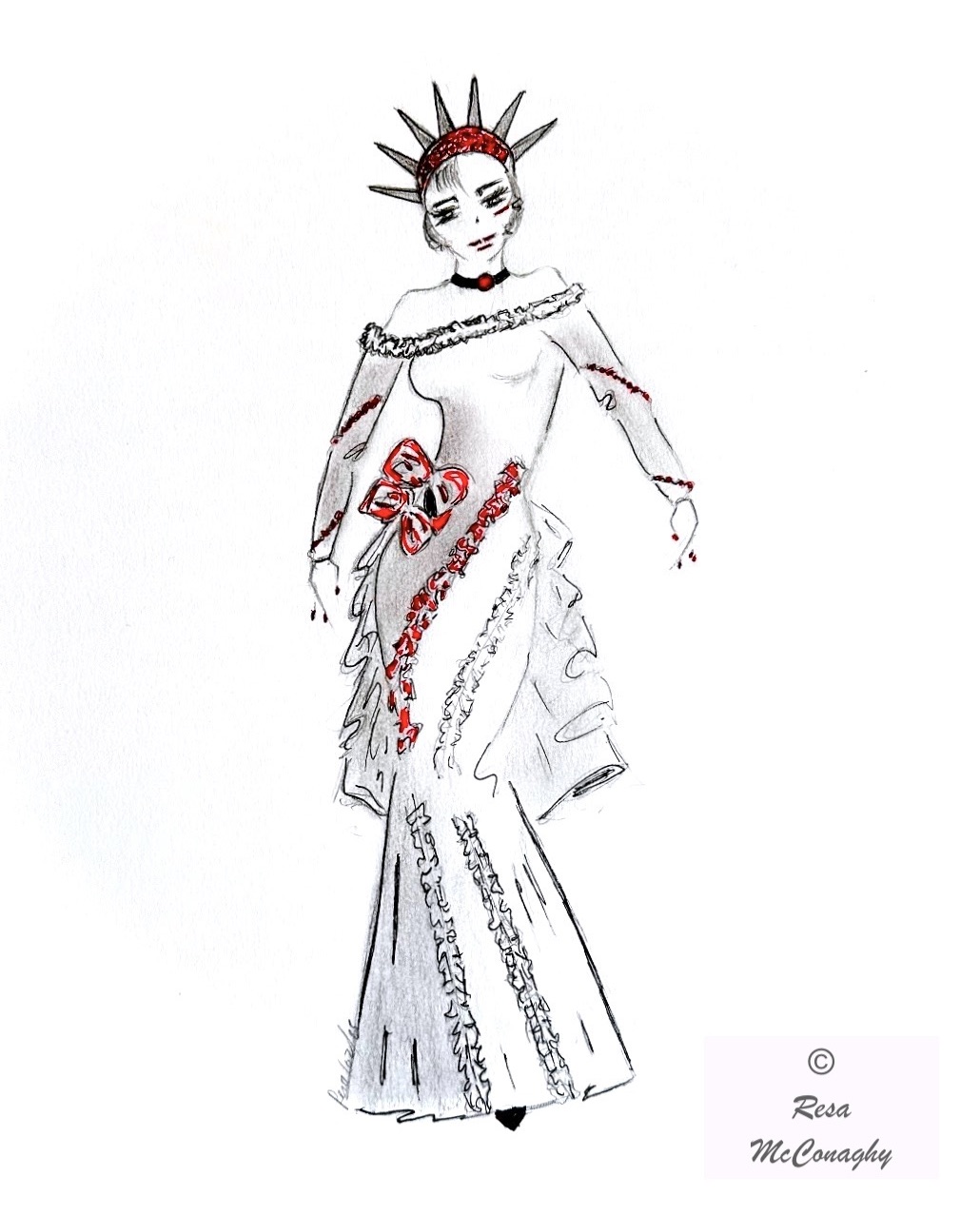
Next out is Gigi dressed for a night at the theare! Her asymetric ruffles play second fiddle only to her Statue of Liberty inspired diadème.
Now, back from her gown change is Mademoiselle Rene with a very Special announcement!

Thank you, Rebecca! Mes Chéris, all of us at Art Gowns put our design hats on and created a special La Belle Époque Super Hero outfit for Princess Blue Holly. Art Gowns presents:
What an honour! Thank you to all! This is a momentous outfit! I love the boots, and they only take a half hour each to button up.

It must have been very difficult to be a female Super Hero in the 1880’s. So much beautiful fabric would make flying a bit of a challenge. Snagging would be an issue and the corsetry is somewhat confining when delivering the martial arts moves.
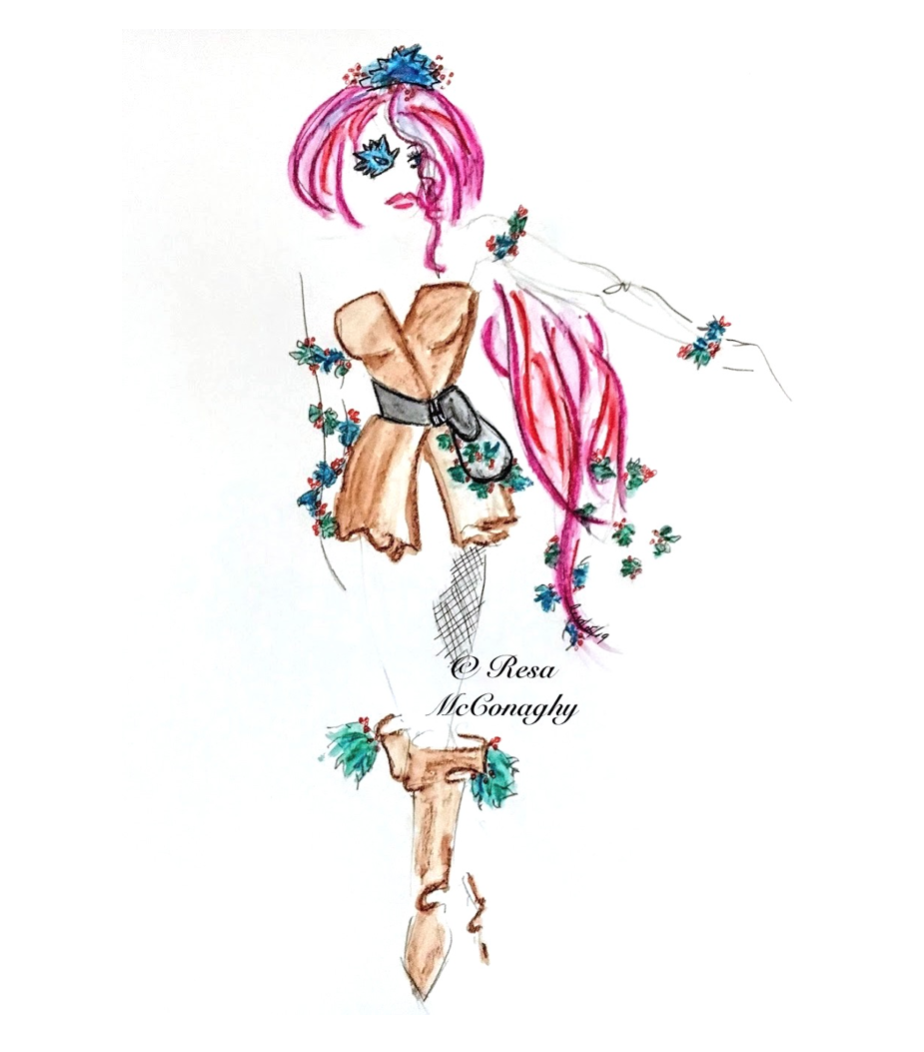
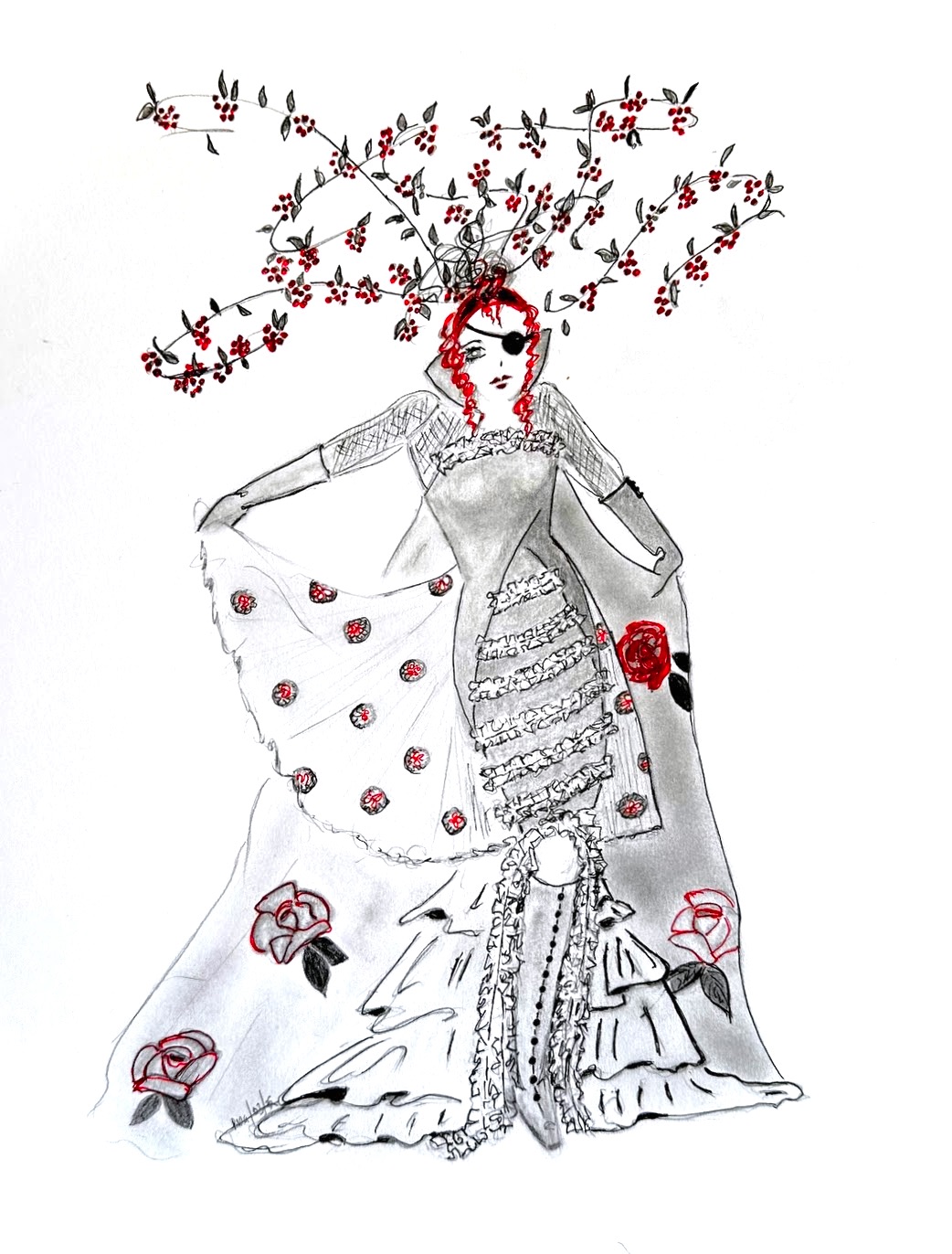
Check out the Freedom difference between 2025 and 1888! ……. aaaand back to Rebecca!
Thank you Princess Blue Holly! You look simply marvellous. That is one special outfit.
Perfect for taking the carriage to the fashion shops, Dale wears a travelling jacket of pinstripe twill, with brocade fishtail skirt completed with a voile tail under a ruched and layered silk bussel. A dainty reticule is the perfect accessory.

It’s a sunny day and Rene is back in another costume change. This is a miracle considering all the buttons she had to do up, as the zipper was not invented until 1917. She is off to the museum with a rose detail parasol and rose reticule.

It’s “dinner at eight” and the opera for Modèle de Robes d’Art, Marina. A rose print corset top with a panière effect from the waist to hips is a lovely accentuation to the fitted fishtail skirt.
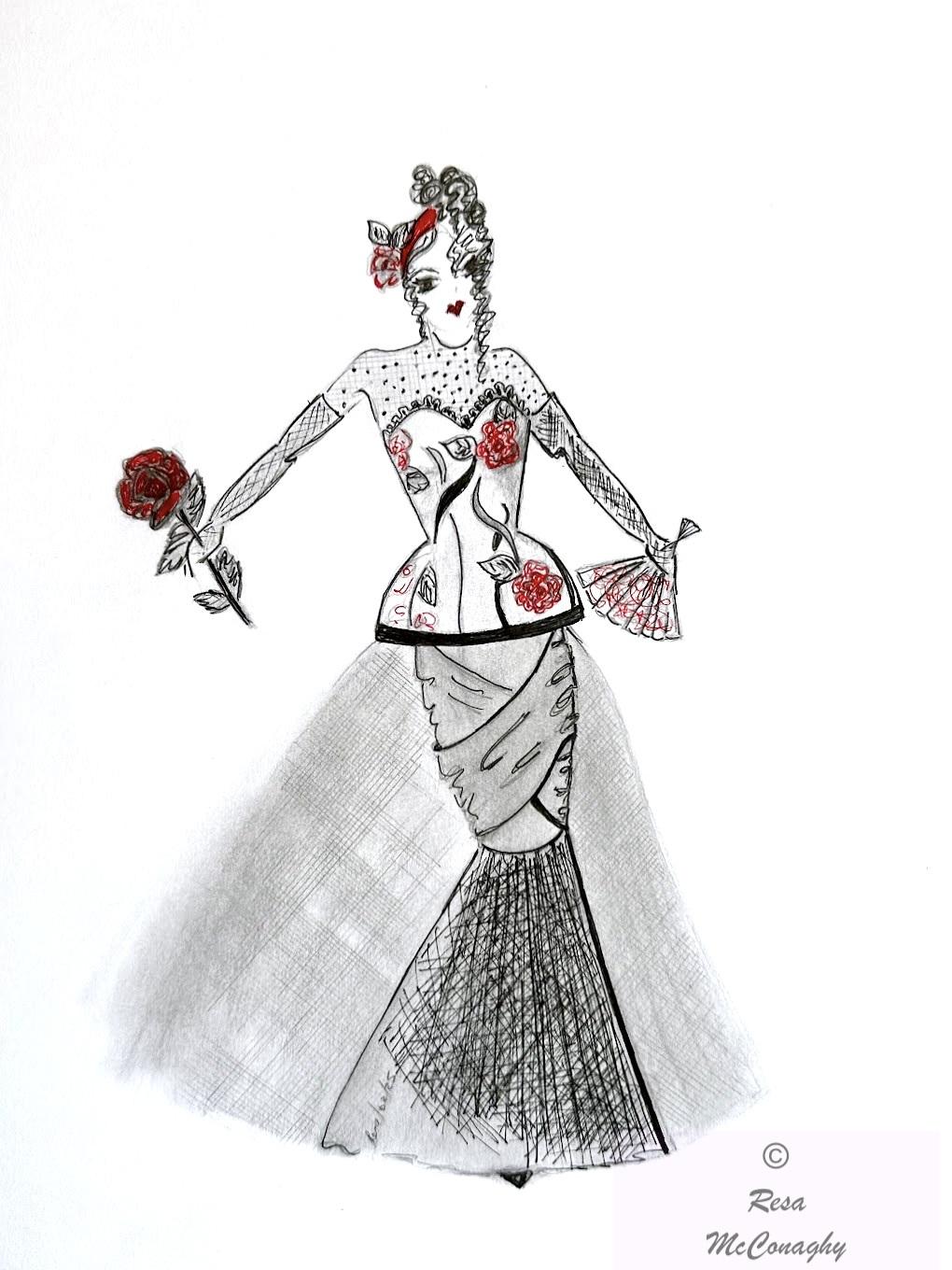
Holly is off to a fancy party in white silk with red ruffle corset top and a skirt of silk Swiss dot. A lush red bow sets off the rose detailed bussel and tail with ruffles on the inside and out.

I’m sad to say the show has come to an end, buts let’s hear it for Mademoiselle Rene, who shall bid you adieu.

Mes Chéris, bon soir! We hate to leave, but it’s time to return to the future! Please enjoy Arabesque No.1 by Claude Debussy, while the beaux modèles de la Belle Époque make their departures.
No one saw when the AGM’s made their way back through the Tangle-Heart as contrails. All landed safely in the Bosque by Tim’s.


However, as Rene began her journey to the future she encountered a strange energy.

She landed back at Tim’s in Rebecca’s Black Bamboo, but she wasn’t herself, nor all there.

No one was worried! All were sure Princess Blue Holly would save her.
However and unfortunately, as you and I know, Rene IS Princess Blue Holly!
Princess Blue Holly & Rene Rosso Character © Resa McConaghy & Holly Rene Hunter
Since 2019

Visit them on their blogs!
Dale – Holly – Gigi – Marina – Shey

Visit Rebecca!

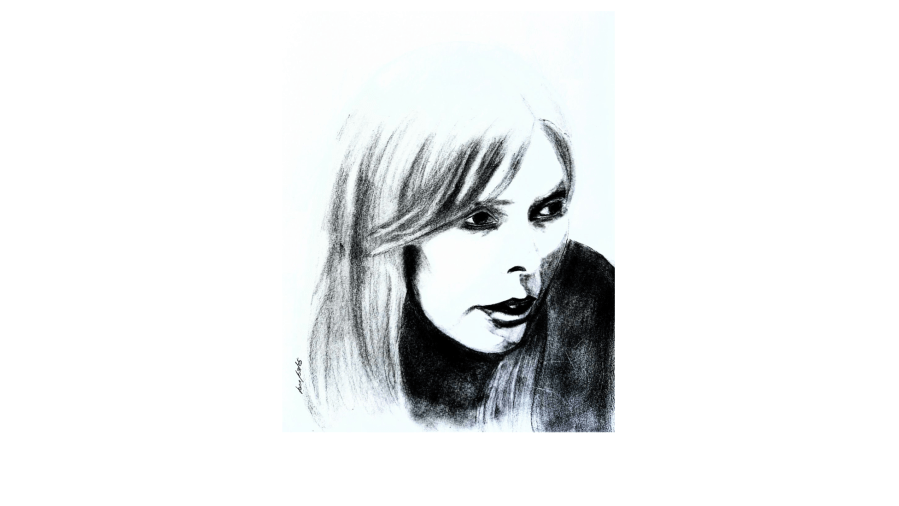
Joni is the latest entry in Bios by Holly and art by Resa.
Holly’s has written a biolette on the amazing Joni Mitchell. It’s always a joy and an honour to collabrate with House of Heart.

Thank you with all my heart, dear Holly!


This is the painting that lured me to the exhibit.

This young woman’s housecoat, patterned yellow pillow and tropical plants were introduced to Europe via colonial conquests in the southern hemisphere.
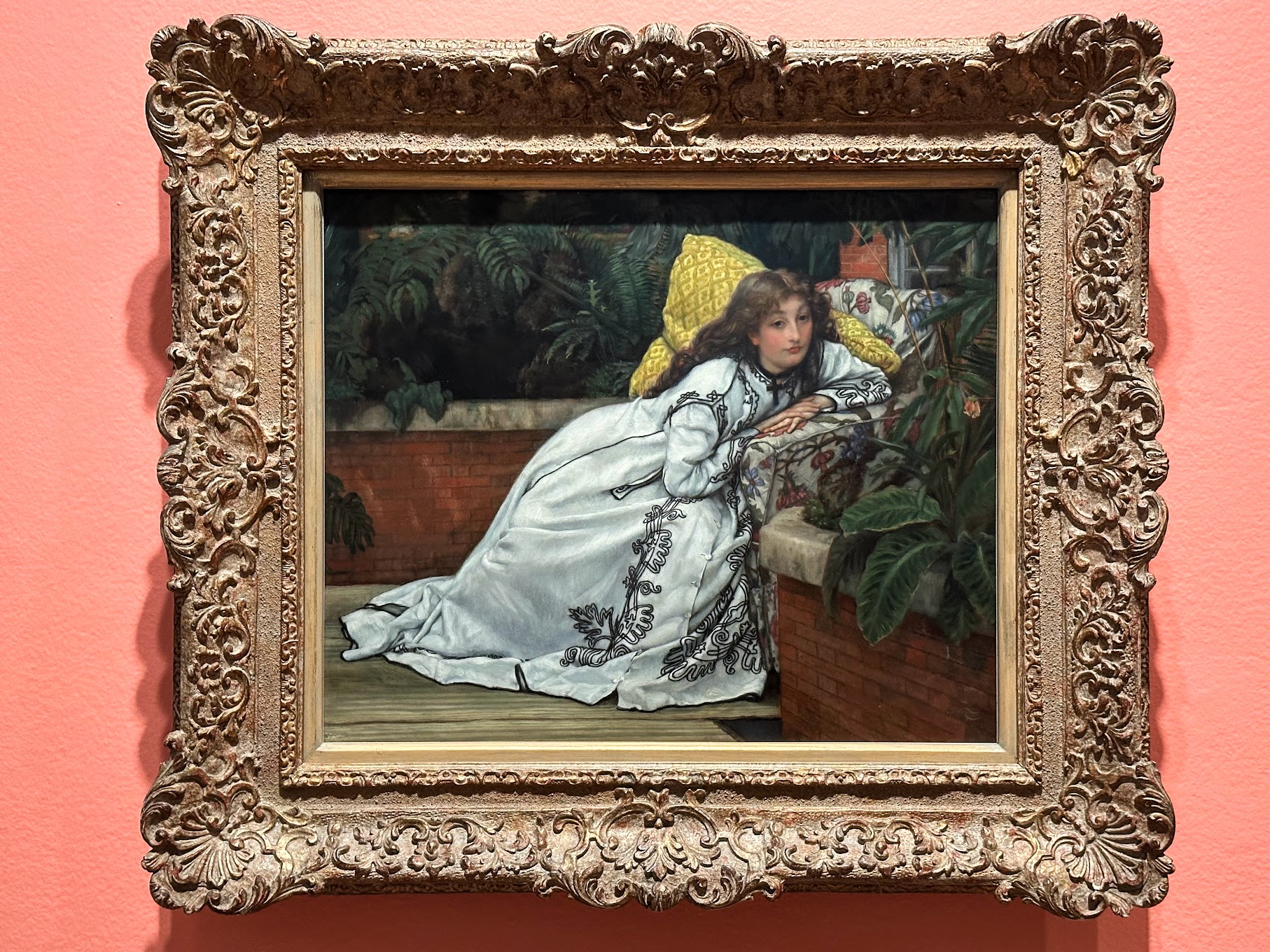
Juxtaposed to these items that signify the speed of travel, trade and fashion are the middle class woman’s long slow hours of recuperating health.
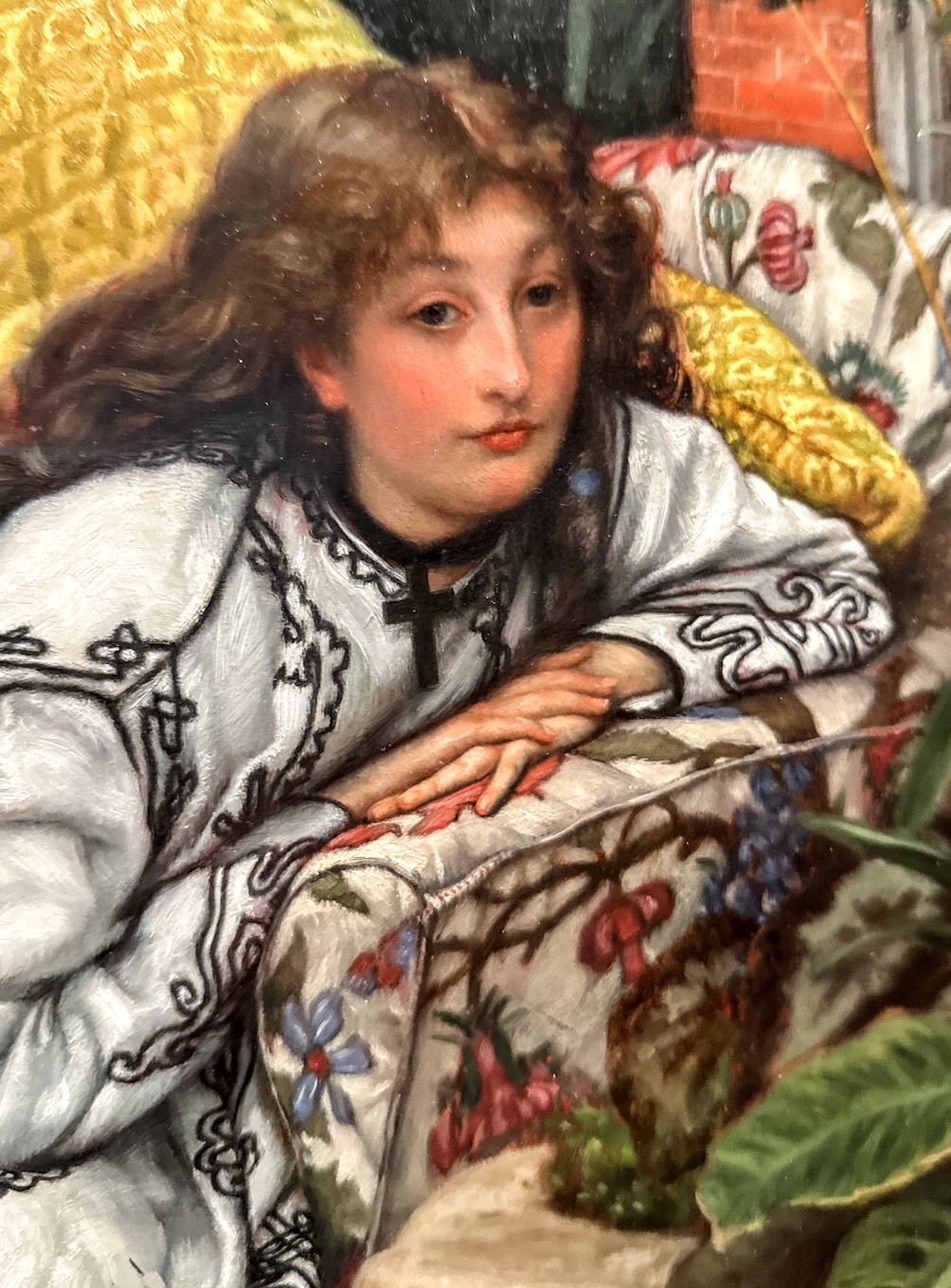
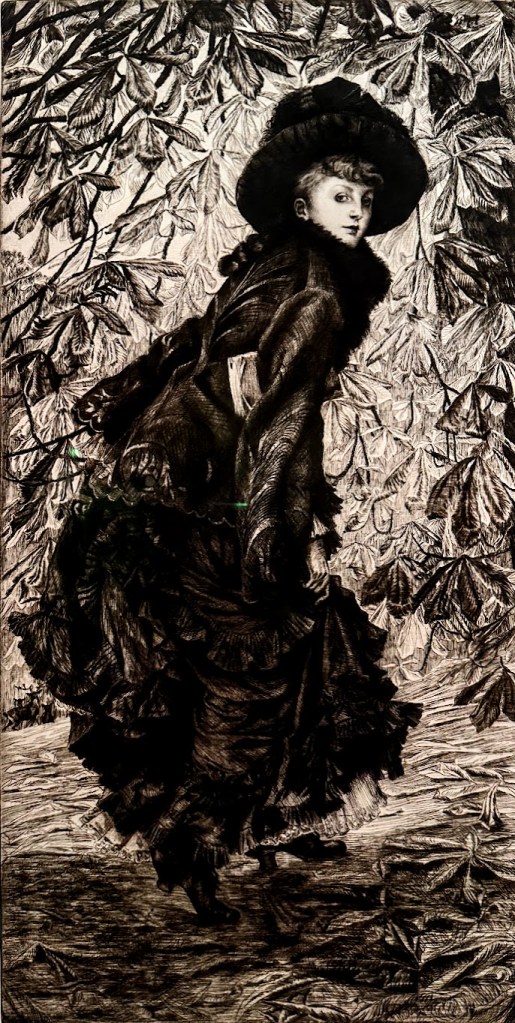
Tissot drew on the art historical tradition of women and natural cycles; ie. young women and spring.

Ippitsusai Buncho (Japanese, active 1765 – 1792), Kabuki. Segawa Kikunojo in female role of Ohatsu in“Yoni Osaka Nitsuino Myoto”
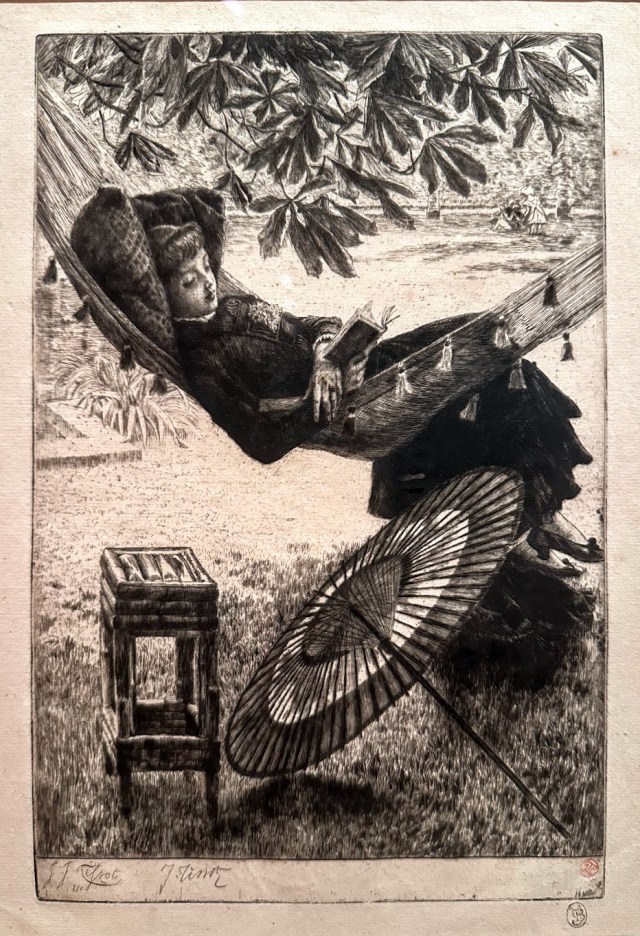
The elongated form, and stylized blades of grass in the foreground shows the influence of Japanese woodblock prints.


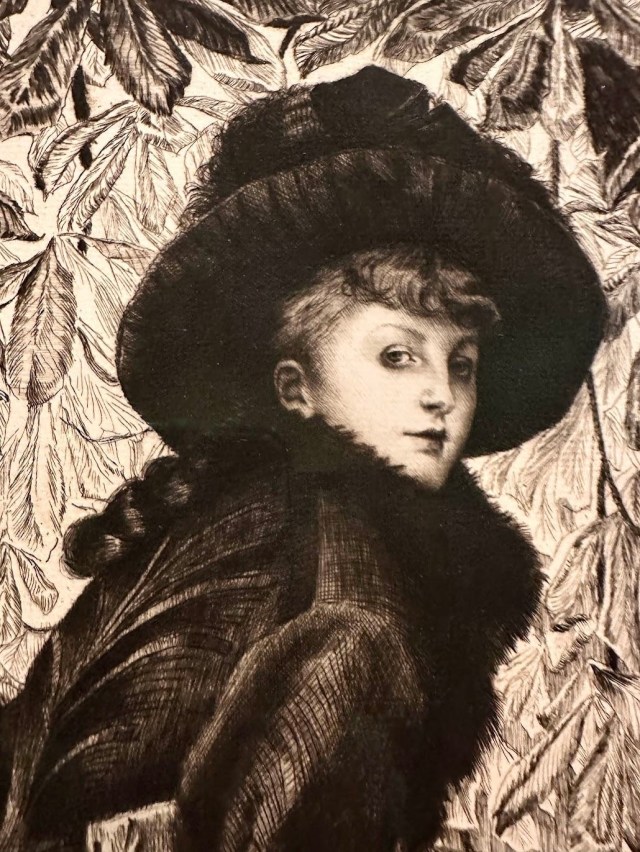
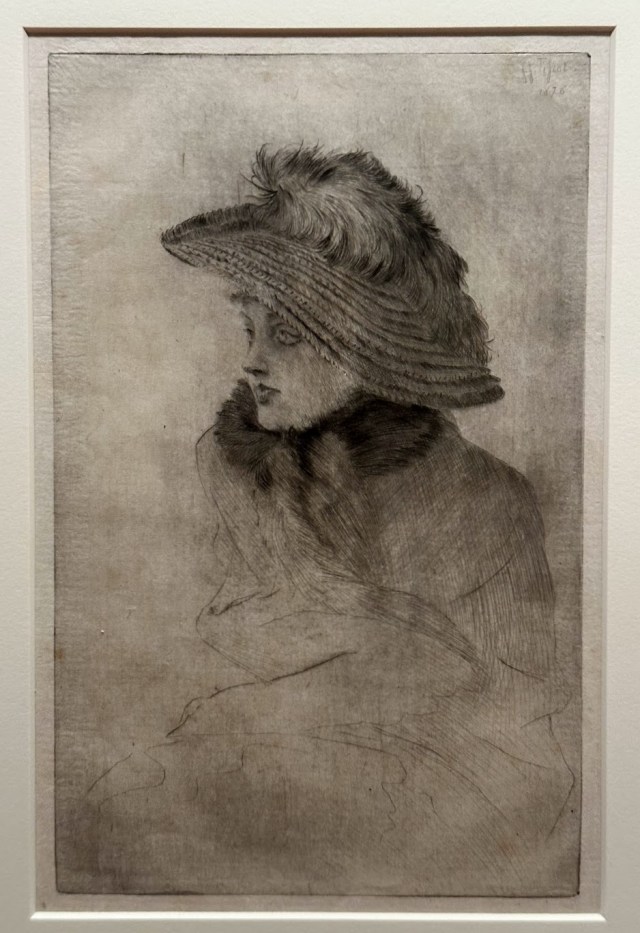
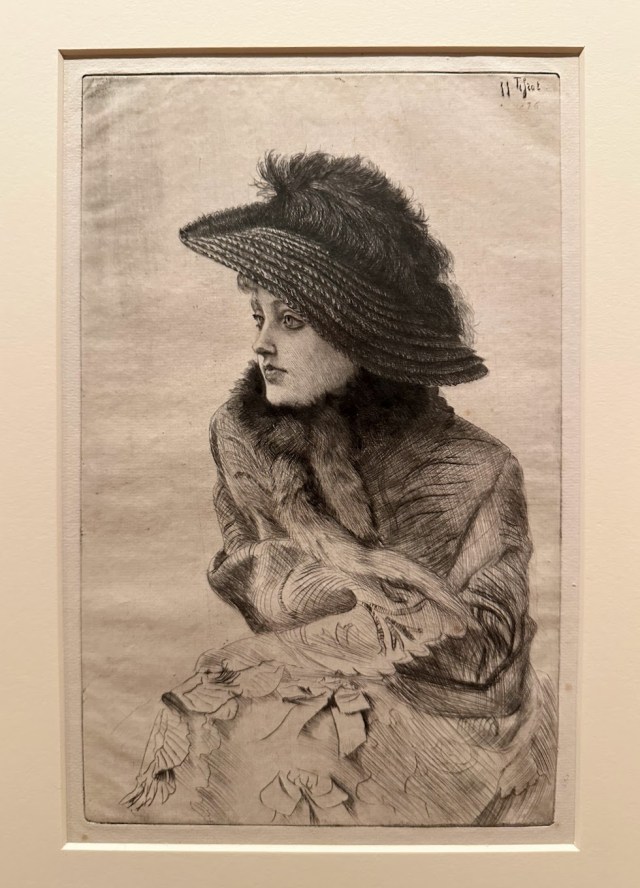
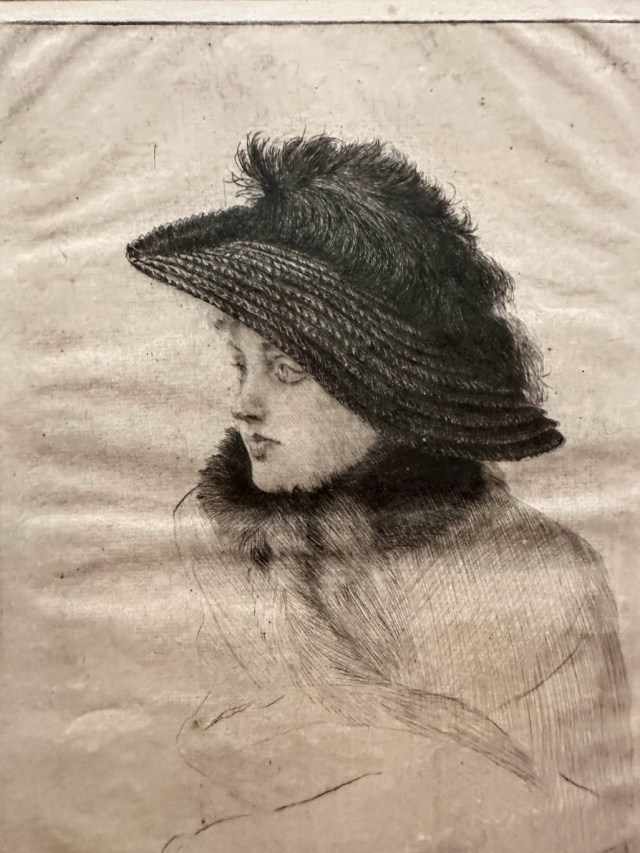
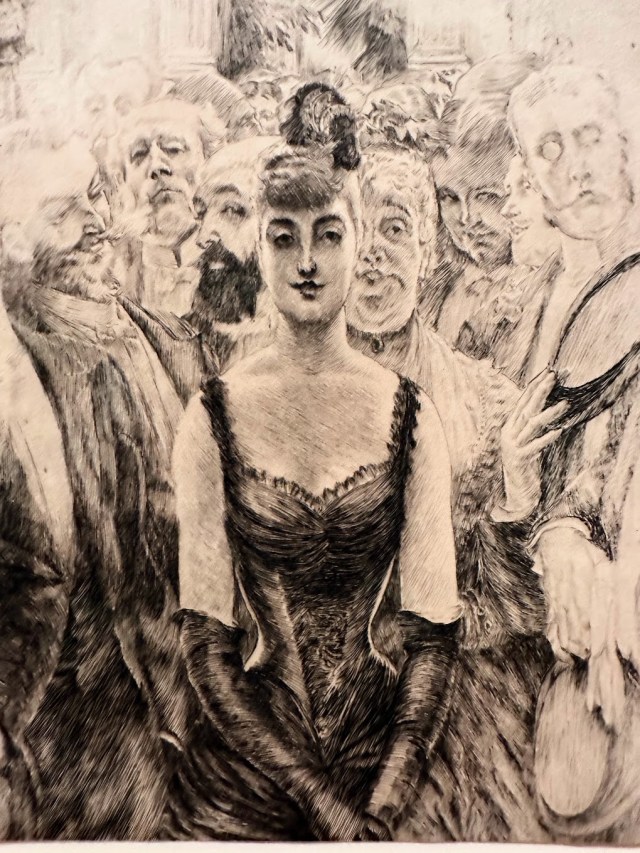
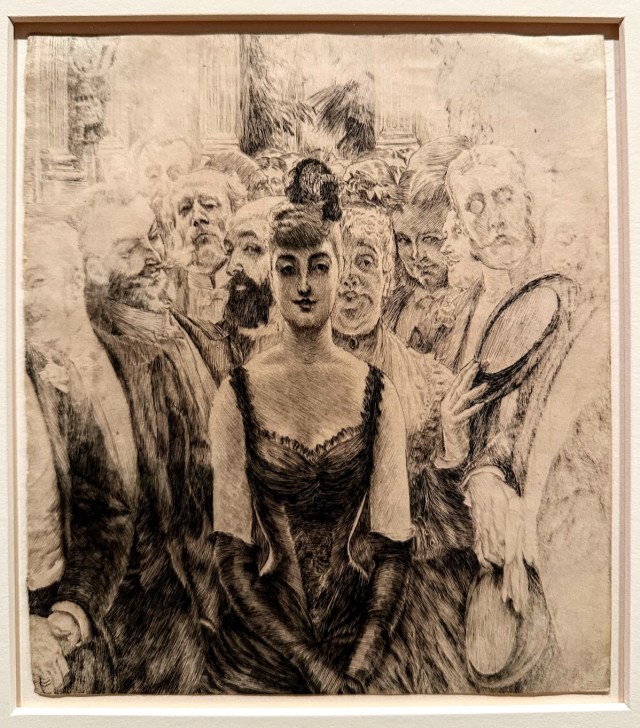
Limiting the number of prints to a plate (which adds value through scarcity) was unusual prior to the second half of the 1800’s.
The simplest way to cancel a run is to rut the metal plate with deep lines.
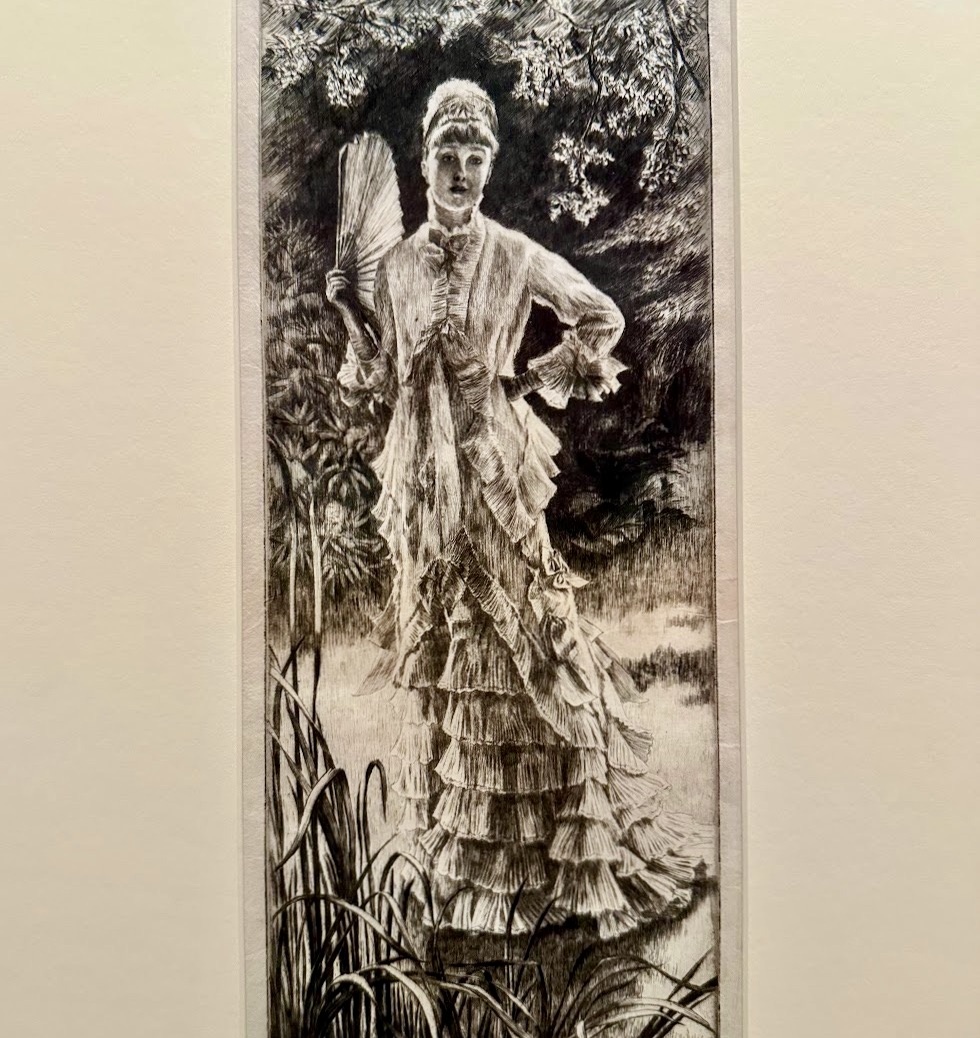


“He also depicted women in current fashions, presenting them as both timeless and contemporary.”
Despite the racial diversity of Europe at the time, Tissot’s artworks focus on white women.
This image of a naval officer cruising the polluted Thames River with 2 women (Must be prostitutes!) was deemed “thoroughly and willfully vulgar”by a critic.

The British saw this as immoral French art, which included Impressionism.


Tissot captured the global flow at bustling ports along the Thames.
This print highlights the artist’s expertise in capturing nautical scenes.
Tissot had an infinitude for portraying women in ambiguous situations.
This emigrant woman leaving a ship with her baby makes one wonder where her journey will lead.

This collection recounts Tissot’s time as a sharpshooter with The French National Guard during the Franco-Prussian War (1870 – 1871)

Tissot’s images of dead or ailing men depict specific historical events and locations. They were viewed by Victorians as accurate reportage.
Kathleen Newton (1854 – 1882)

Kathleen Turner was a young Irish divorcée and mother, who lived with Tissot in London until her early death at 28 from tuberculosis. Tissot often used her as a model.
Tissot’s prints were affordable, attracting middle-class and international buyers. His Victorian themes were adored and his prints circulated the globe, amassing the artist a small fortune.
Following the death of Kathleen in 1882, Tissot returned to Paris.
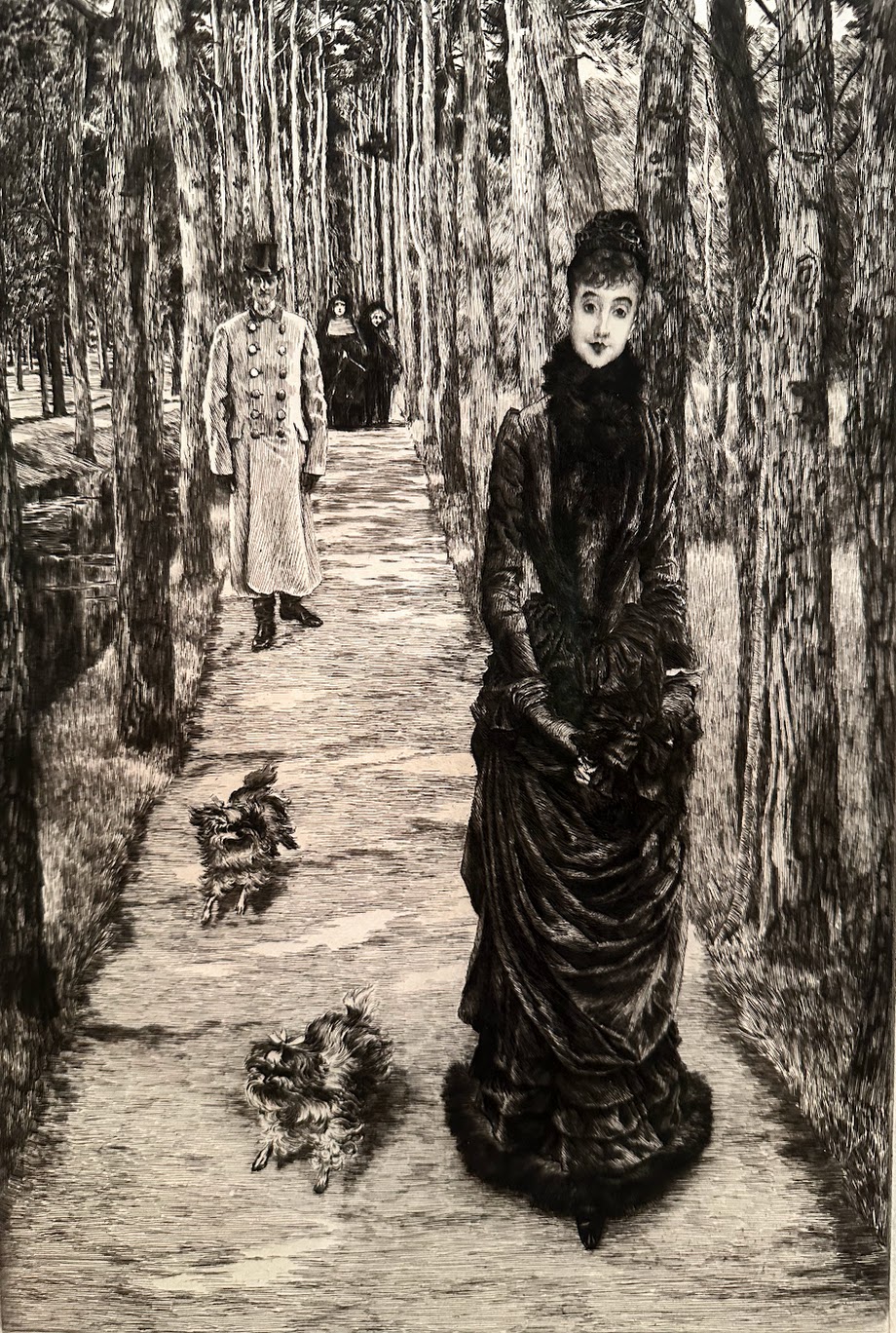
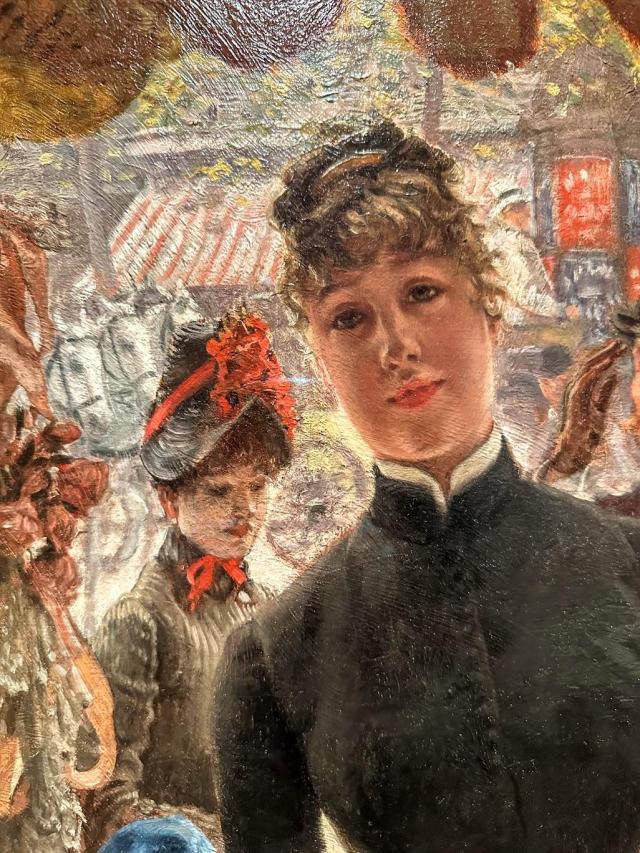
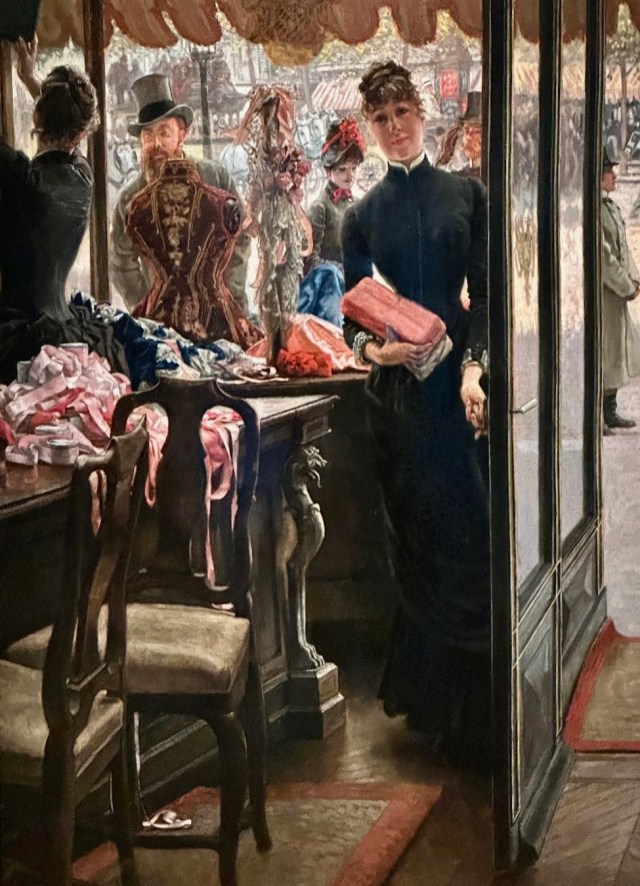
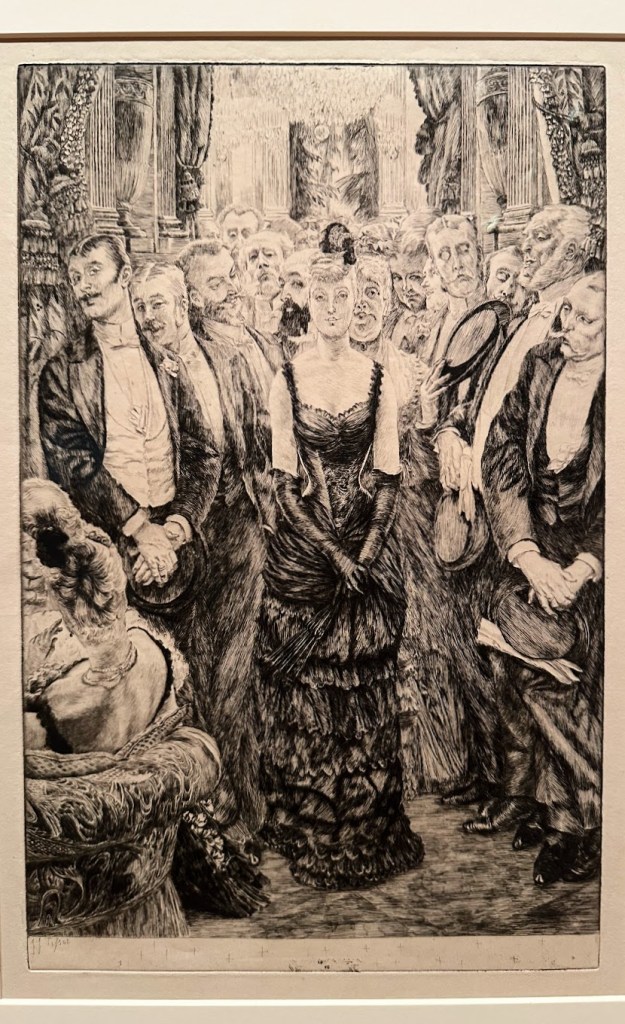
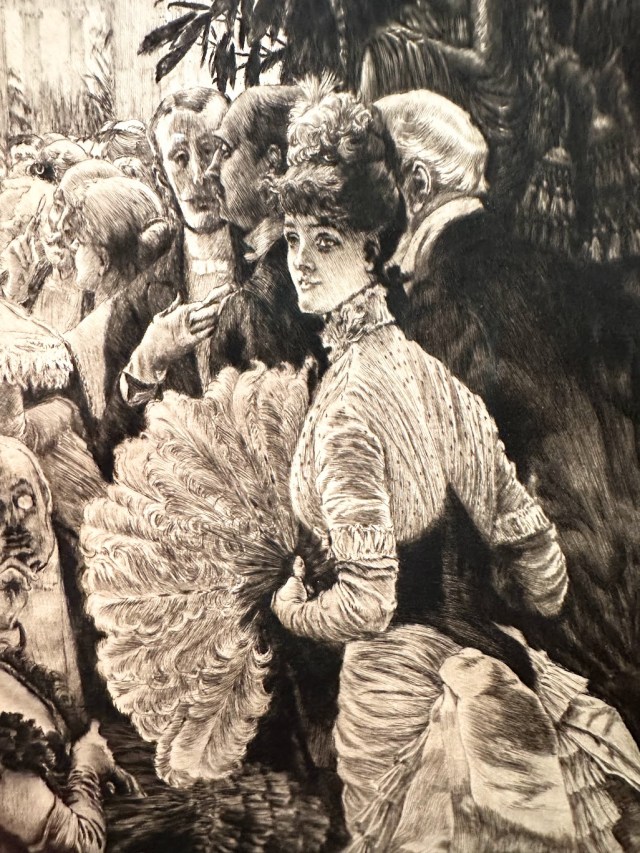
Tissot exhibited 15 paintings and a corresponding print series of modern Parisian women from different social classes, each accompanied by a short essay by a prominent French writer.

Critics panned the show as behind the times. They claimed he painted “the same Englishwoman” repeatedly.
“Following the critical failure of his exhibition, Tissot never focused on the theme of modern womanhood again.”
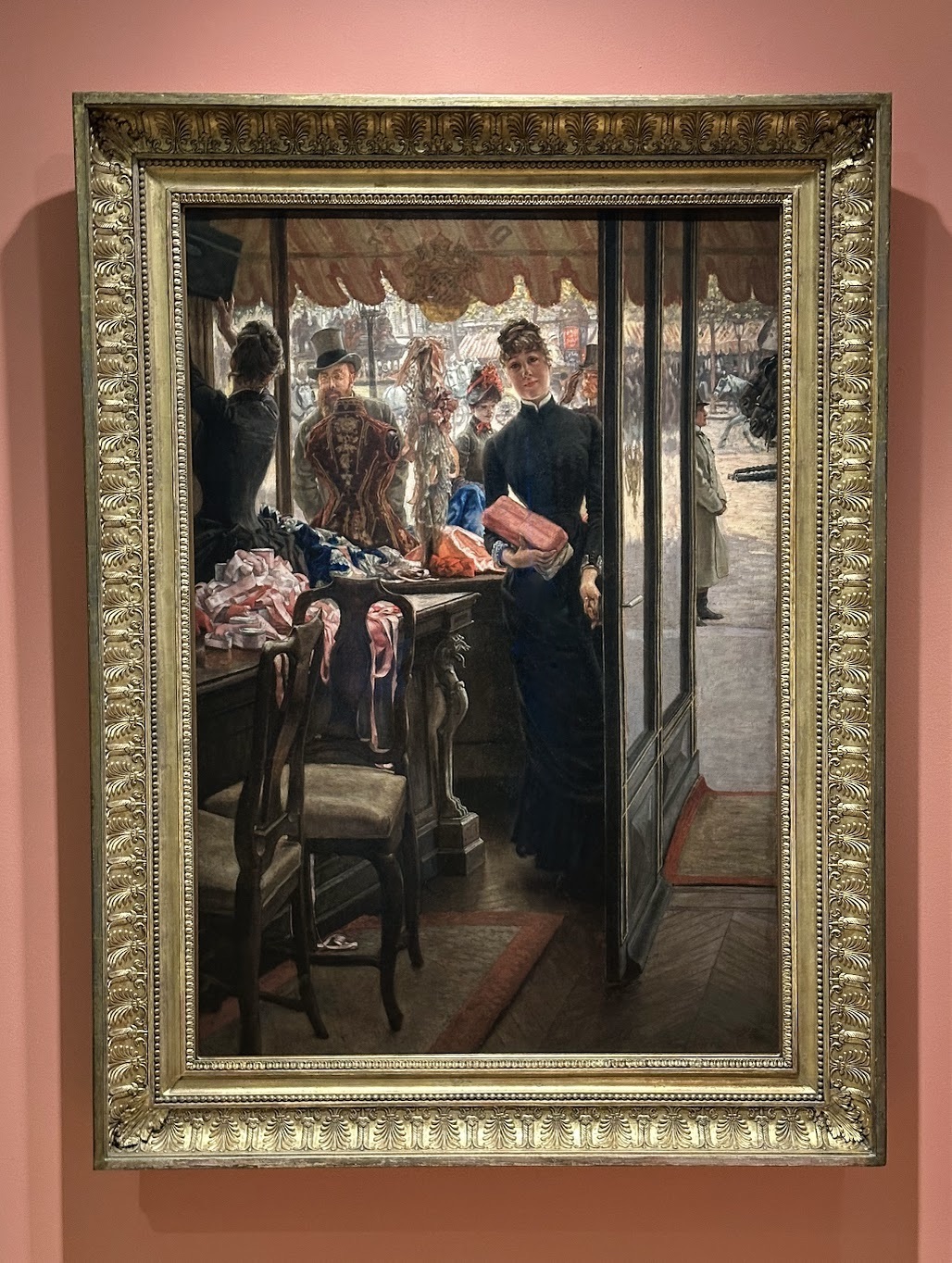
Photos taken © Resa McConaghy – January 7, 2025
Art Gallery of Ontario, Toronto, Canada
Source material – Art Gallery of Ontario


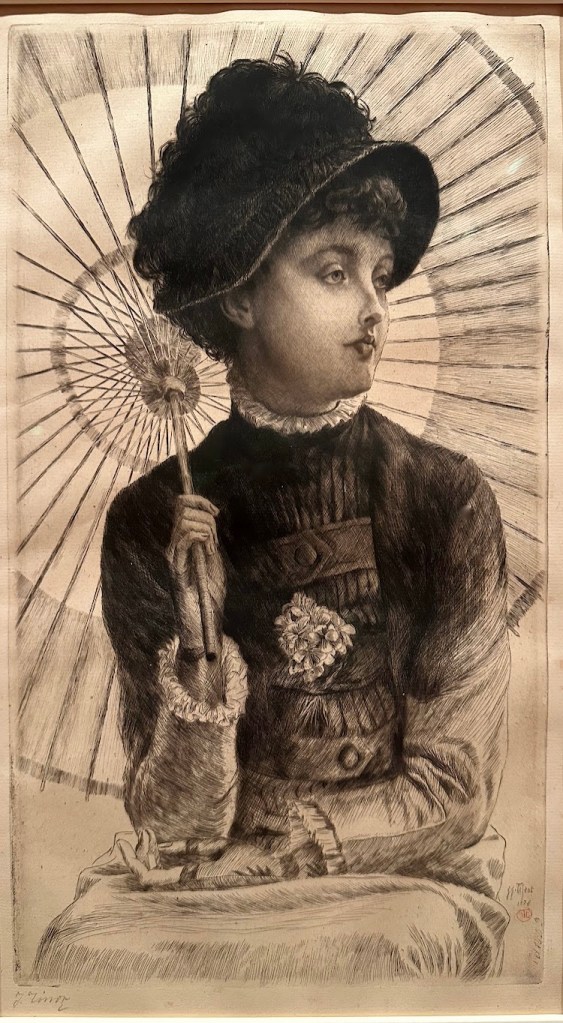
Tissot, a name I hadn’t heard much. Then the AGO announced an exhibit featuring their collection of 2 oil paintings, 1 watercolour and 30 etchings on paper.

In the last decades of the nineteenth century, James Tissot portrayed women within the contradictions of the period.
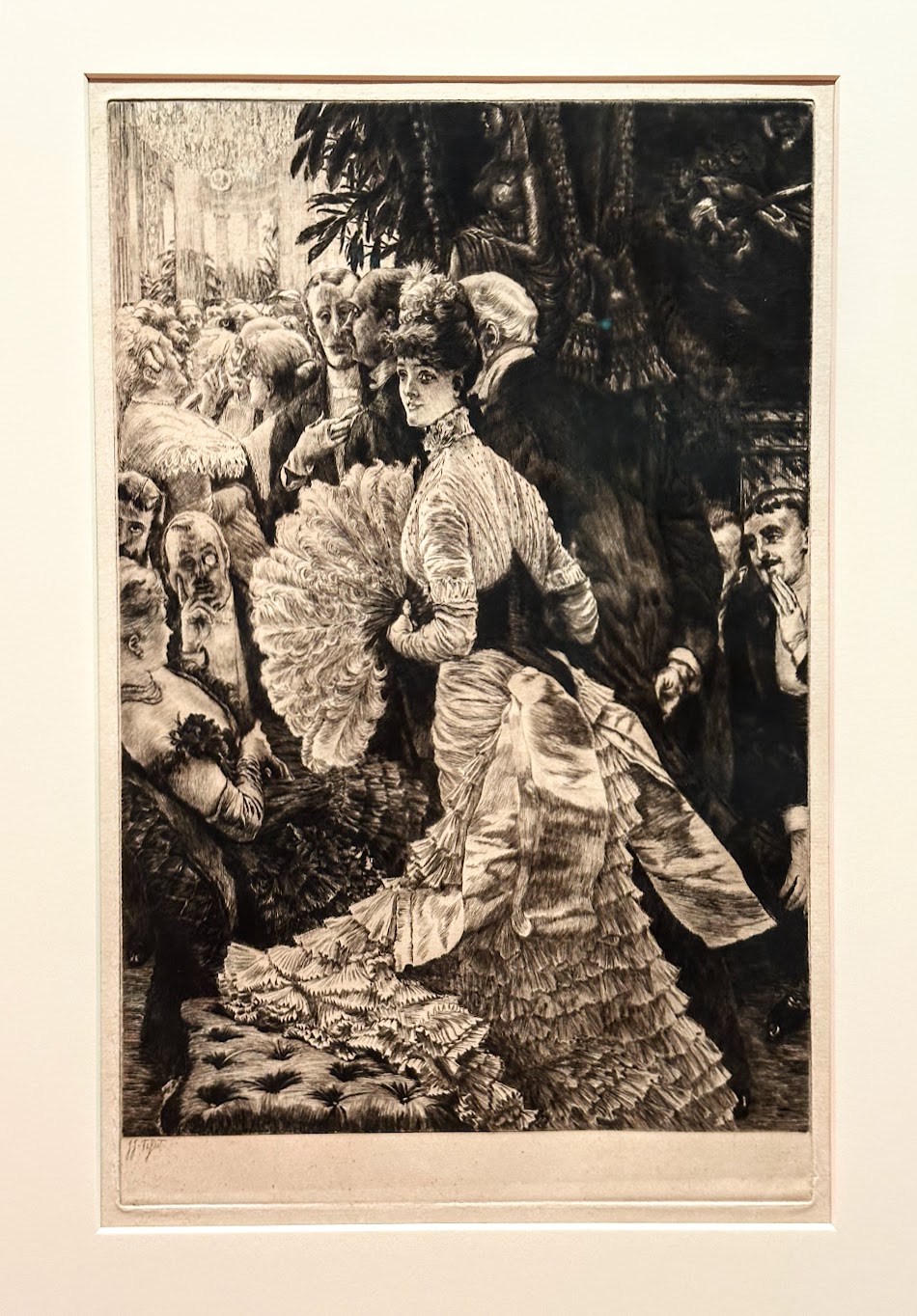
Modernity via the speed of travel, fashion and commodity culture is juxtaposed with the constraint of women’s every day lives.
A well dressed woman reads a newspaper. The fashionable Japanese-influenced wallpaper lining the wall informs of her engagement with the outside world & knowledge of trends.
Fashion magazines and novels were appropriate for Victorian women.
Newspapers were linked to men, as they symbolized factual knowledge and interest in global politics. Although, the image below depicts another reason a woman would read a newspaper.

The above image portrays a young woman and her mother in a Parisian park. The black clothing suggests they are mourning a male relative, and are without a dowry. The daughter sits in an available position, while the mother searches the newspapers for marriage offers.
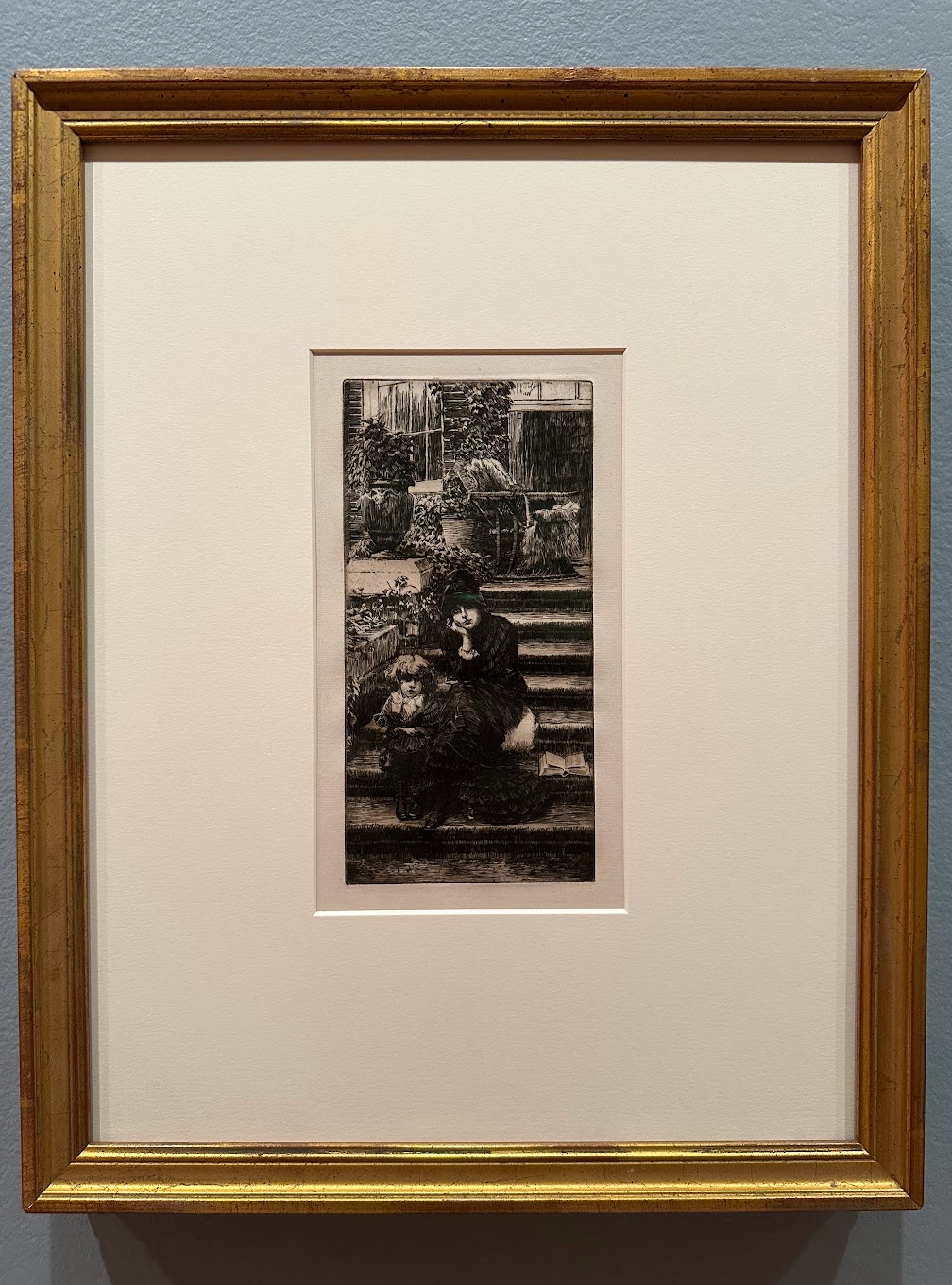
“Best known for his paintings of fashionable figures, Tissot began his career in Paris. While he turned down Edgar Degas’s invitation to exhibit with the impressionists, he shared the groups desire to portray scenes of modern life in an innovative style. He moved to London in 1871 after fighting in the Franco-Prussian War, and became a popular painter of Victorian scenes, particularly those showing young women in typically modern moments, before returning to France in 1882.” – Art Gallery of Ontario
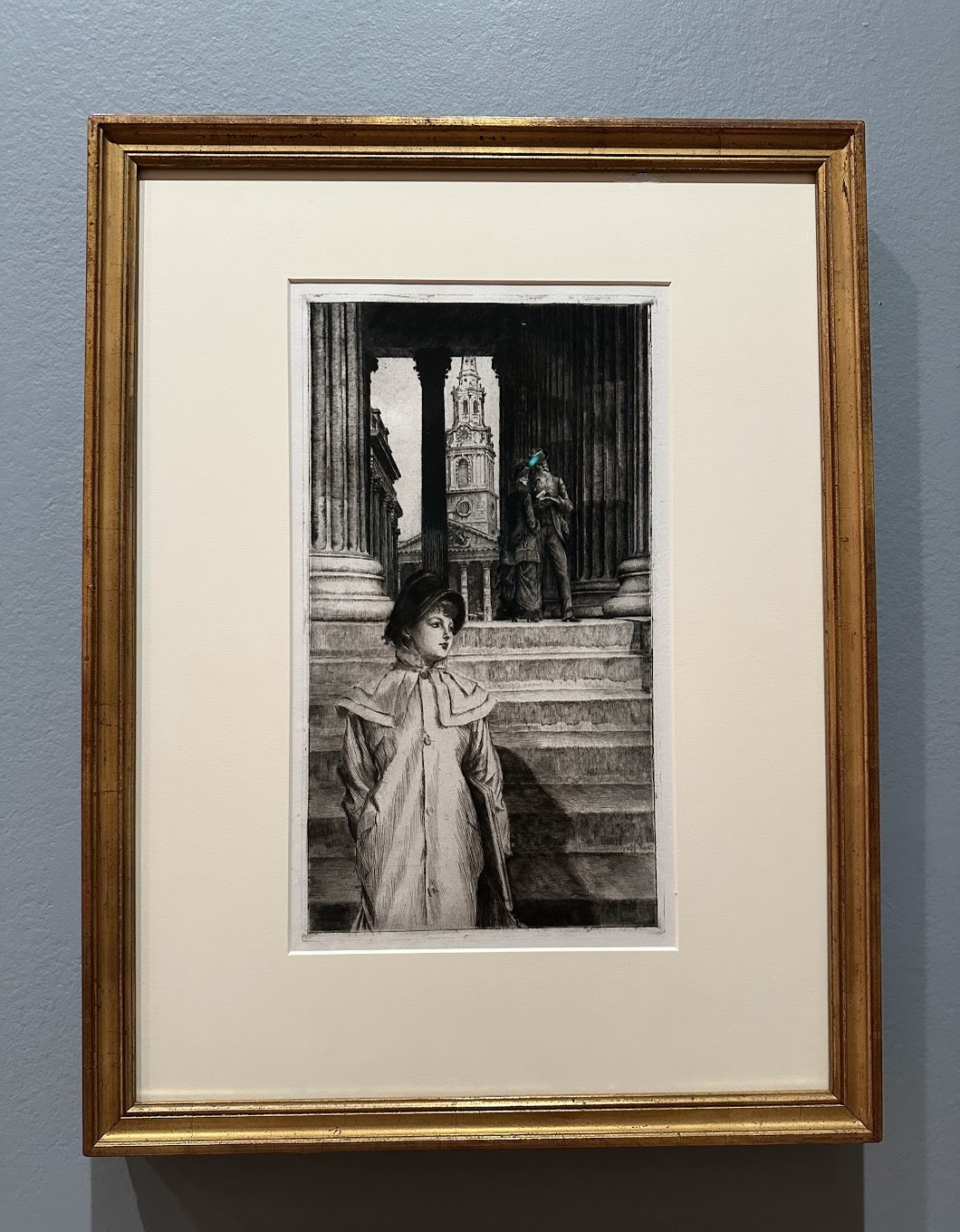


A well dressed young woman walks to church holding a bible. Her raised eyebrows and tentative gaze pose the question, does she need to atone for her sins, or is she nervous about being late for service?
Horizontal women’s bodies were lubricous from a voyeuristic perspective.

Slumbering female figures had erotic connotations in the Victorian Era, especially in semi-conscious states like dreaming or sleeping.

Now discredited – The below woman’s twisted hand was indicative of the pathological disorder – hysteria. This “chic” female disease was considered fashionably feminine and modern.

The moral ambiguity of Tissot’s images was integral to their popular appeal.
British critics claimed they were too, risqué, too French.
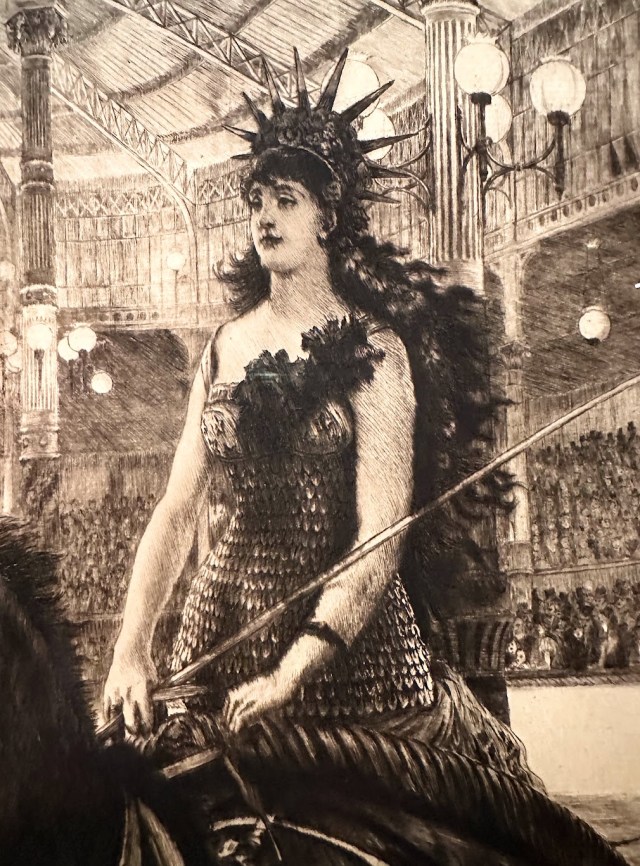
Other than the title, I know only that the etching below is in the Hippodrome (ℹ︎ Met Museum site). I was mesmerized by it. All that skin makes the costumes seem so modern and the Statue of Liberty crowns were piquing.

I can’t get everything into 1 post, so there will be a Tissot – II. In the meantime, I leave you with a shot of the 1 watercolour with gouache on paper.
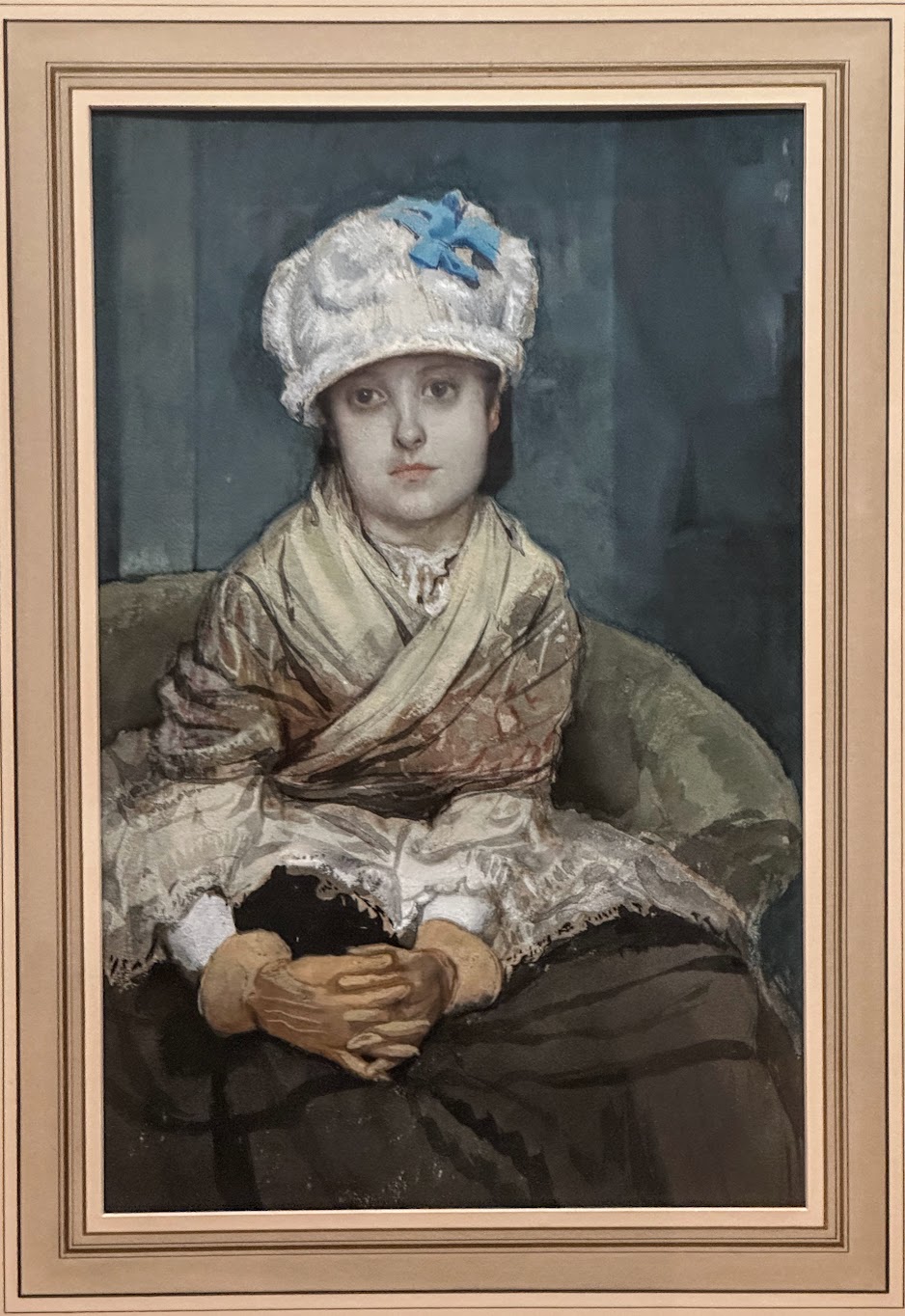

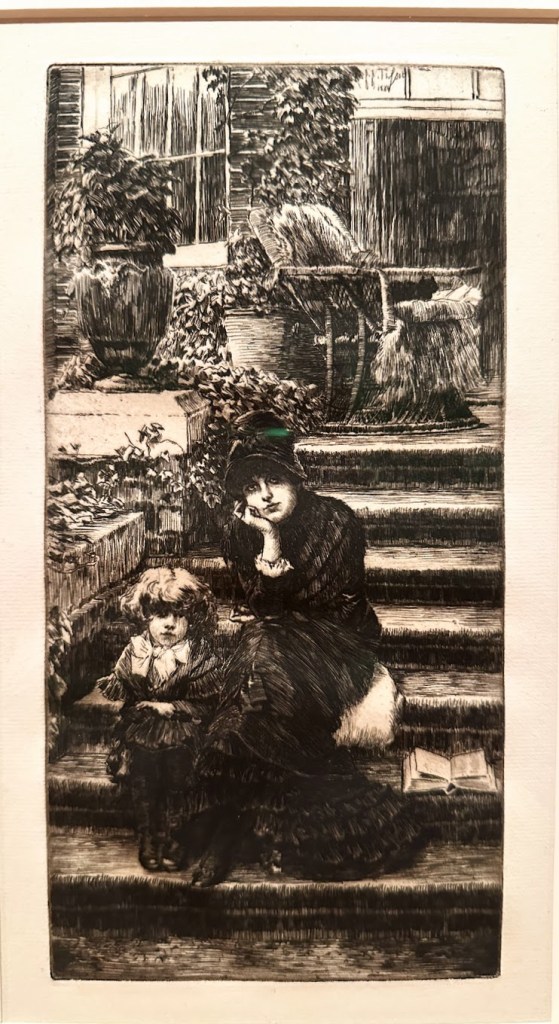
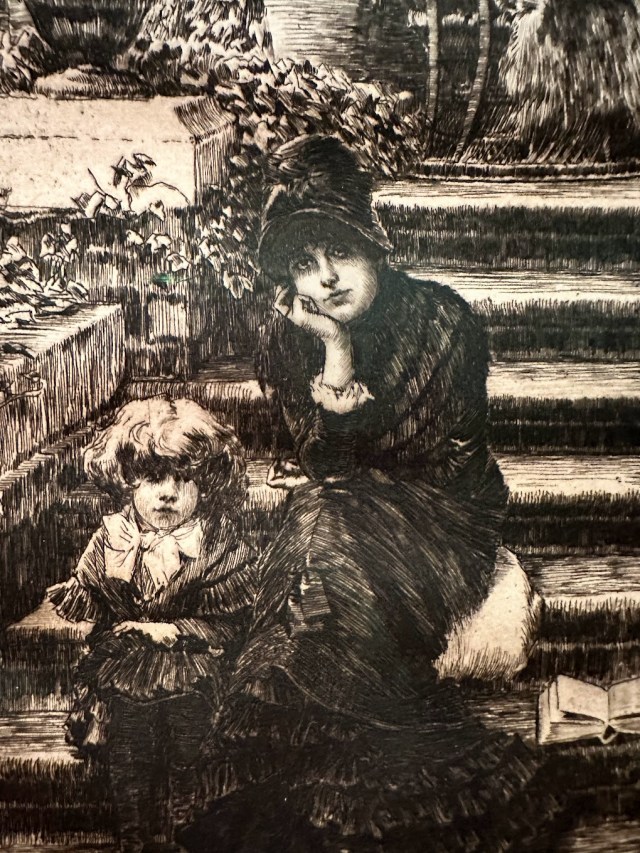
The young girl’s bored stare, pale skin, under eye circles with oversized bonnet and gloves (highlighting weight loss) suggest tuberculosis.
“Consumption” was coined a term, as it consumed patients, and ate away bodies.
Is she waiting for someone or something?
Is she waiting to heal or die?
Photos © Resa McConaghy – Taken January 7, 2025
Art Gallery of Ontario, Toronto, Canada
Information Source: The Art gallery of Ontario


The plan was to read an advance copy of Detour on the Eternal Road, do some drawings of Sam and do a pre-release promo post. Well, I “took a wrong turn in Albuquerque“, hit a detour and missed the print release.
So the road trip, of a post lifetime, passes through Albuquerque? Well, no, but it does pass through 1881!
Resa – John, Detour on the Eternal Road is set in the past, present and possible future of earth’s history and in the possible eternality of existence. You animate eternity’s goings on with non-haloed, wingless angels helping to guide souls to their eternal home. The adventures are informative, but mostly harrowing.
Yet, through “it all”*, the message remains uprightly positive. I’m not talking about the ending, per se, but the body of your story. Is this purposeful, or unconscious?
John – I have always carried a positive attitude regarding life. It is no surprise to me that this comes through in my writing even in the most dire of circumstances. You mention the ending which I don’t want to spoil for folks is an example of this positivity. It does rain a question about how much responsibility each of us has to take for the existence of evil on this Earth.

Hello! I’m Sam. When not on the road guiding souls to their eternal home, I’m at home on my cloud.
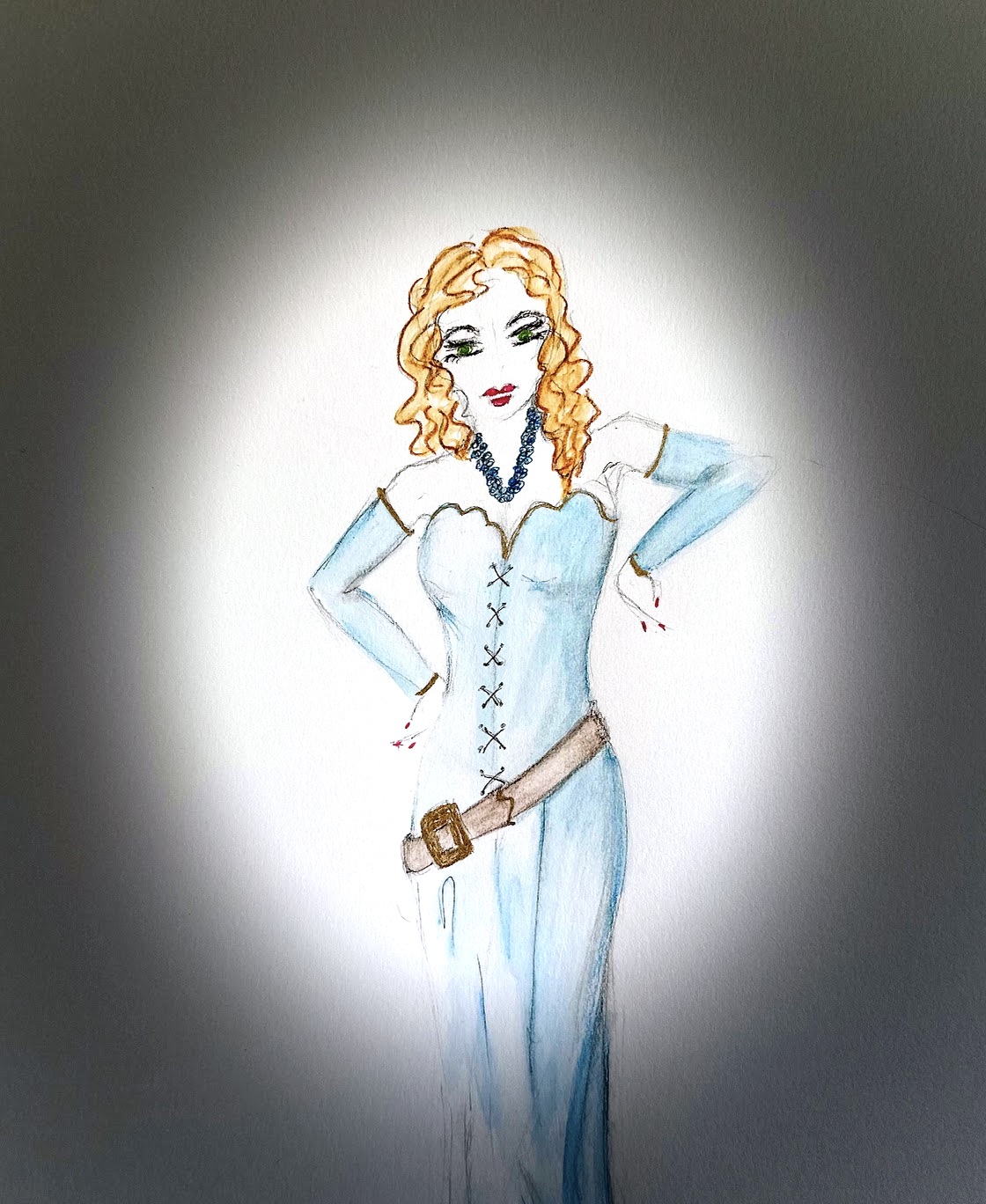
CLOUD WEAR is a custom wardrobe designed especially for me by Resa, who at this point remains earthbound.
Resa – Do you, or did you ever have a crush on Sam?
John – Sam is an agglomeration of every woman for whom I have had the honor of having feelings. Of course, I love her.
1. Windy Day (sun dial on wrist) - 2. Grecian Ode - 3. Rock'n'Roll Angel - 4. Fortune Teller - 5. Dream Away - 6. Honey 7. Surprise! (all blue beads and earrings made from dew and raindrops)
Resa – Without preaching any religion, you metaphorize good and bad/evil with god and the devil. In the story our protagonists, Sam and James angels, are presented moral dilemmas.
What say you to the idea that I think you are speaking to man’s “better angels”?
John – I think you have figured out the fact that I believe there are angels that walk among us. I also believe we all have inside of us the ability to behave as if we have been anointed with title ‘angel.’ On the corresponding side we all can be perfect devils at times. The control of the dominate characteristic is left up to how we were raised and our perception of what constitutes goodness.
Resa – So John, this is the third book in the Eternal Road series. I’ve read the first two and this one seems, in its fictional light, more politically predictive than the other books. It seems a pejorative on the future, on behalf of mankind’s progeny. Can you speak to that?
John – Since my books are written in the present tense it might appear as if there is a perjoritive view as the reader moves through the action. Quite the contrary the story attempts to provide human kind with a tool that can be used to continue the species forever. Yes we have to look at nuclear war as a possibility, but the essence of the story which is repeated is that all mayhem is preventable.
The one pejorative view that I will raise my hand to is the increasing dependence the average person has on Government. I believe in the government being representative of the people and not an entity that exists for itself.
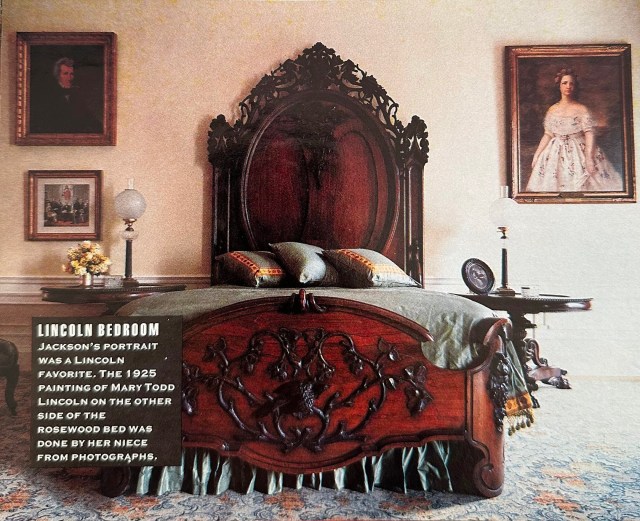
“Lincoln’s Bedroom” in the White House.
What does this have to do with Detour on the Eternal Road? We go to the White House?
Yes, but which wing and what rooms ?
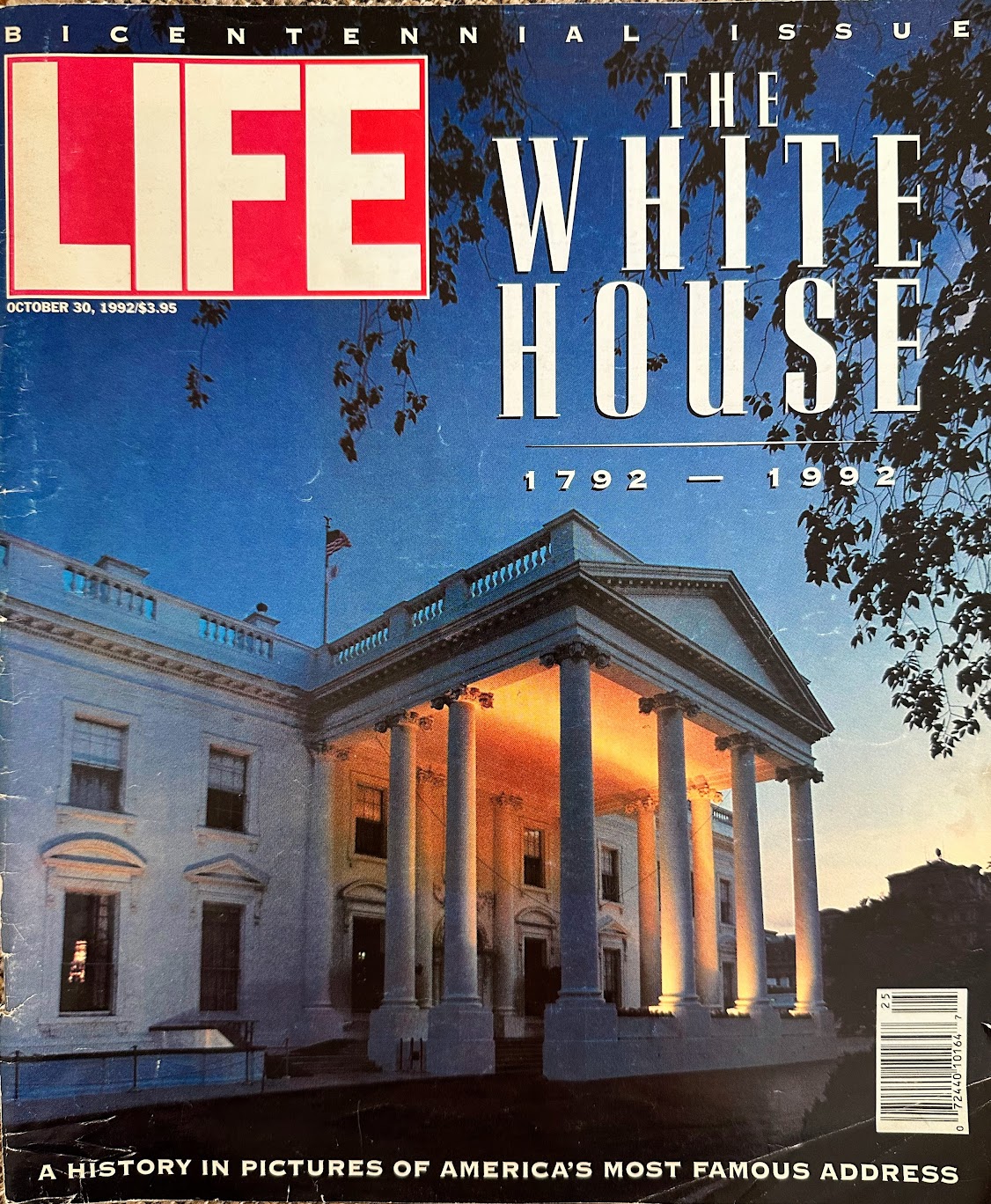
The replica is 60 feet long & 20 feet wide. The Artists, Historian John Zweifel and his wife Jan, took 25 years to complete it. It includes all furnishings. The clocks tick, flags wave, phone rings and TV’s work.

On Its 200th Birthday in 1992 – This to scale replica of the East Wing of the White House was presented in a special issue of LIFE magazine.
1 - First Lady's Dressing Room
2 - President's Bedroom
3 - Family Sitting Room
4 - Yellow Oval Room
5- Treaty Room
6 - Lincoln Bedroom
7 - Lincoln Sitting Room
8 - State Dining Room
9 - Red Room
10 - Blue Room
11. Green Room
12 - East Room
13- Library
14 - Map Room
15 - Diplomatic Reception Room
16 - China Room
17 - Vermeil Room

I think you can enjoy this book without reading its predecessors. However, certain questions will come up, such as this question I asked John after I read the first book.
Resa – “Eyes are mentioned on almost every page, mostly due to travelling, but I could not find the colour of Sam’s eyes. I also searched brown, blue, hair…no luck. Thing is, I was thinking of drawing Sam as an angel, maybe no wings. This way I could do a gown.”
John – “You are not crazy. You won’t find a color of Sam’s eyes since I very seldom describe the characters in terms of physical attributes. My reason for doing this is I would rather the reader form an image in their mind of what the characters look like. So you can make her eye color whatever pleases you. She is more your character than mine since you invested your time reading the book. “
So, if you are thinking of jumping straight to book 3, you might want to read a few of the Amazon reviews on the first 2: Eternal Road & The Last Drive. OR read my Out-of-the box reviews.
Or read the books.
Click covers of Eternal Road or Last Drive & go to John’s Amazon page, where you will find these, their reviews & many of his other books!

To buy a print copy of Detour on the Eternal Road click on the above cover.
To Pre-Order the EBook, click on Abstract Art Sam below!


“it all”* – Read the book and find out!


Inspiration came in 2 boxes from Diana – Myths of the Mirror

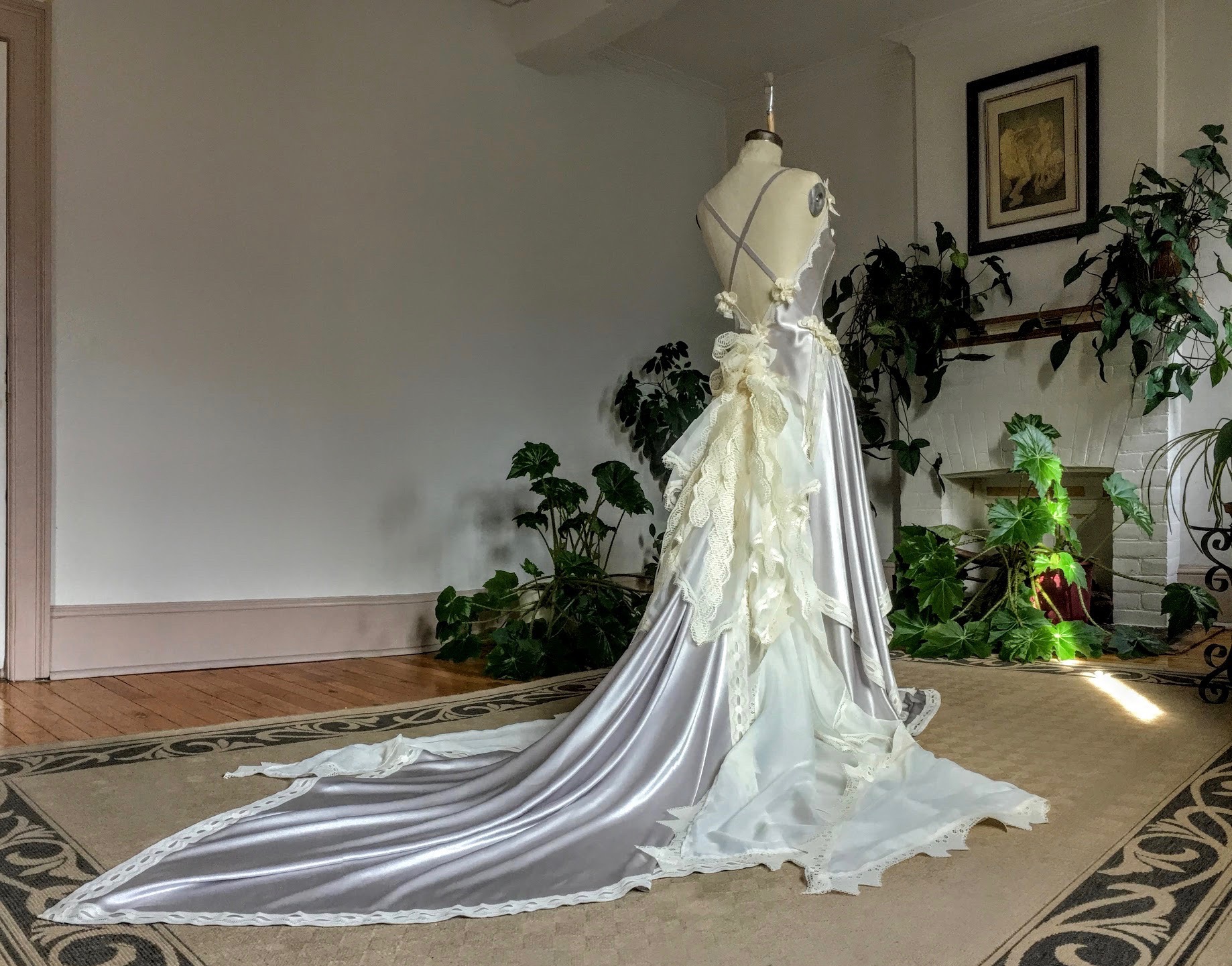
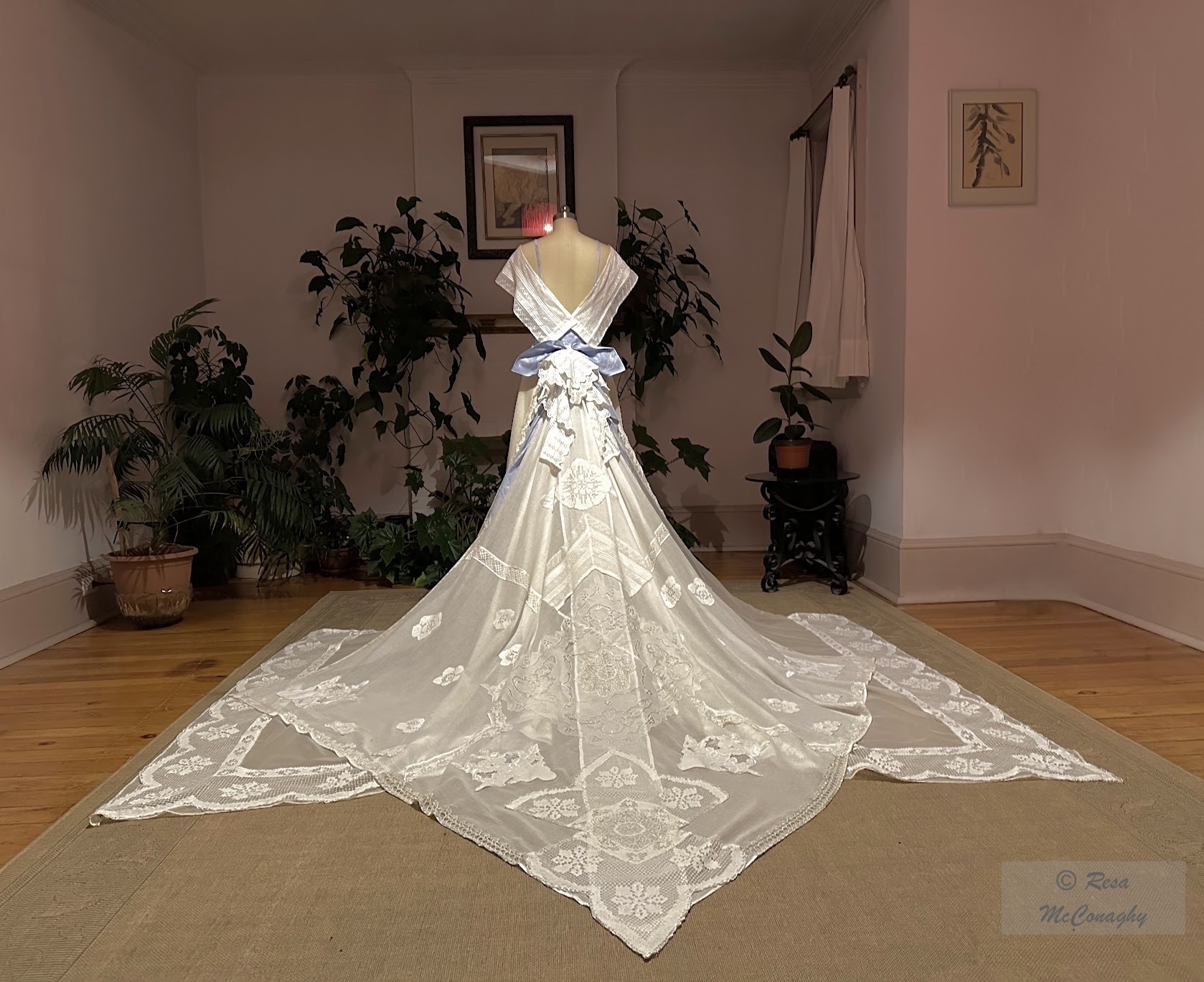
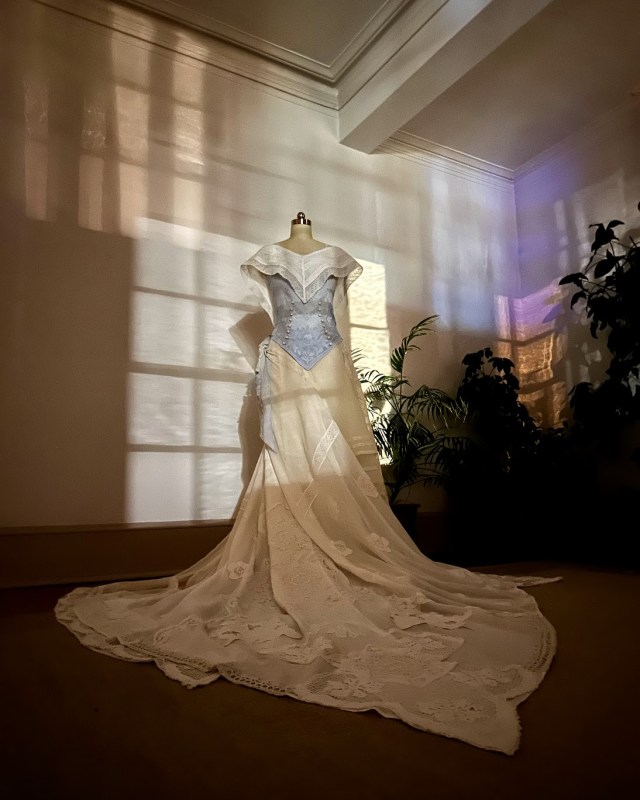
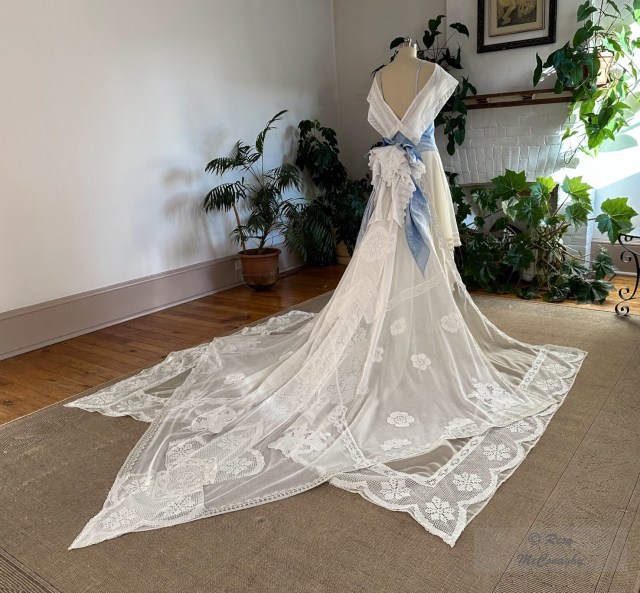
Linens & laces inherited from great grandmother & grandmother to mother then her, became all mine; an Art Gown to share.

Her beauty holds memories of Victorian times, and the bright light of many tomorrows.
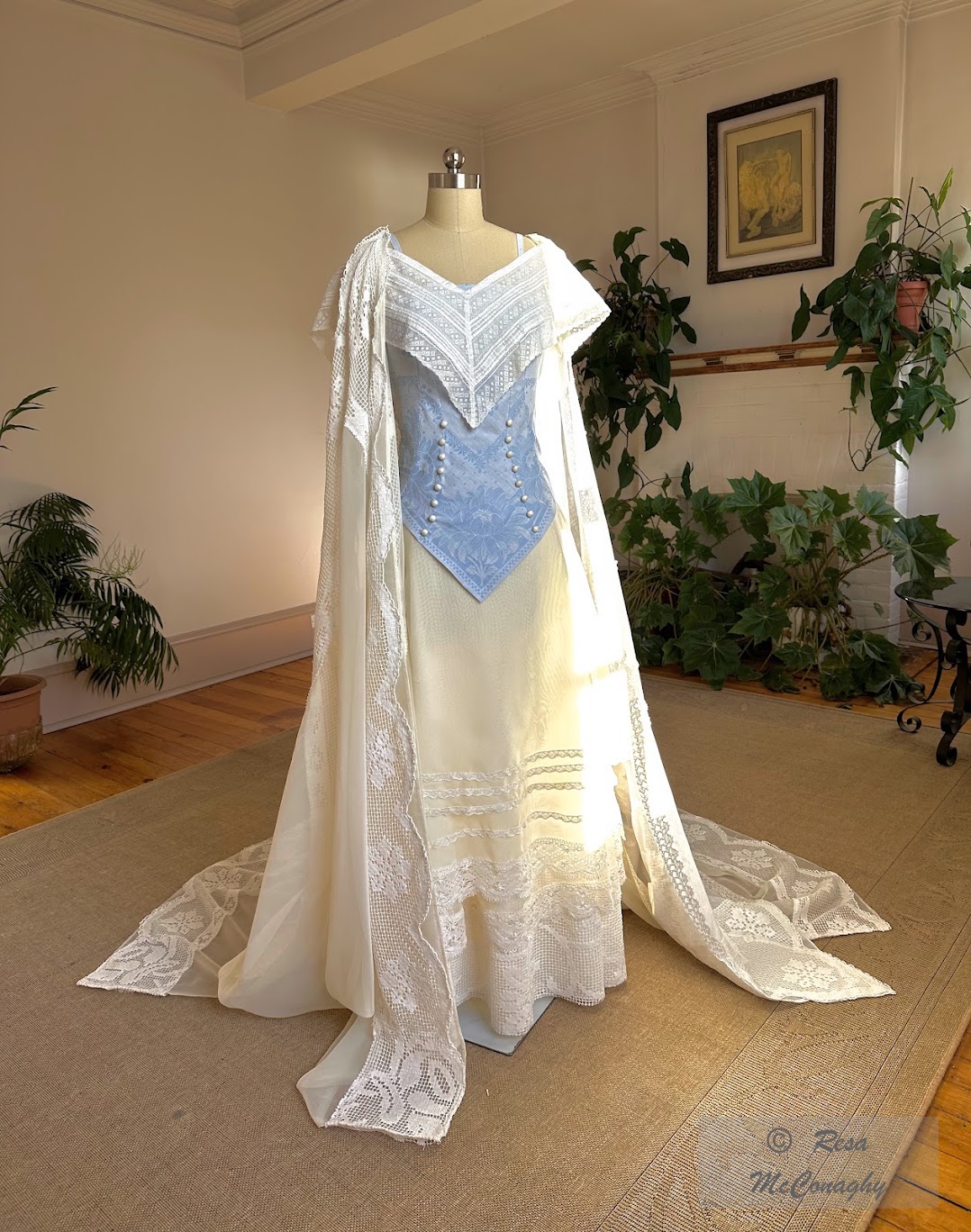
Victorian Sonnet is dedicated to Diana, her great grandmother Emilie, her grandmother Truly (Caroline), and and her mother Tineke (Dutch nickname for Anna Martine).

Structure
Iambic pentameter – 5 feet to a line – 4 lines to a verse – 3 verses & a couplet
Rhyme scheme – ABAB, CDCD, EFEF, GG
Third verse volta
I

Dear Diana your lace and your linen
Great grand mother, grandma, mother then you
Woven treasure fair sent passed on to begin
Romance dance a dress white and blue.

Lace held, fabric draped inspiration gold
Creation libation confusion strewn
All threads gay with gathers theirs to unfold
Ancestry, a love light shimmering through!

Yet should something arise break then the spell
To find magic's construct tattered  and torn
Ere rendered fore tendered tossed into the swell
Became fragments merely blithely left lorn.

Our memory painted lingers in mind,
Inherited Victoriana's time.

                                                               © Resa


When the fabrics arrived, I threw the lot on top of Lilac Fan Dance. There was also a fabulous mosquito net with cotton top.
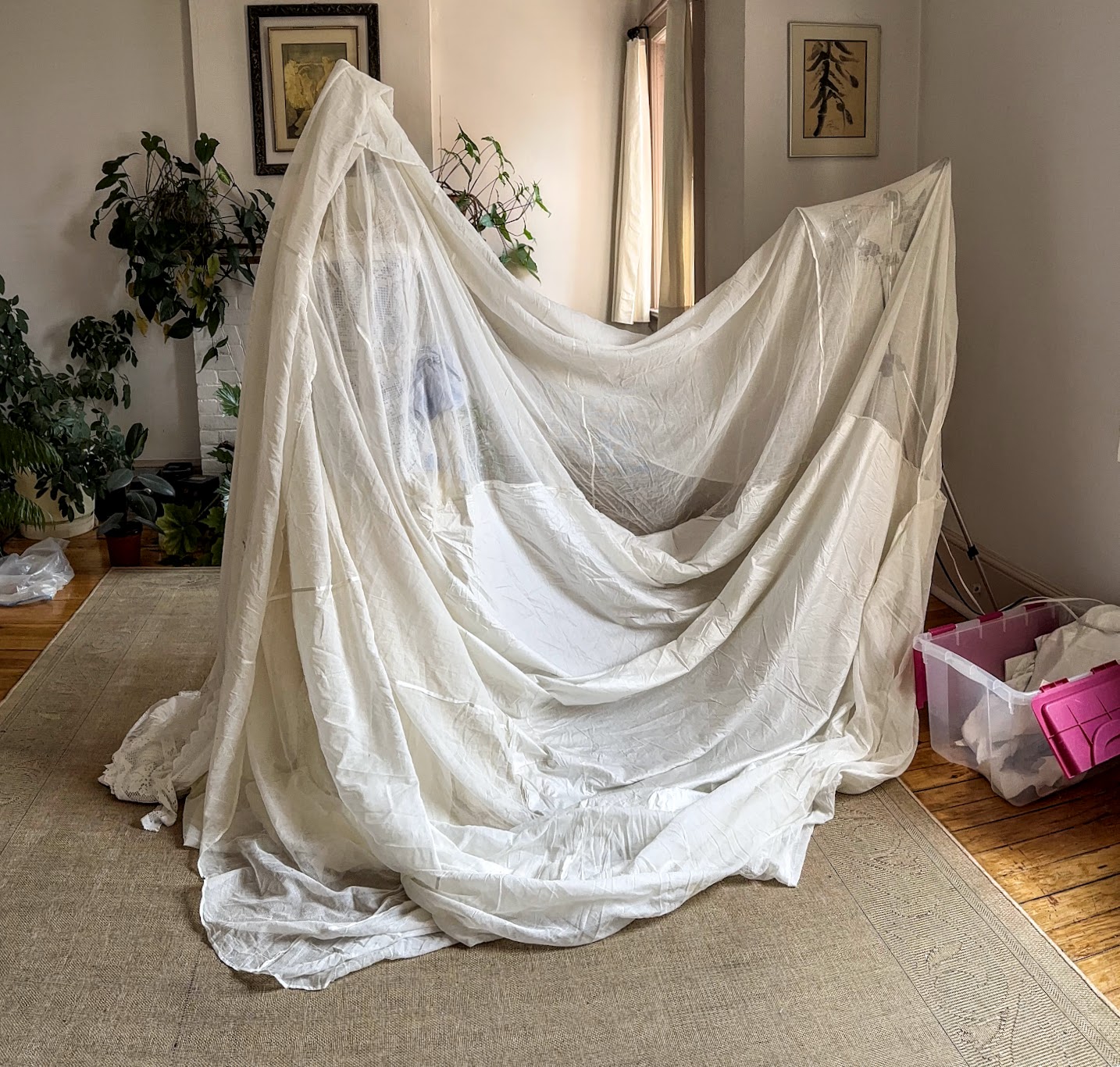


When the time came to begin, there was so much lace and linens, I needed to spread them all out.

All laces and fabrics were hand washed, and tested for tensile strength.

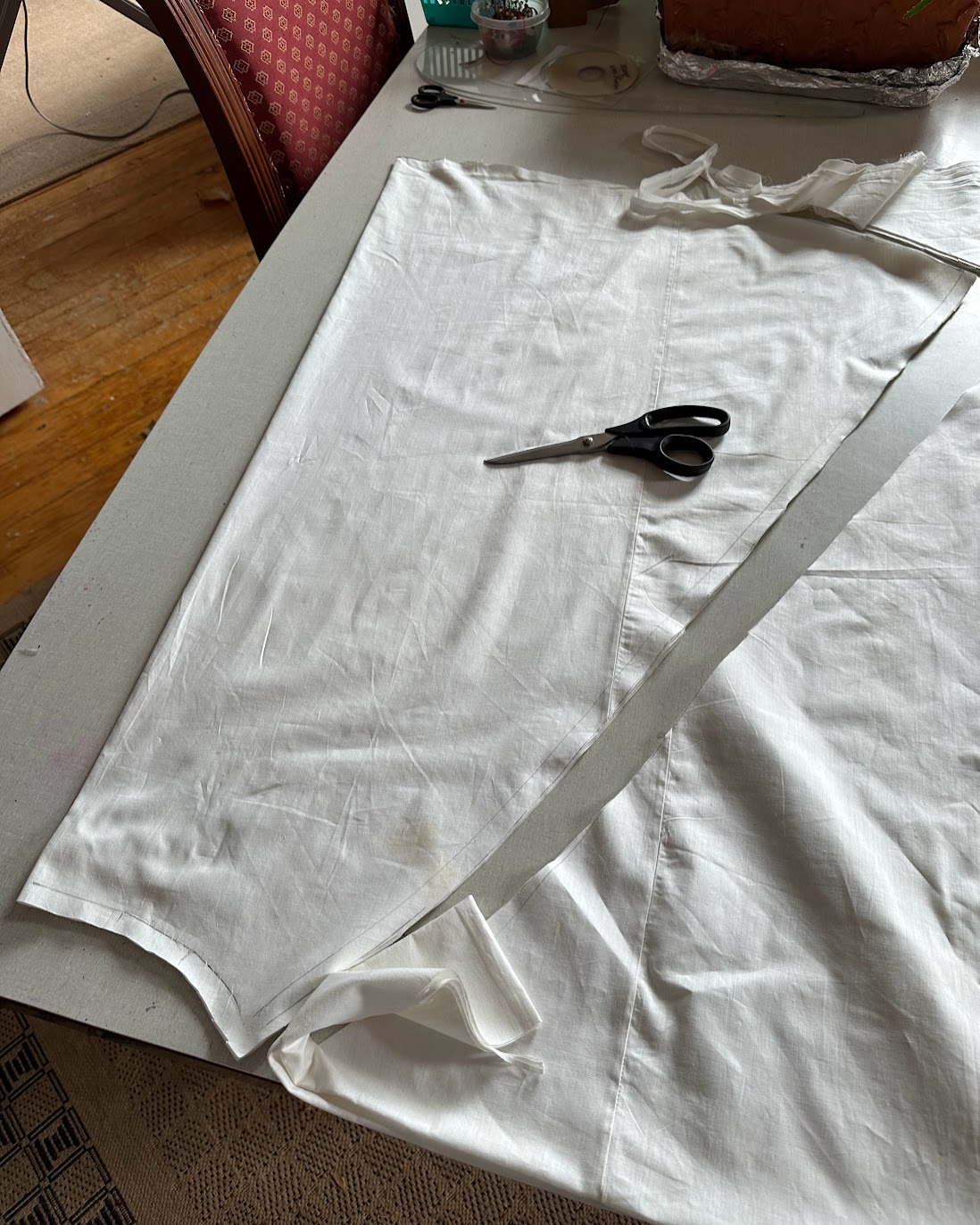
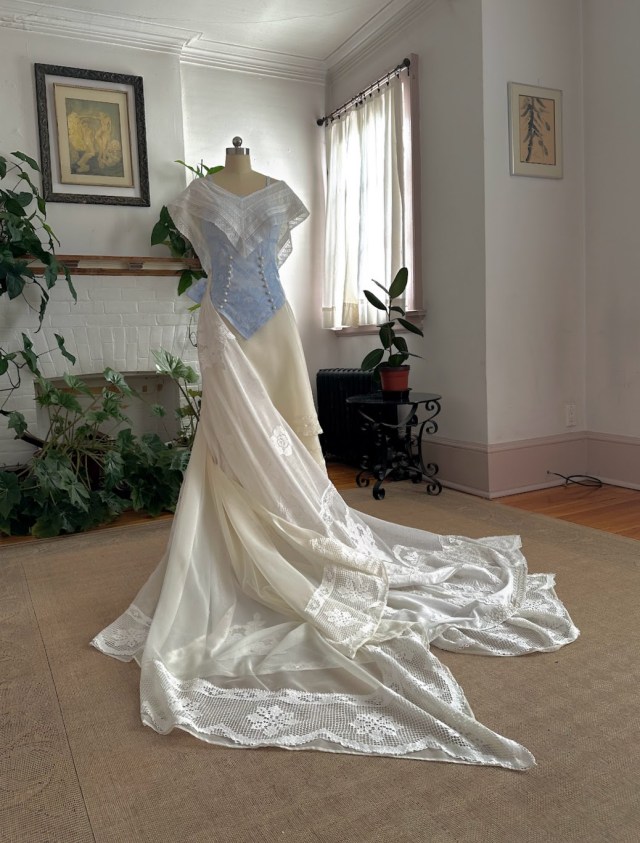
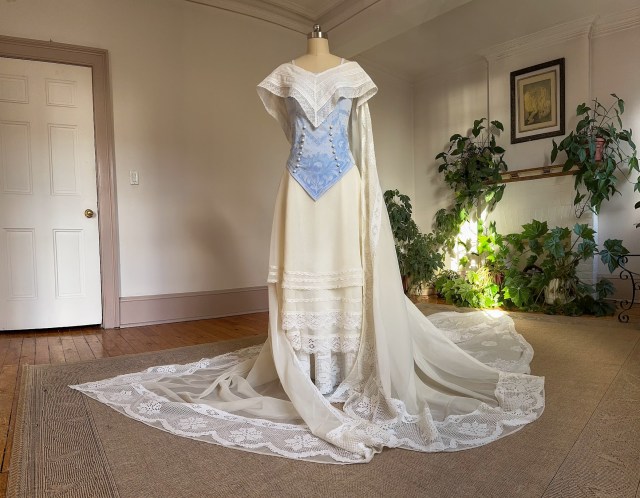
A bertha collar was formed from a bed jacket’s trim and lined with mosquito net.
An underskirt was cut from the cotton top of the netting.
Mosquito netting was added to the underskirt to make it full length. Lace cut from the lace tablecloth was sewn on top of the netting.
A blue linen jacquard tablecloth was formed into a corset shaped top with straps into a plunging back.
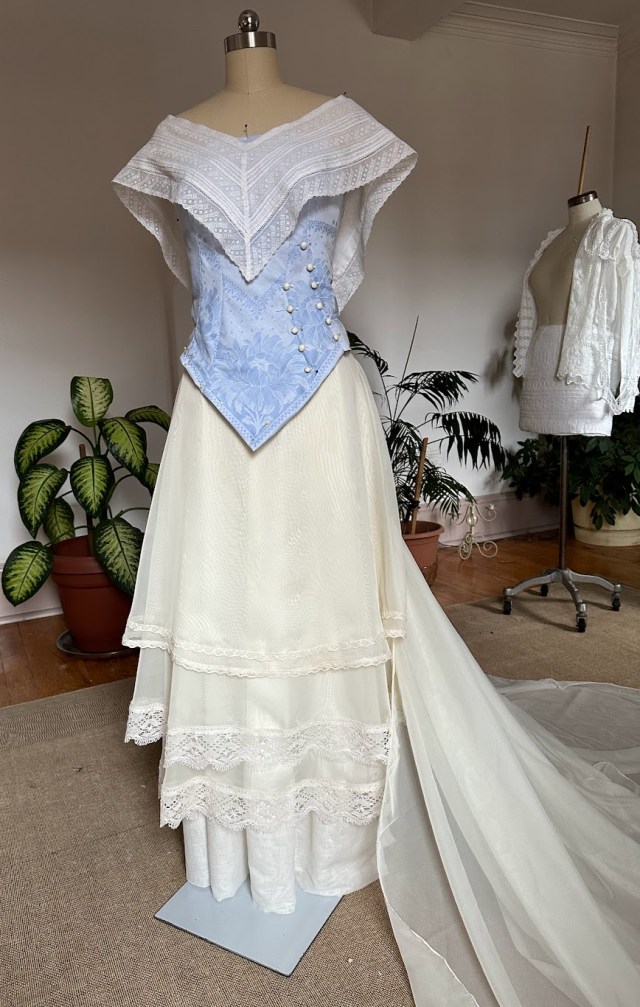
My friend Kat gifted me a new Judy, so I transferred the gown to her. She also sent massive yardage of new, but cut into, winter white synthetic curtain sheer, found for a pittance at the good will.
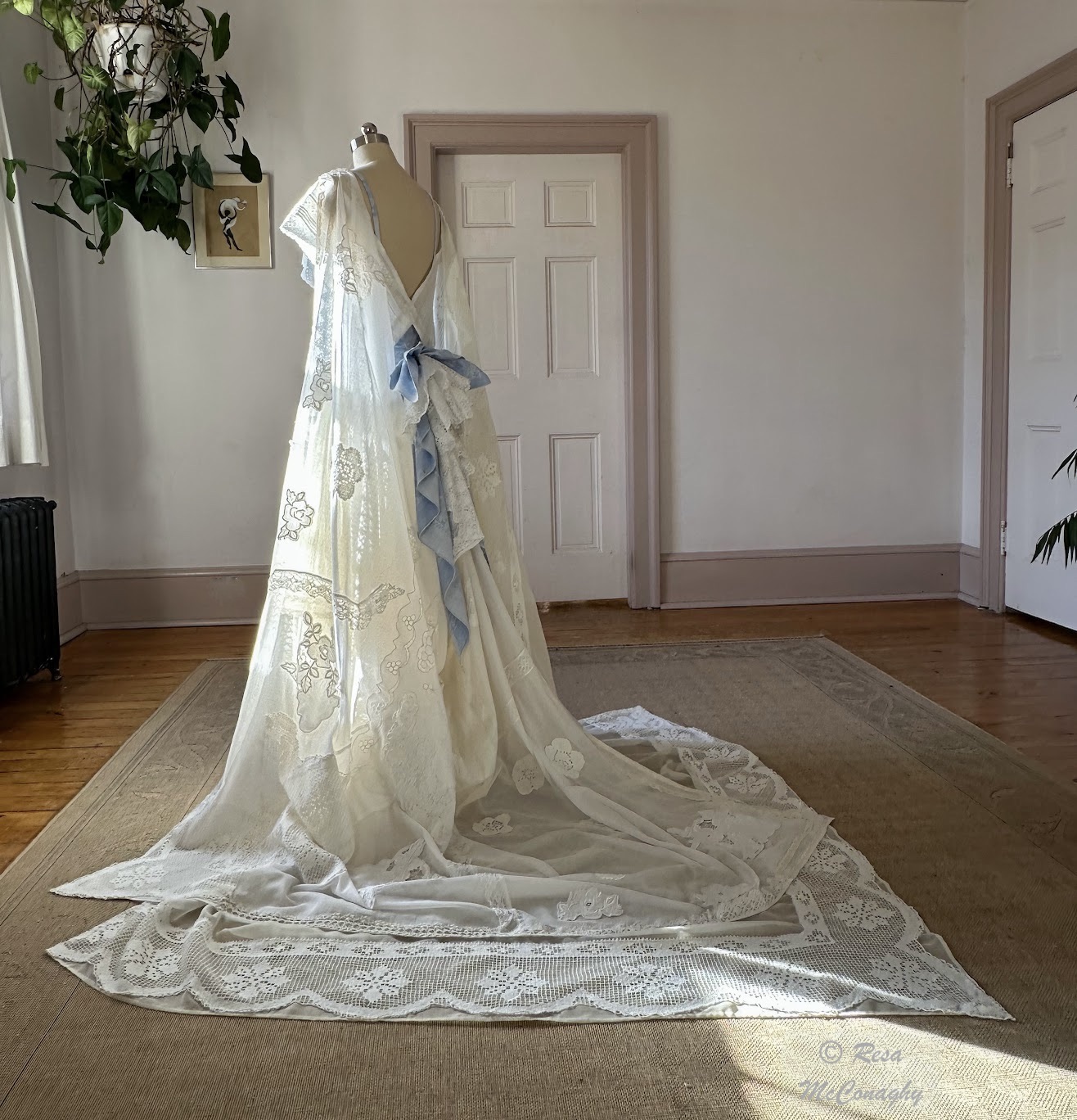
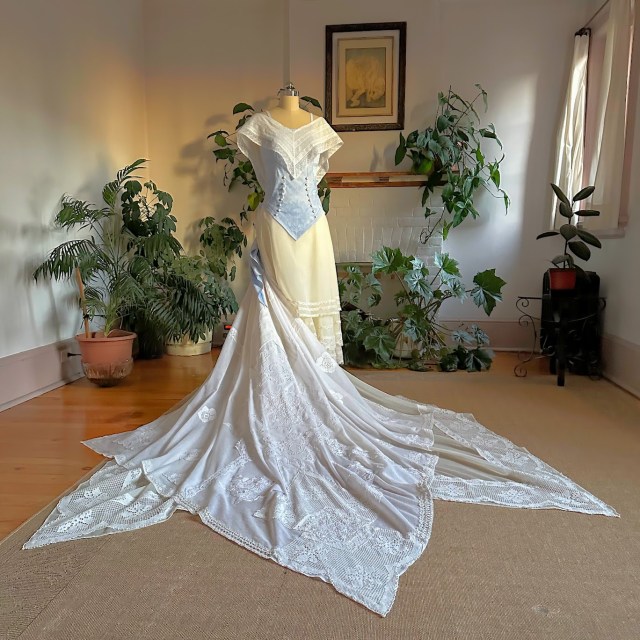
After washing, the sheer was cut into a 3 tiered overskirt, and trimmed with the lace yardages. The sheer makes a solid backing that fortifies the antique laces.
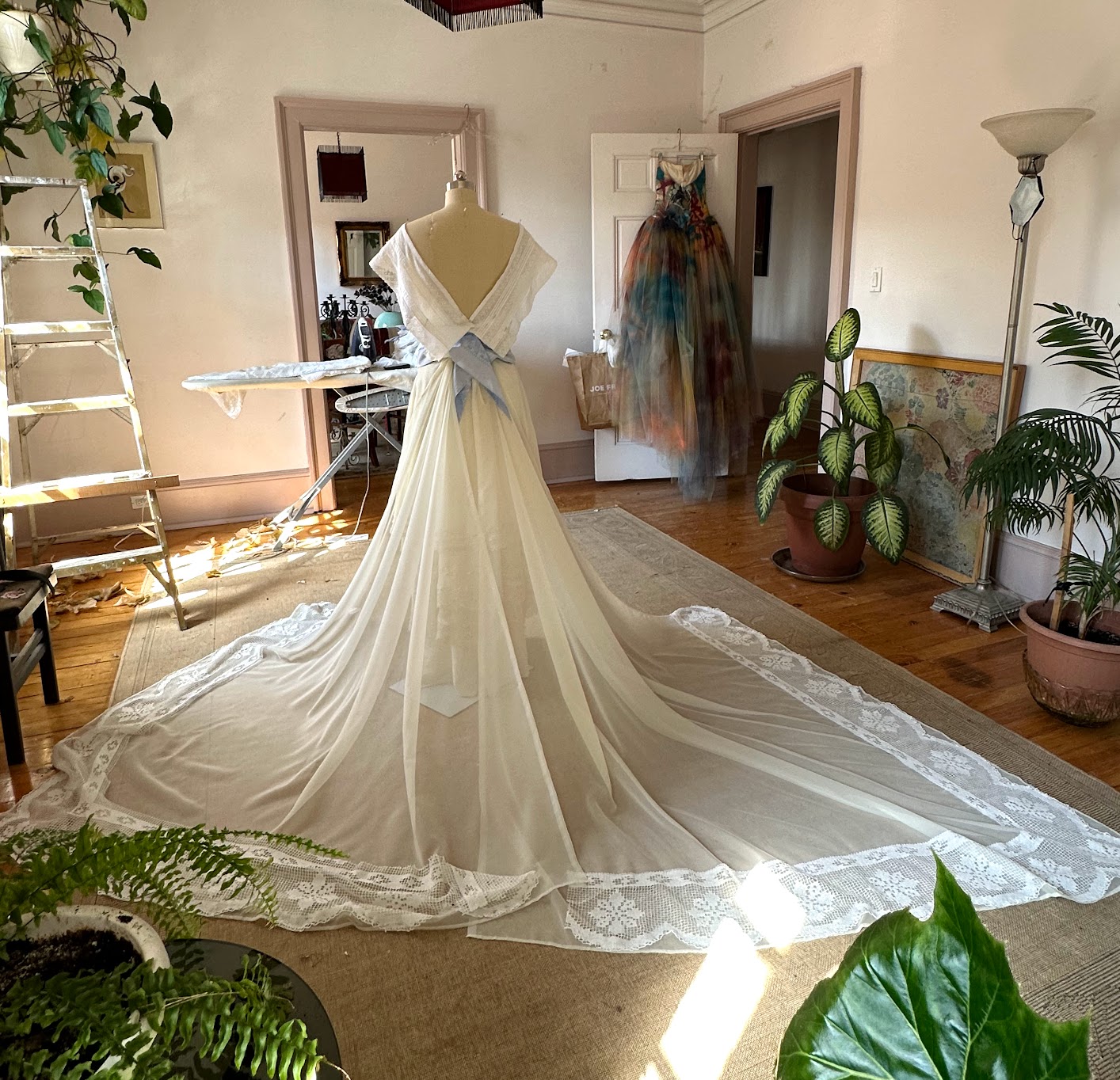

Two side tails were draped in bias from the sheer, then trimmed with edges cut from the lace tablecloth.
A third centre tail was draped from the mosquito netting on bias. This tail was trimmed with the last of the lace yardages. It was then filled in with geometrically placed doilies, table covers and bits of cut up lace edgings.
A bussel was formed from blue serviettes that matched the bodice’s tablecloth, and eyelet lace trim from the second bed jacket.
Vintage hand covered buttons adorn the bodice.

She’s so beautiful, I went overboard taking pics.

OUTTAKES
November, 2023 – The 2 boxes arrived, from Diana. Lilac Fan Dance was still in the making. I knew Diana was mid book. In May, 2024 Victorian Sonnet was begun. 6+ months later, the gown and Diana’s book – Tale of the Seasons’ Weaver – were finished, more or less at the same time.
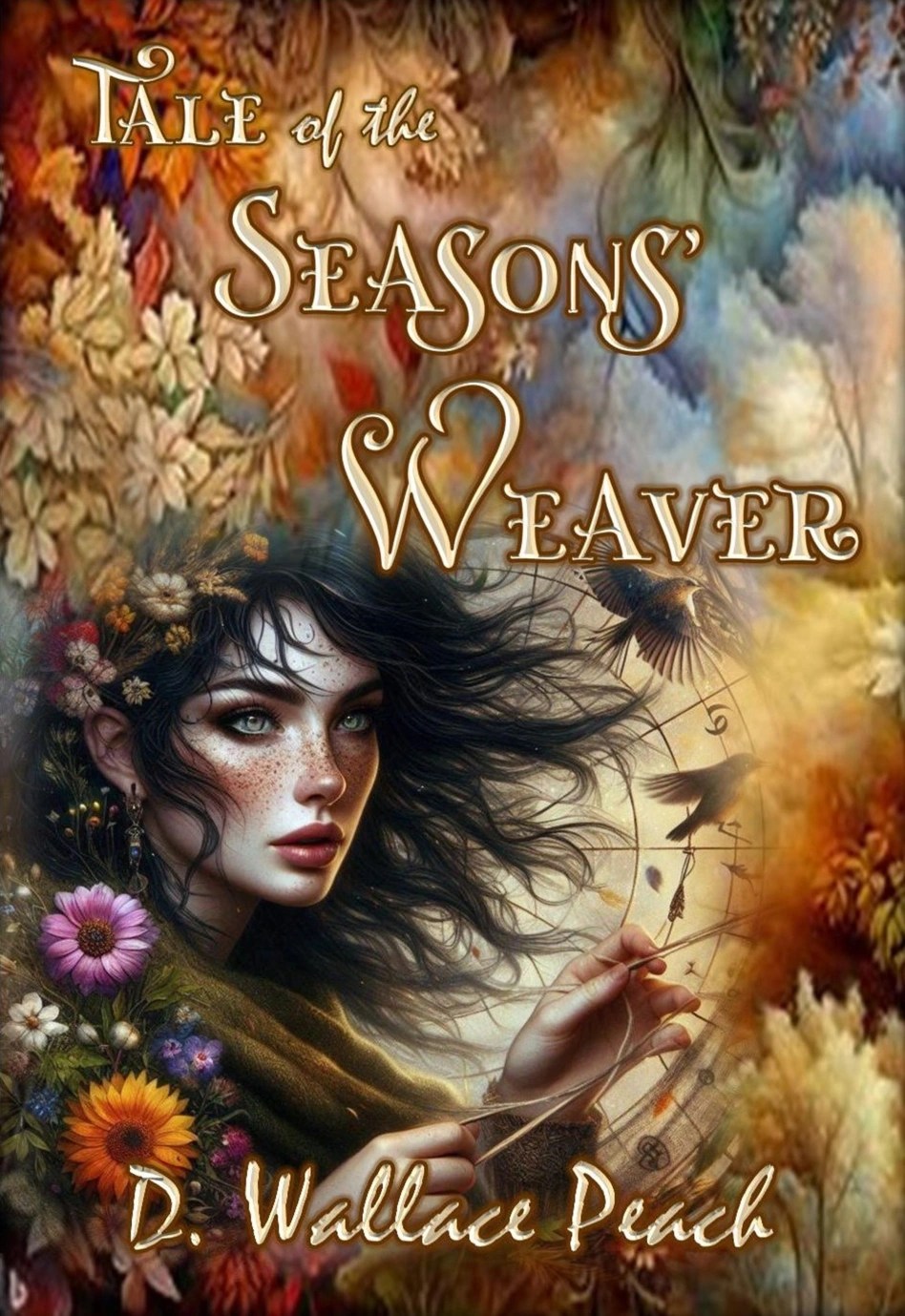
Available exclusively on AMAZON – Worldwide

How is an art gown like a good book?


You hate it to end!

HAPPY NEW YEAR!


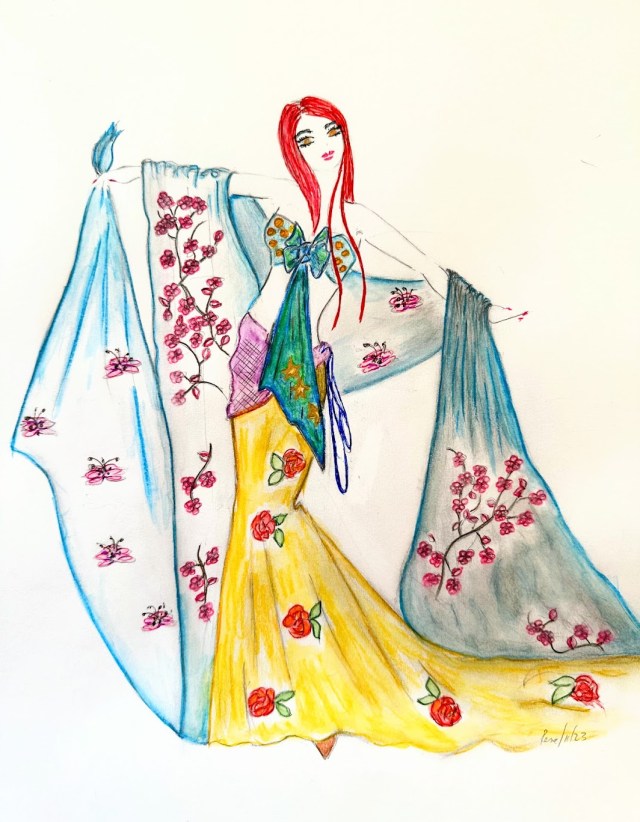

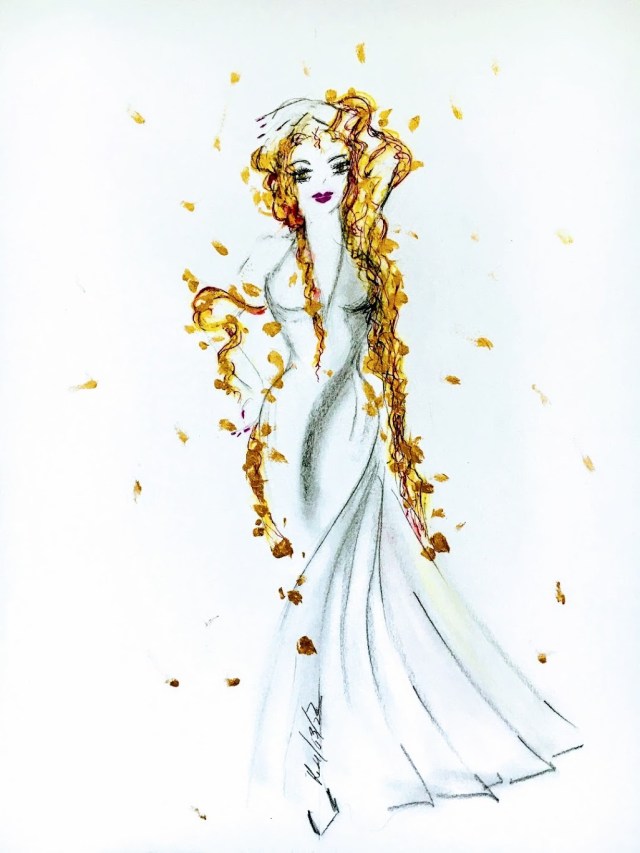
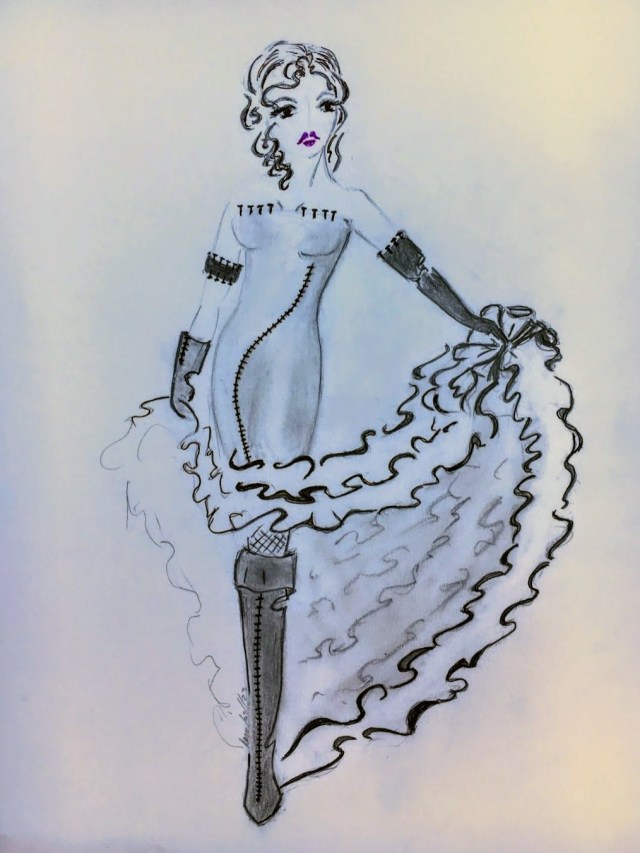


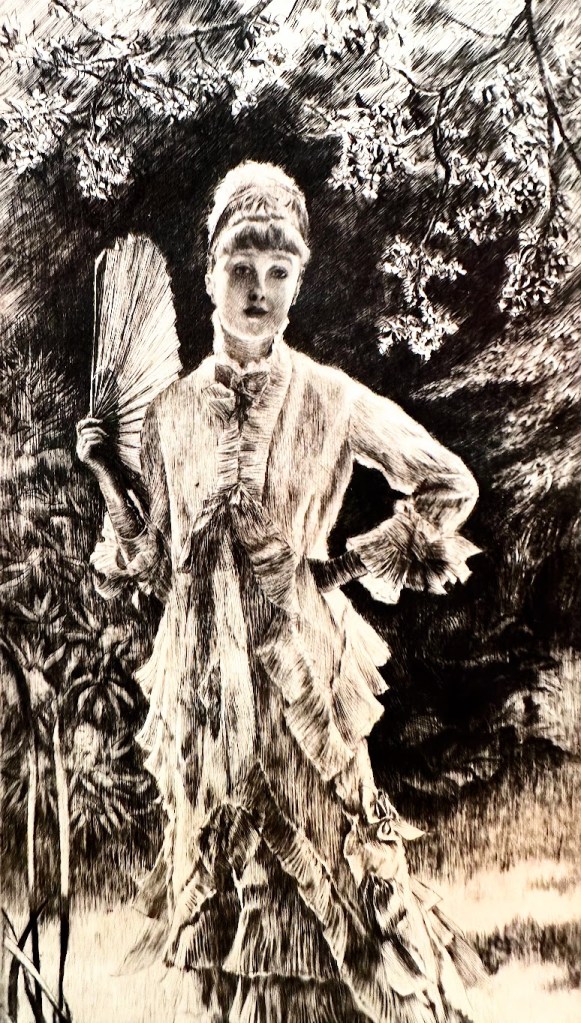
























 Art Gowns
You must be logged in to post a comment.