Lo, in the east is a glamour and gleam,
Like waves that lap on the shores of a dream,
Or voice their lure in a poet's theme!
                                                                     - L.M. Montgomery
Maple Moonrise is a neo-goddess; Canadian born simultaneously on the Pacific beaches of British Columbia and Atlantic shores of Prince Edward Island.
Maple Moonrise throws her beams on the all of the arts: poetry, story telling, painting, drawing, music, dance, sculpture, and more.
She decrees – Make Art not War!
It is in this spirit of arts appreciation, and a desire for Peace on Earth, that she is dedicated to Rebecca Budd.
The Making Of
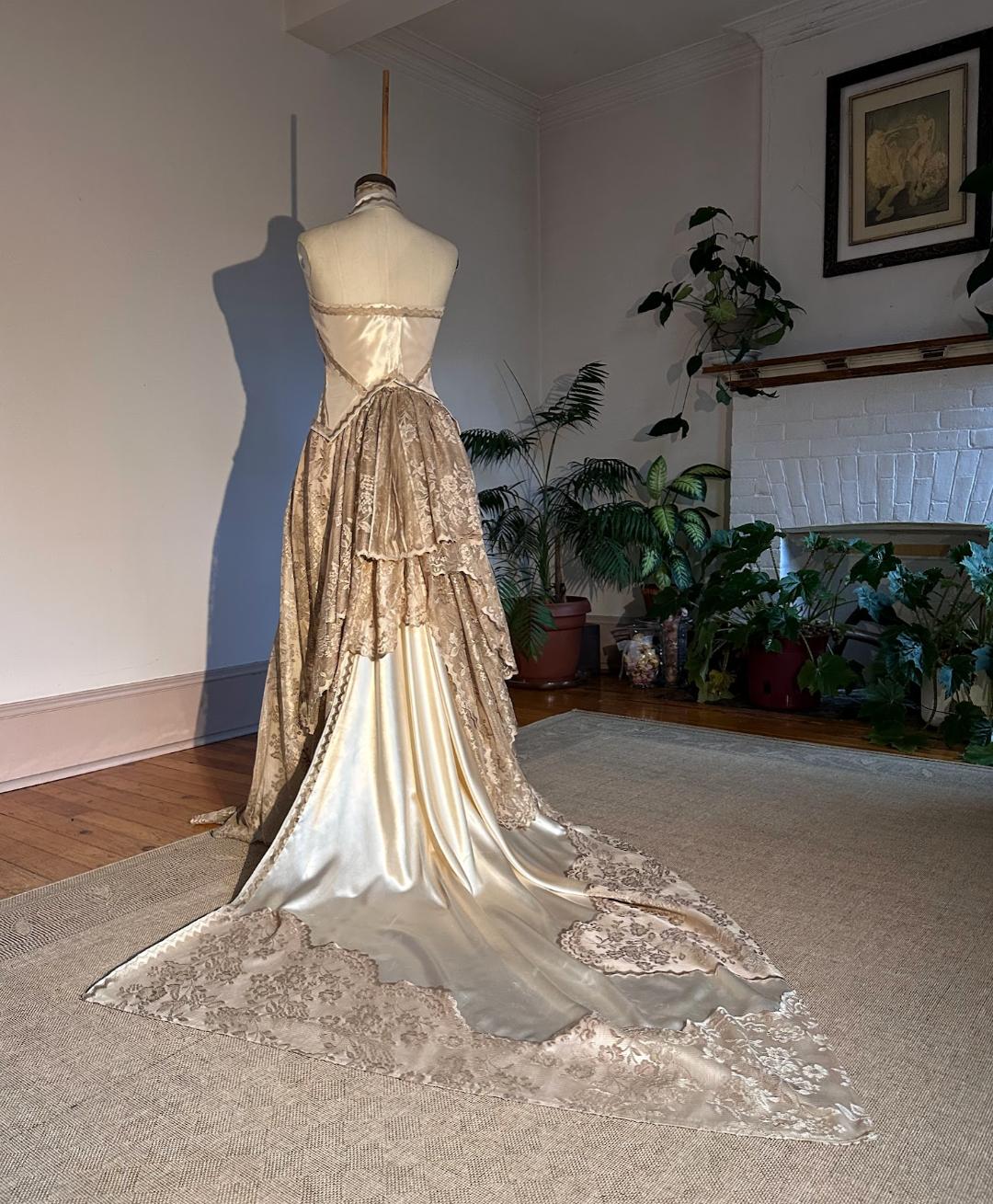
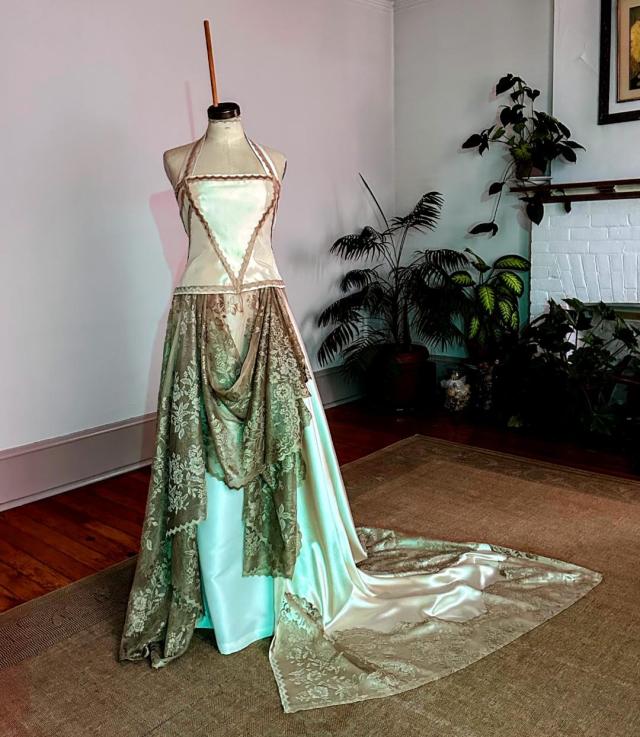
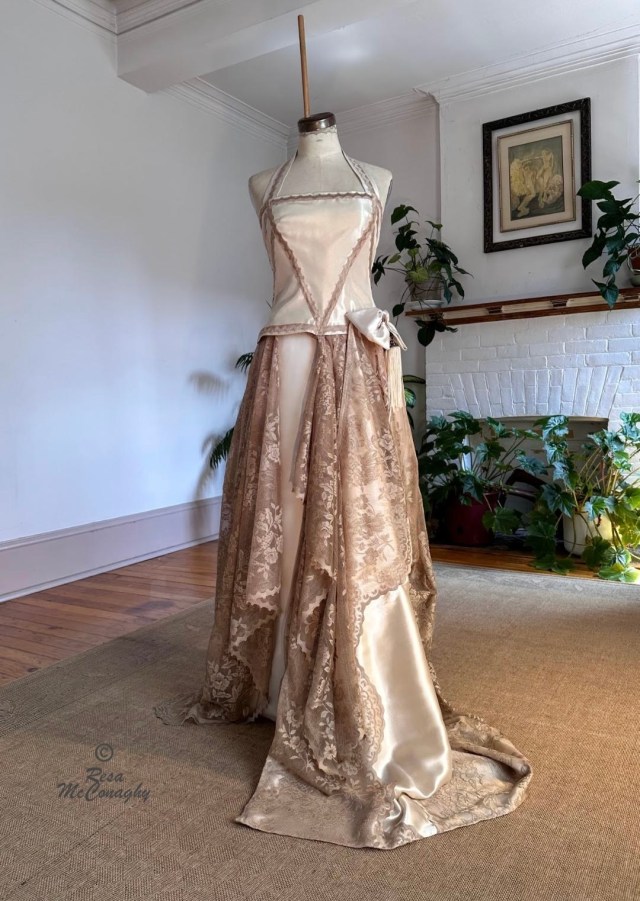
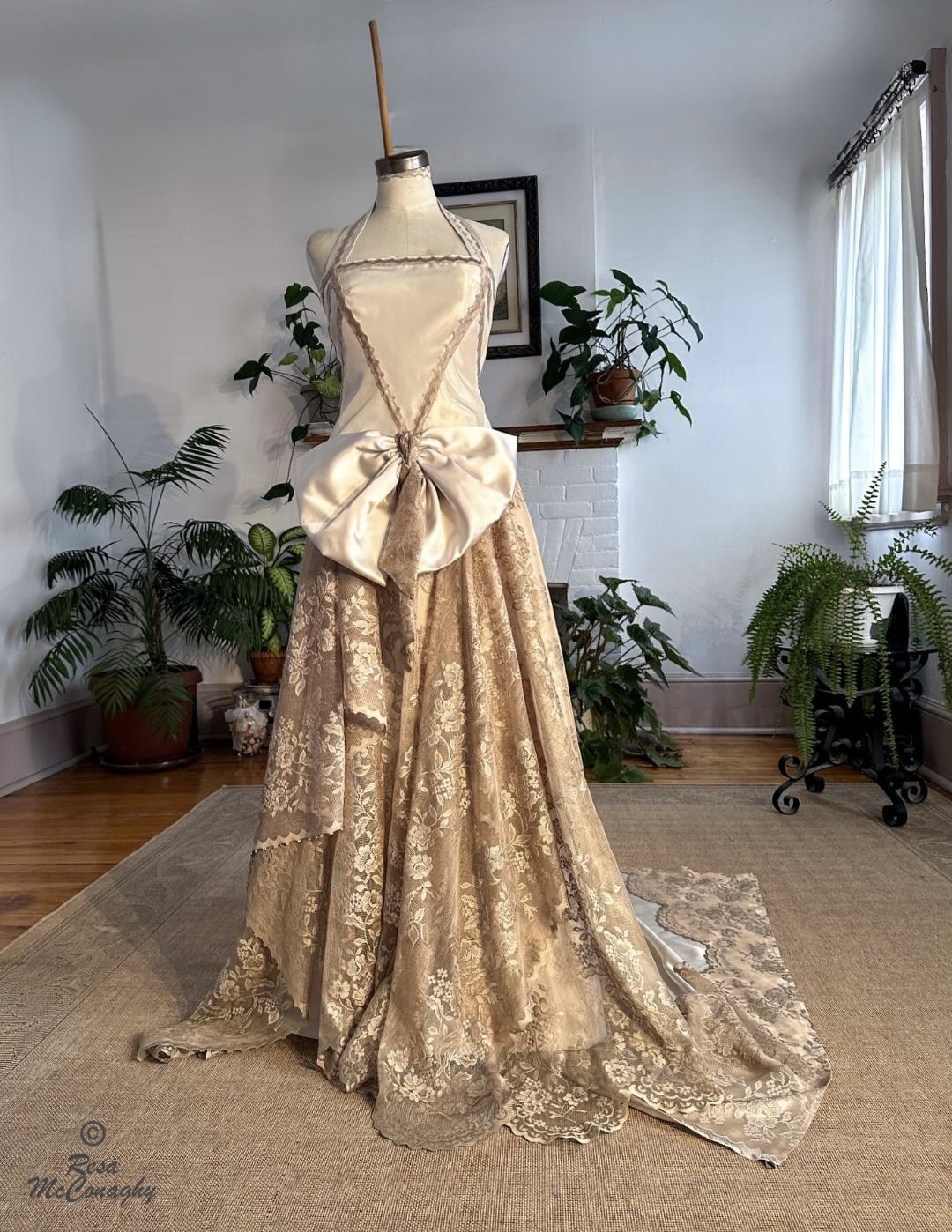
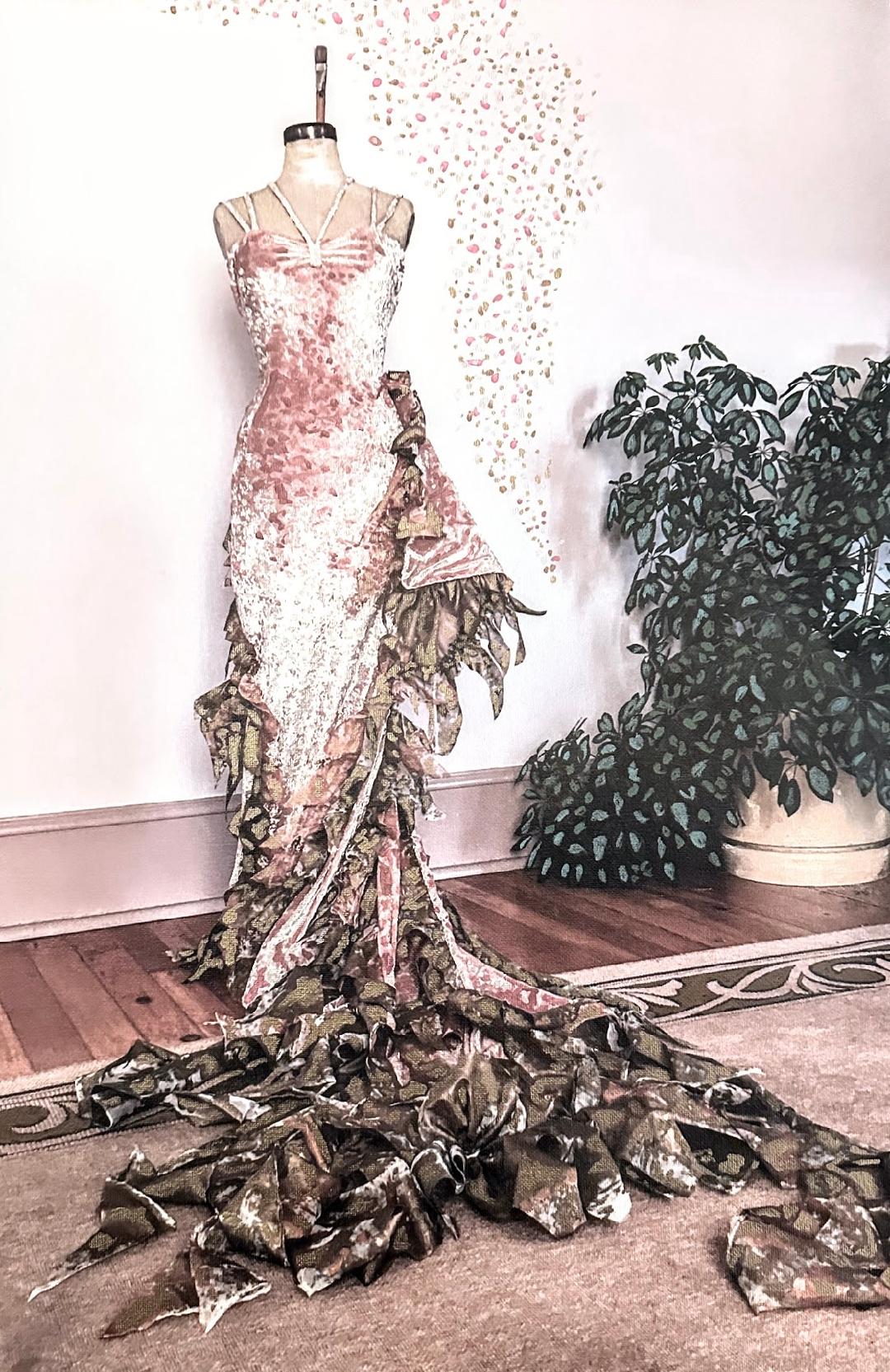
It began when I opened a gift box & found 4 massive lace curtains. From the colour, fabric & finish, I’d date it mid-late 70’s.
The box arrived while I was preparing the post – La Belle Époque .
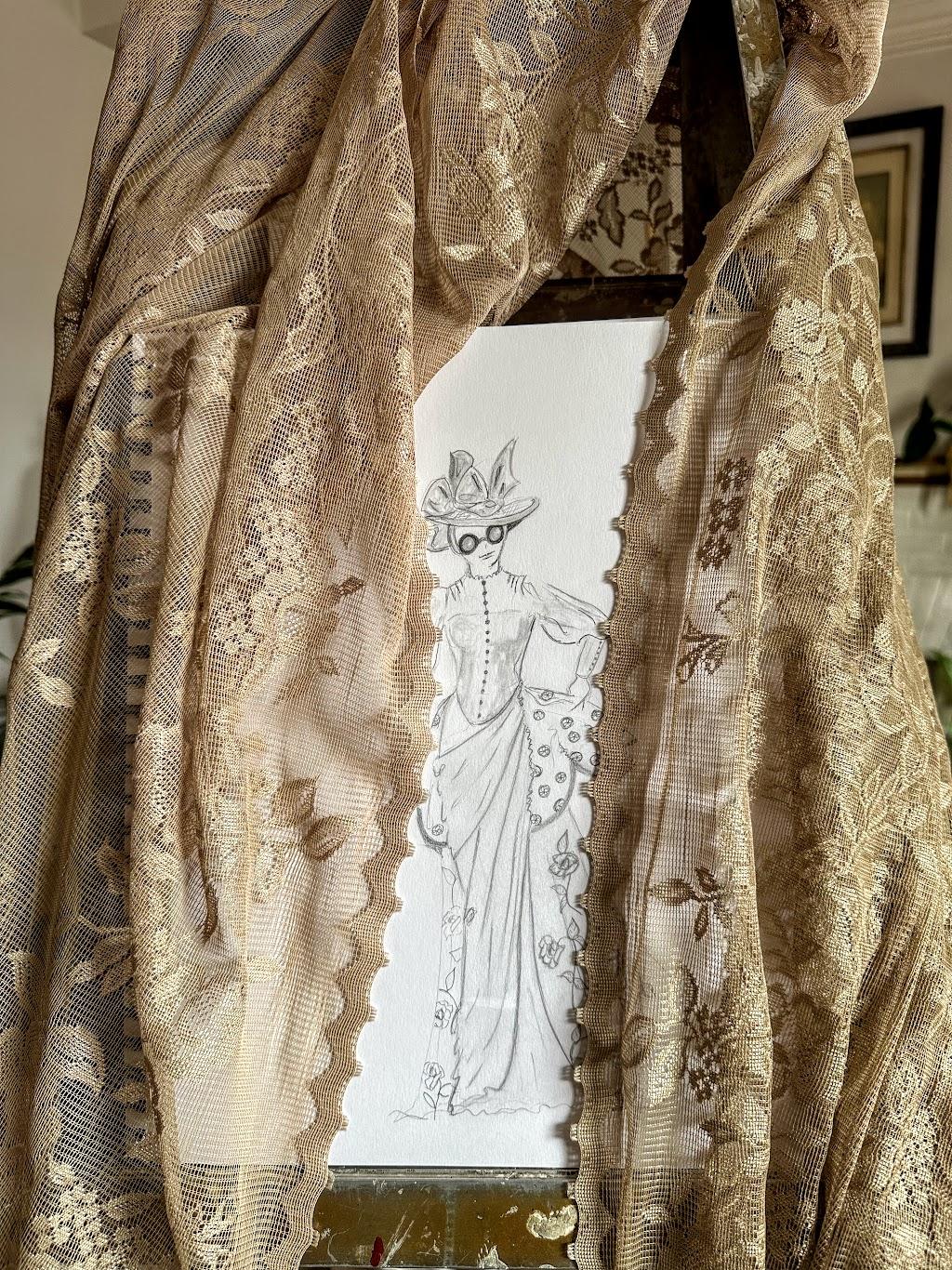
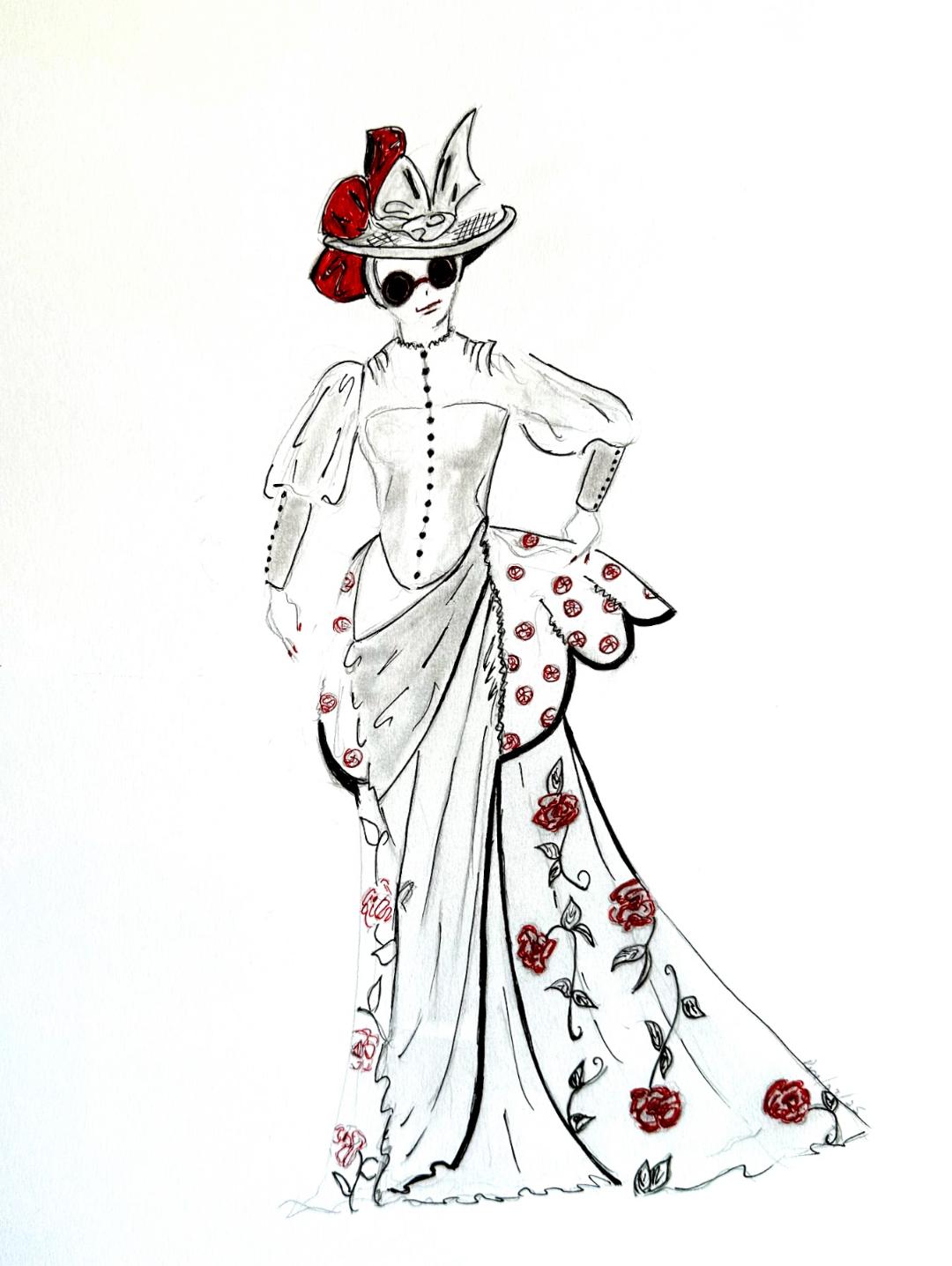
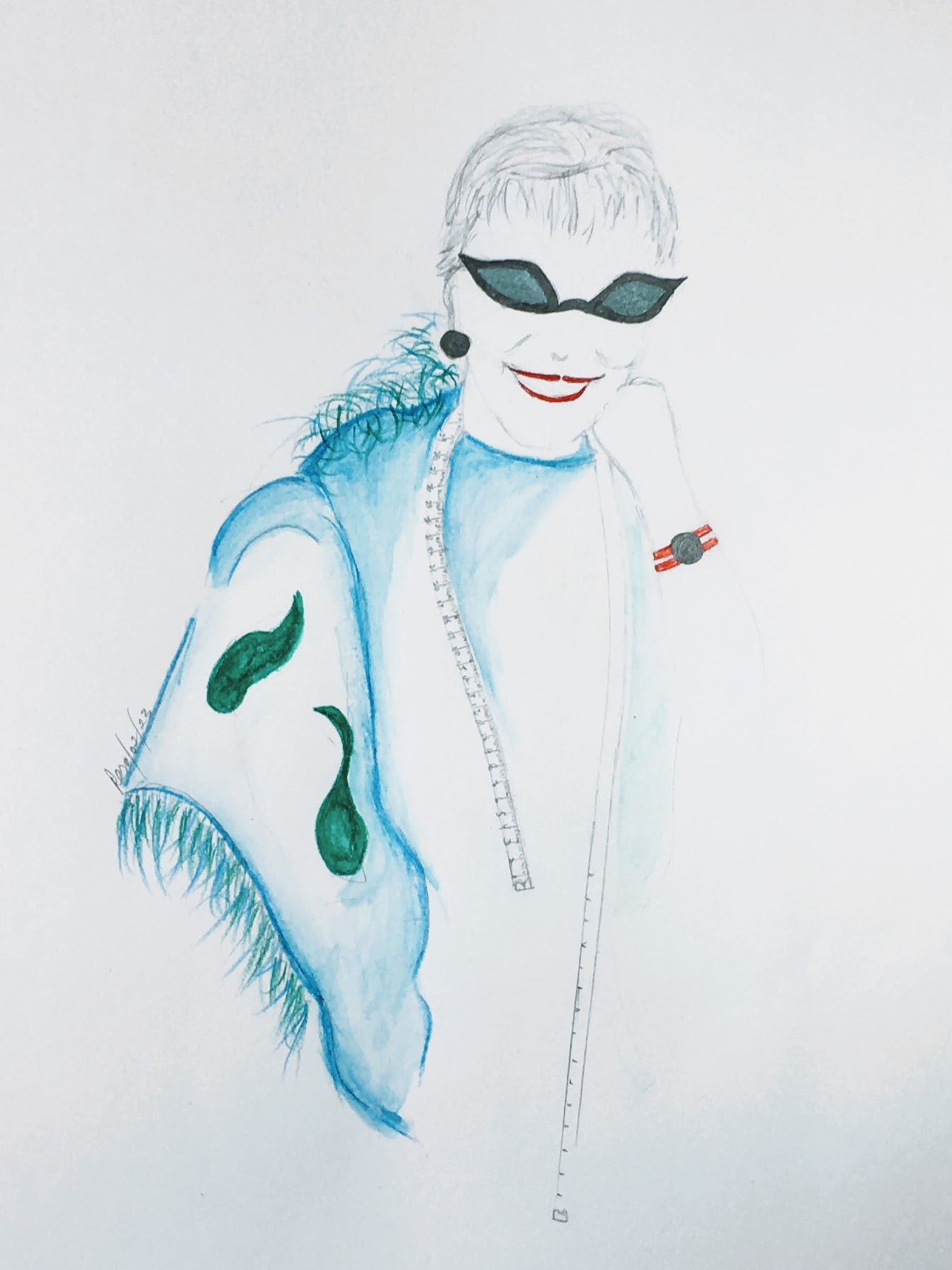
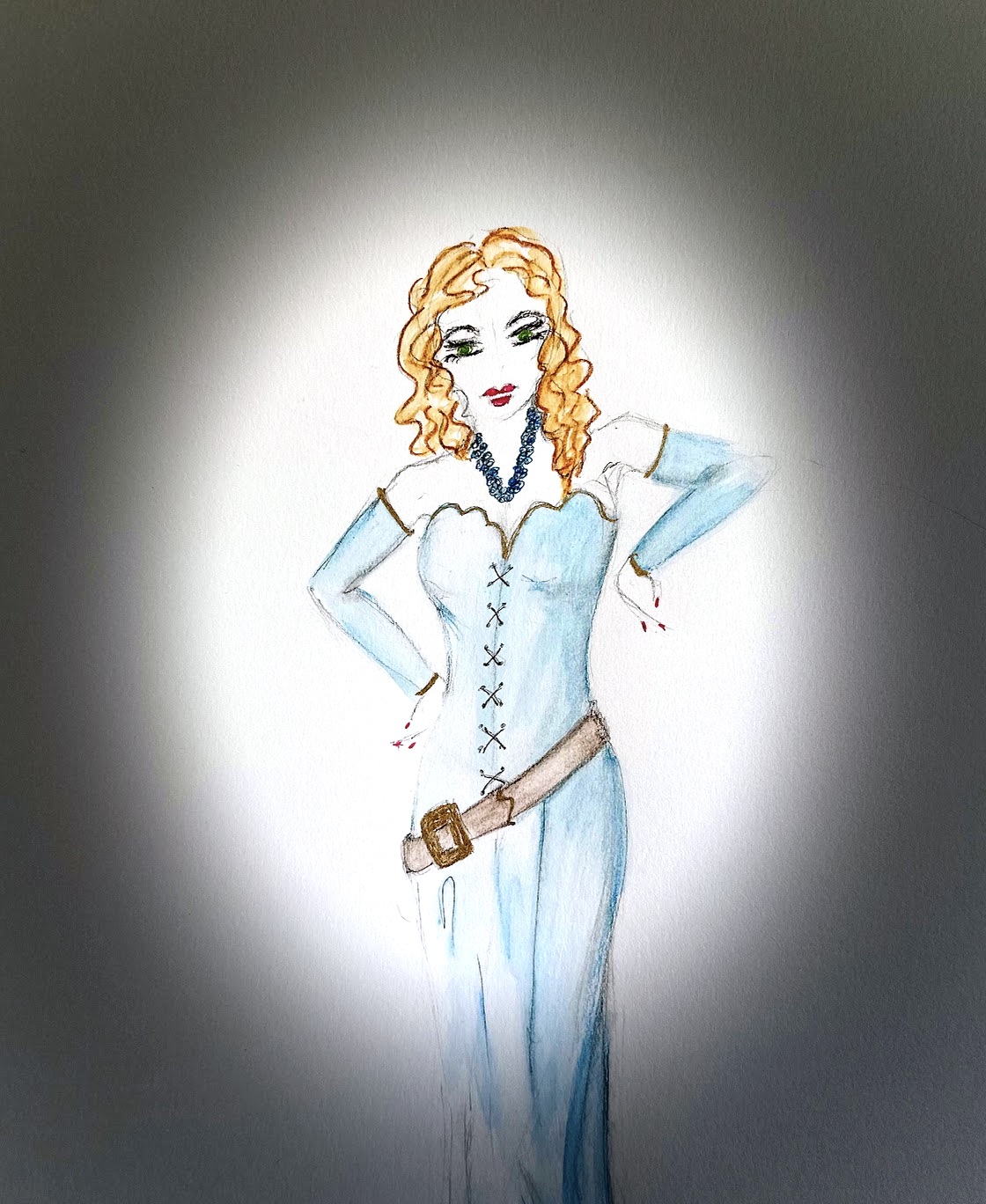
The drawing of Rebecca I was working on came to mind. The fabric was draped over it, a pic was taken and an Art Gown idea was born.
As you can see, the fabric arrived after the sketch was done, but before the colour was added.
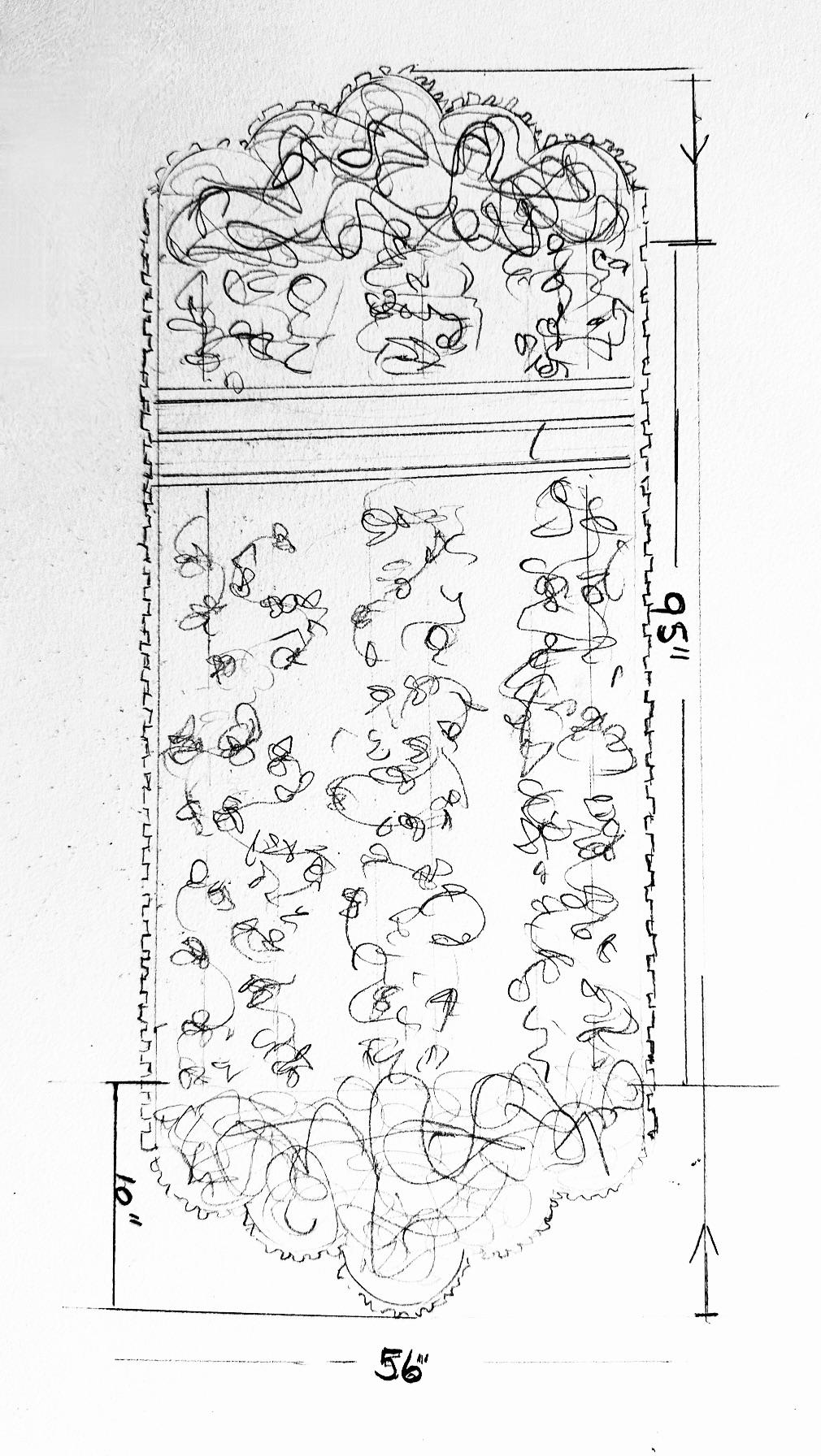
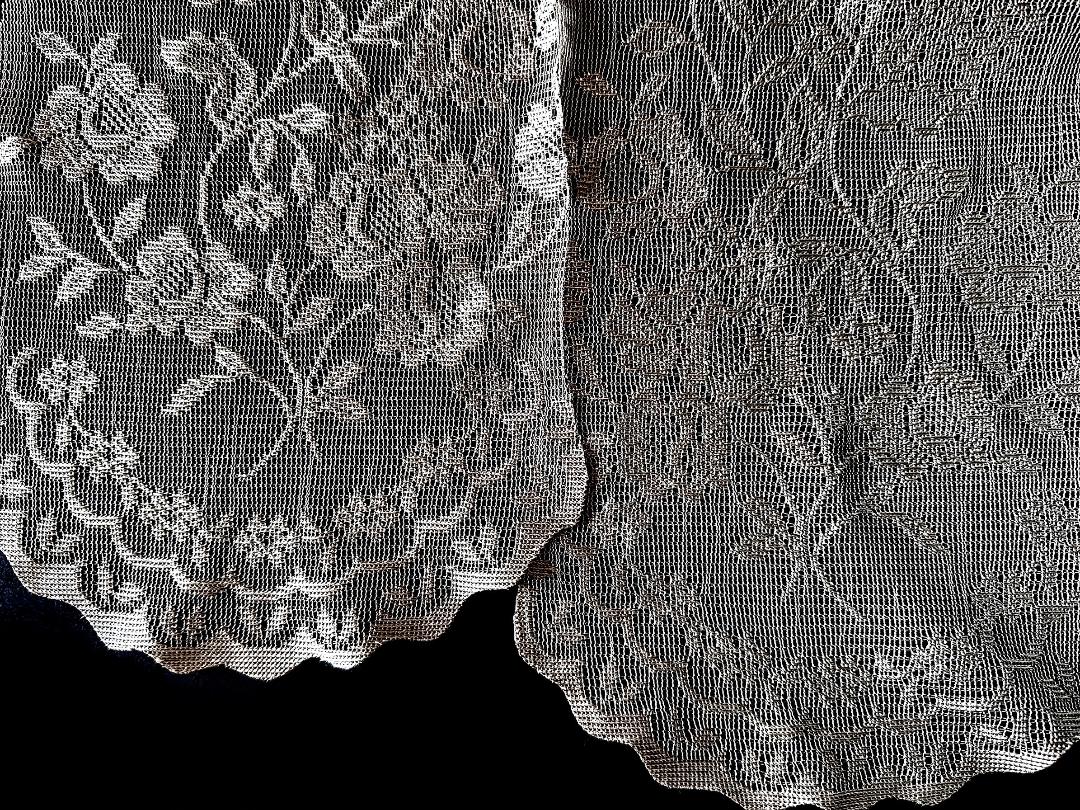
There were 4 panels, all the same. They were 56″ wide & at the deepest points 115′ long.
As you can see from the drawing of the panels, there are no cut ends, so these pieces were custom woven.
Selvages were woven into a geometric picot.
The ends were scalloped. The scallops were scalloped. The lace is a floral repeat pattern, not overall. There’s a mesh type drop out with 3 solid lines at about the 3/4 point.
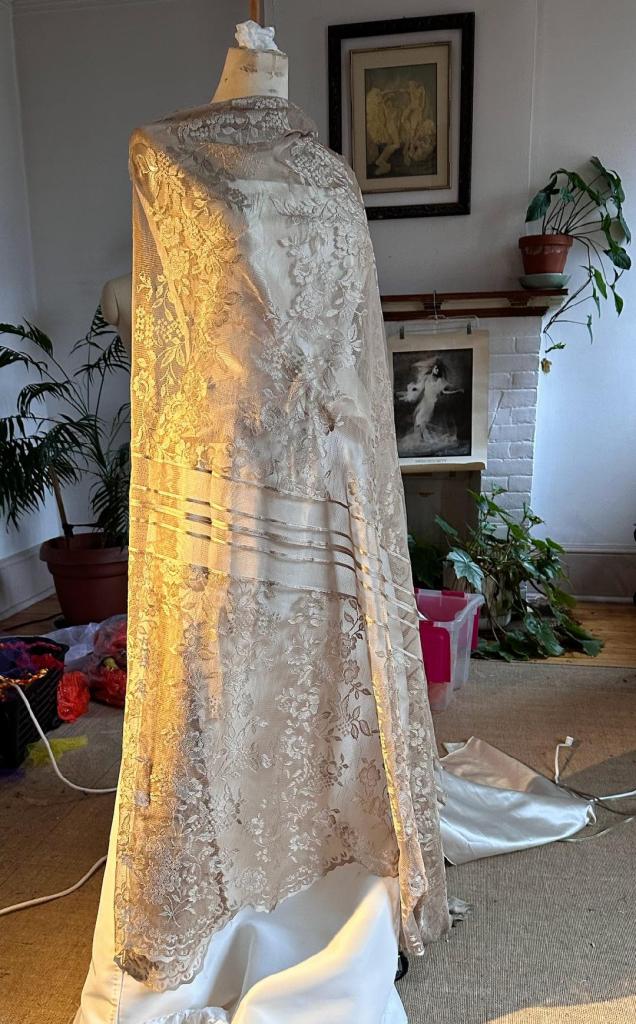
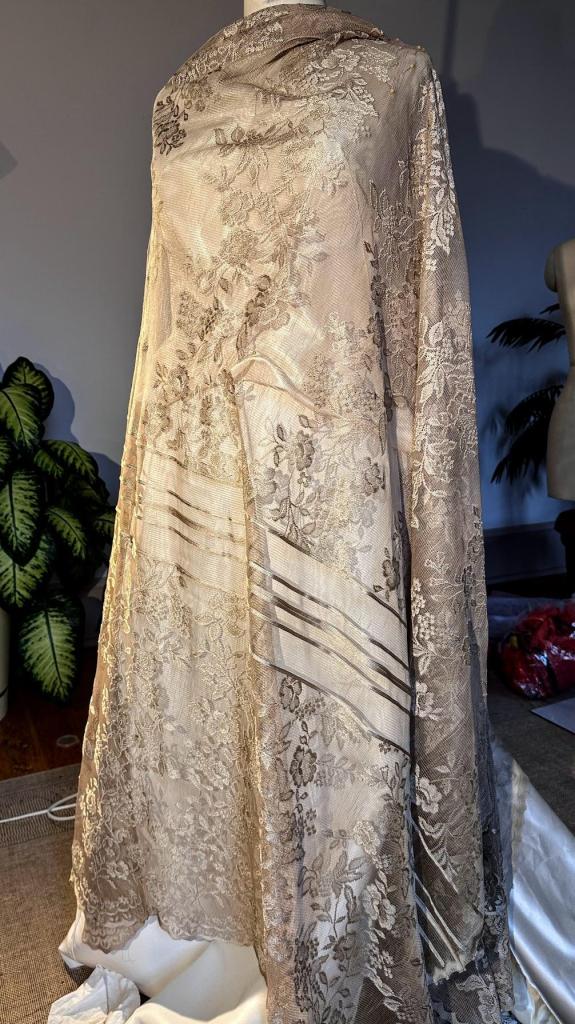
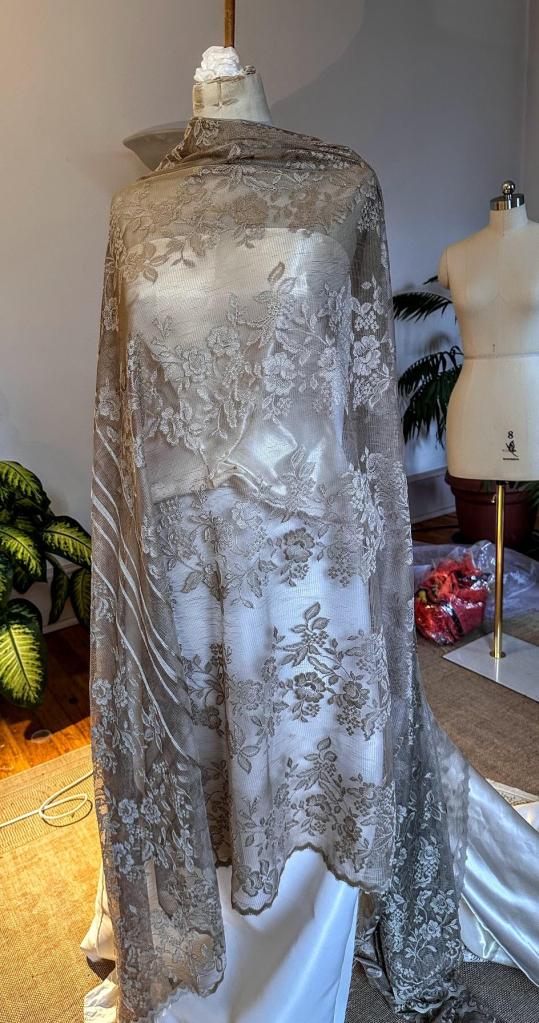
The fabric was one sided. Although the pattern showed on both sides, when light hit – one side shone, the other died.
There were several pieces of older, varying in shades of white, acetate satin & one piece of nasty modern poly satin in the stash baskets.
Those were pinned to Judy and the lace was thrown on top.
Test shots were taken.
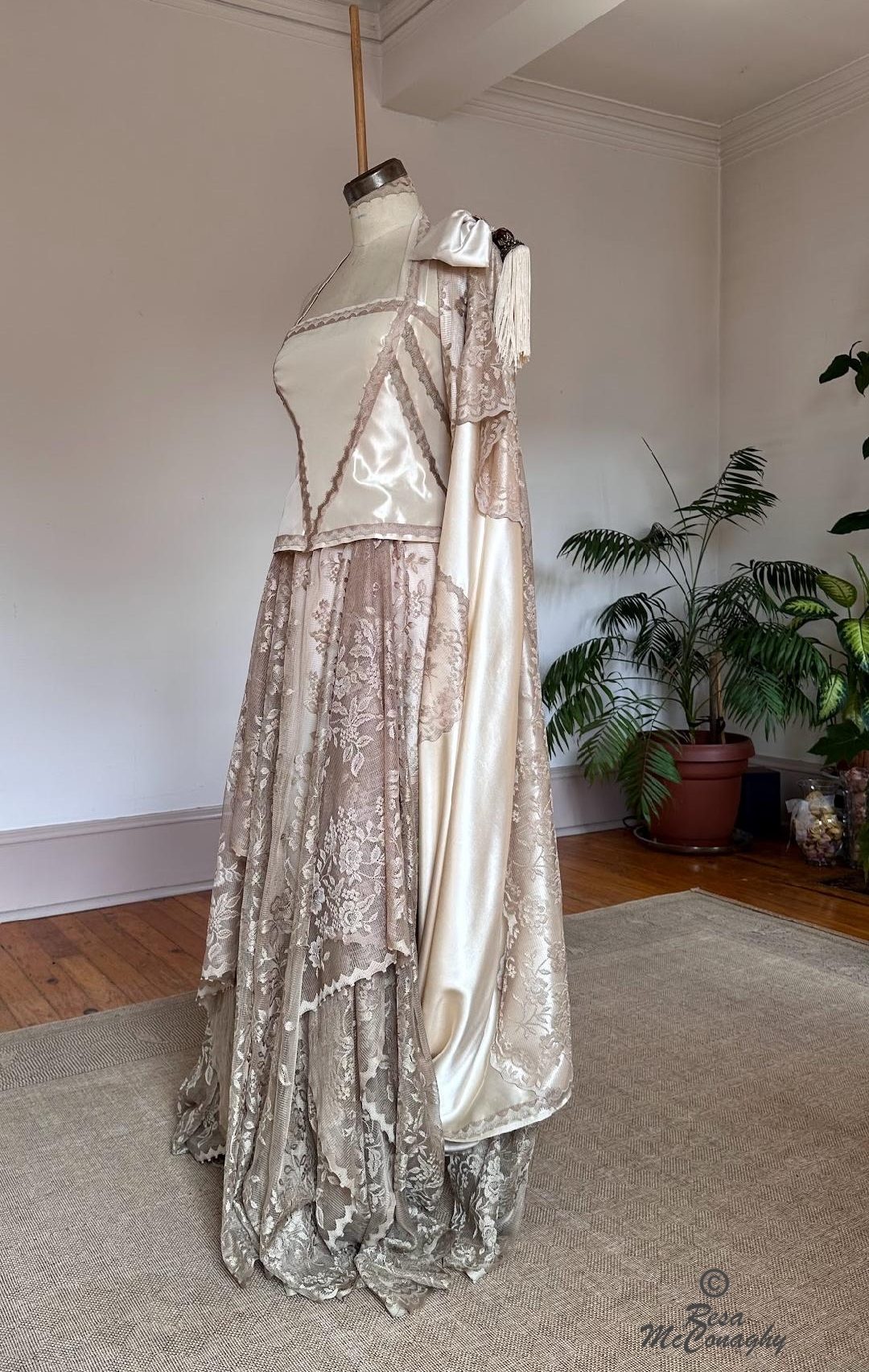
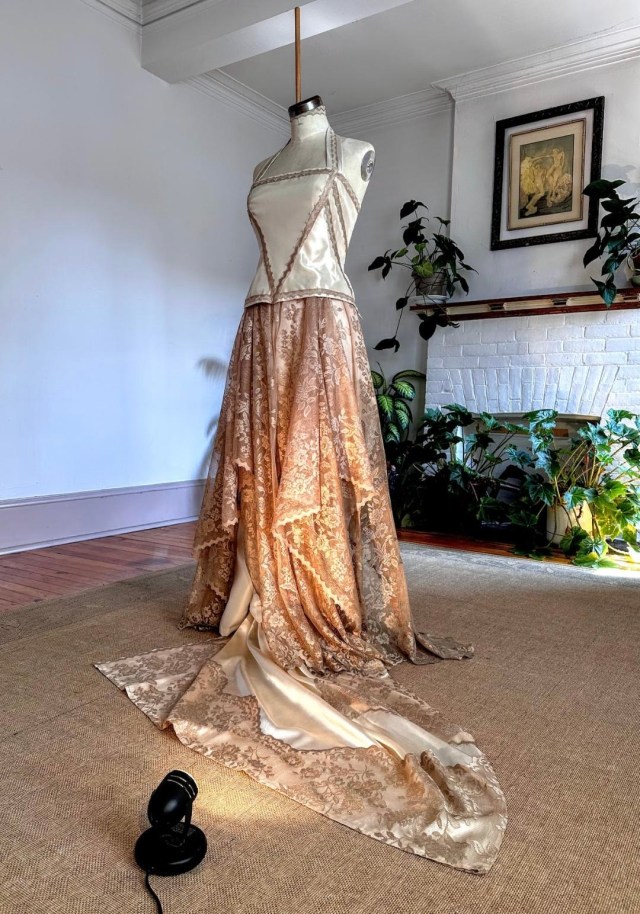
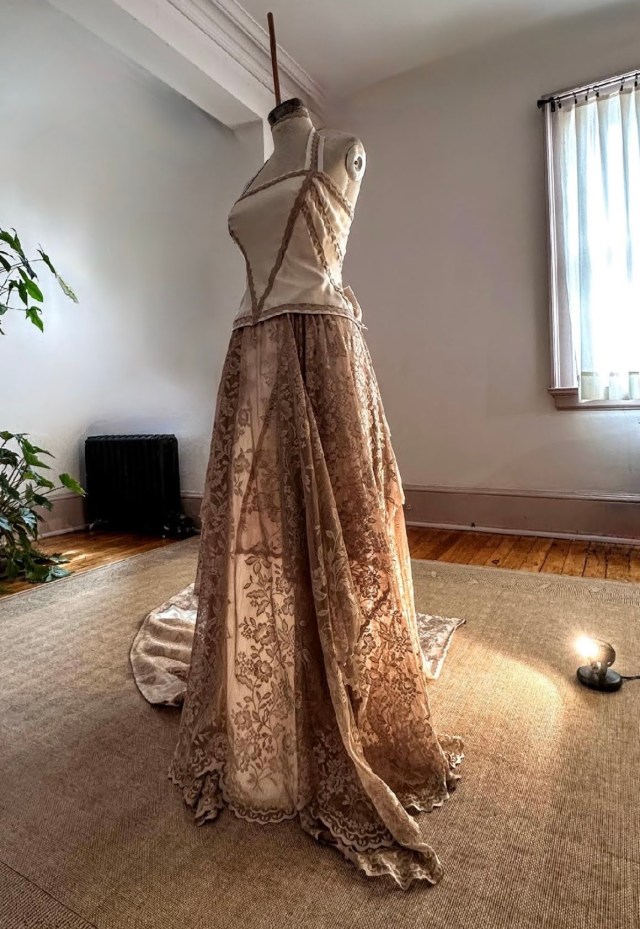
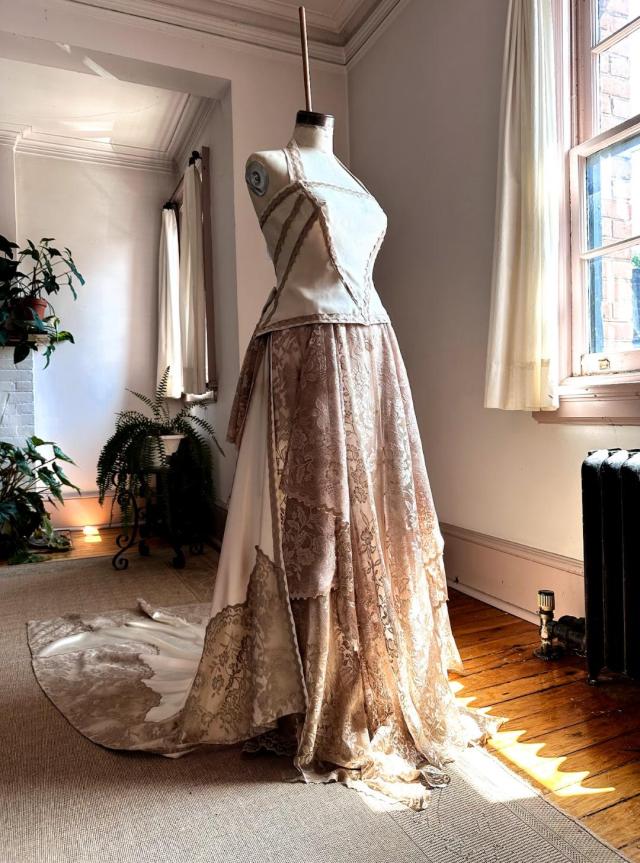
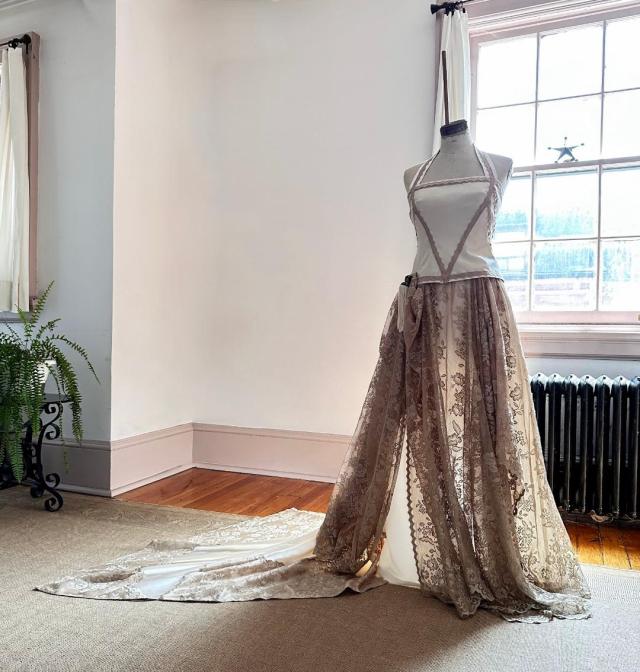
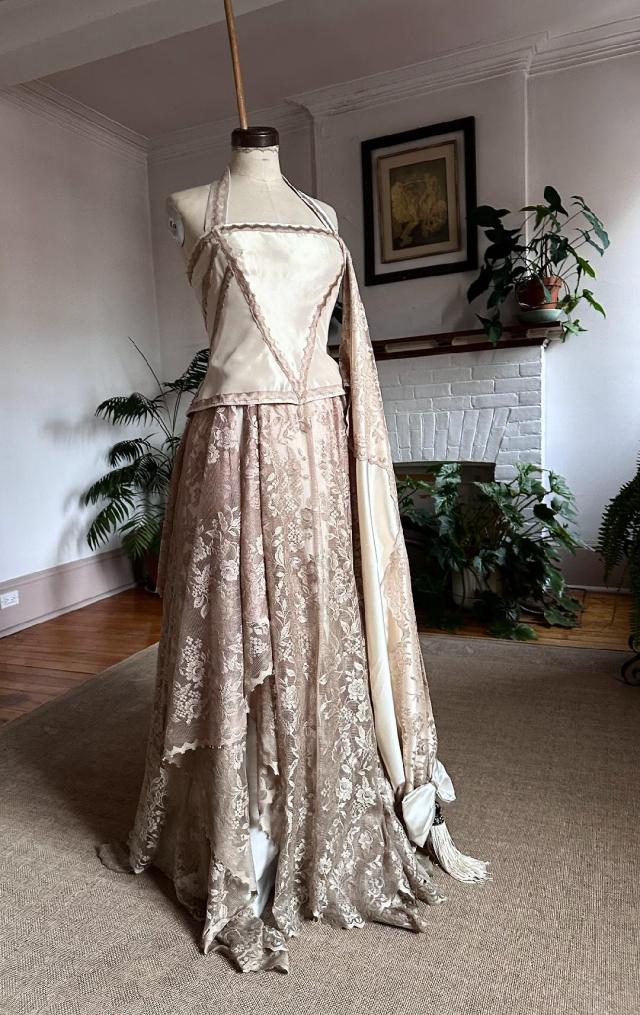
Sometimes the lace lit like various shades of maple syrup: a light golden to dark brown to shades of reddish brown.
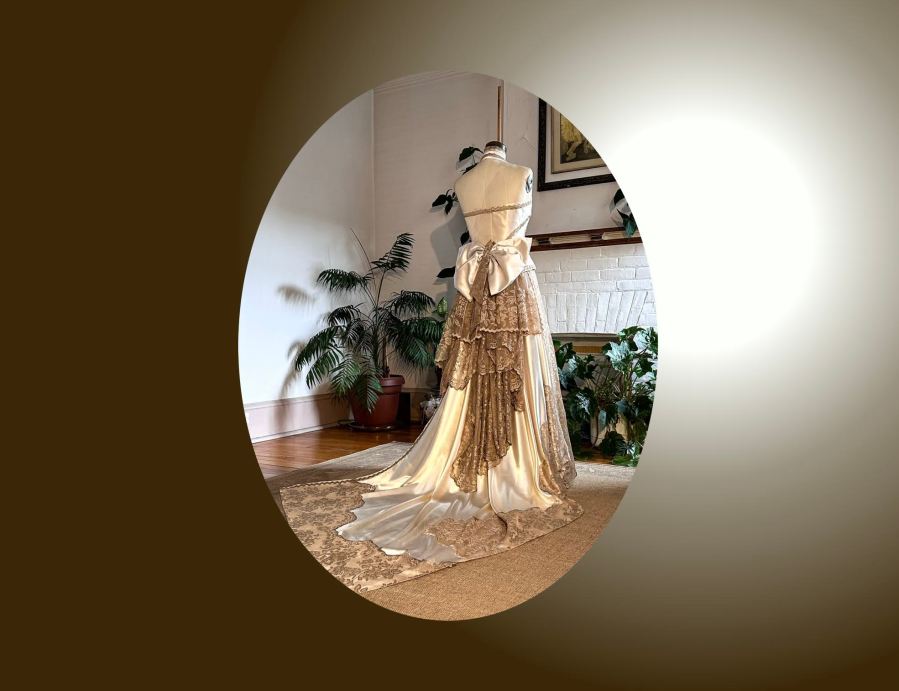
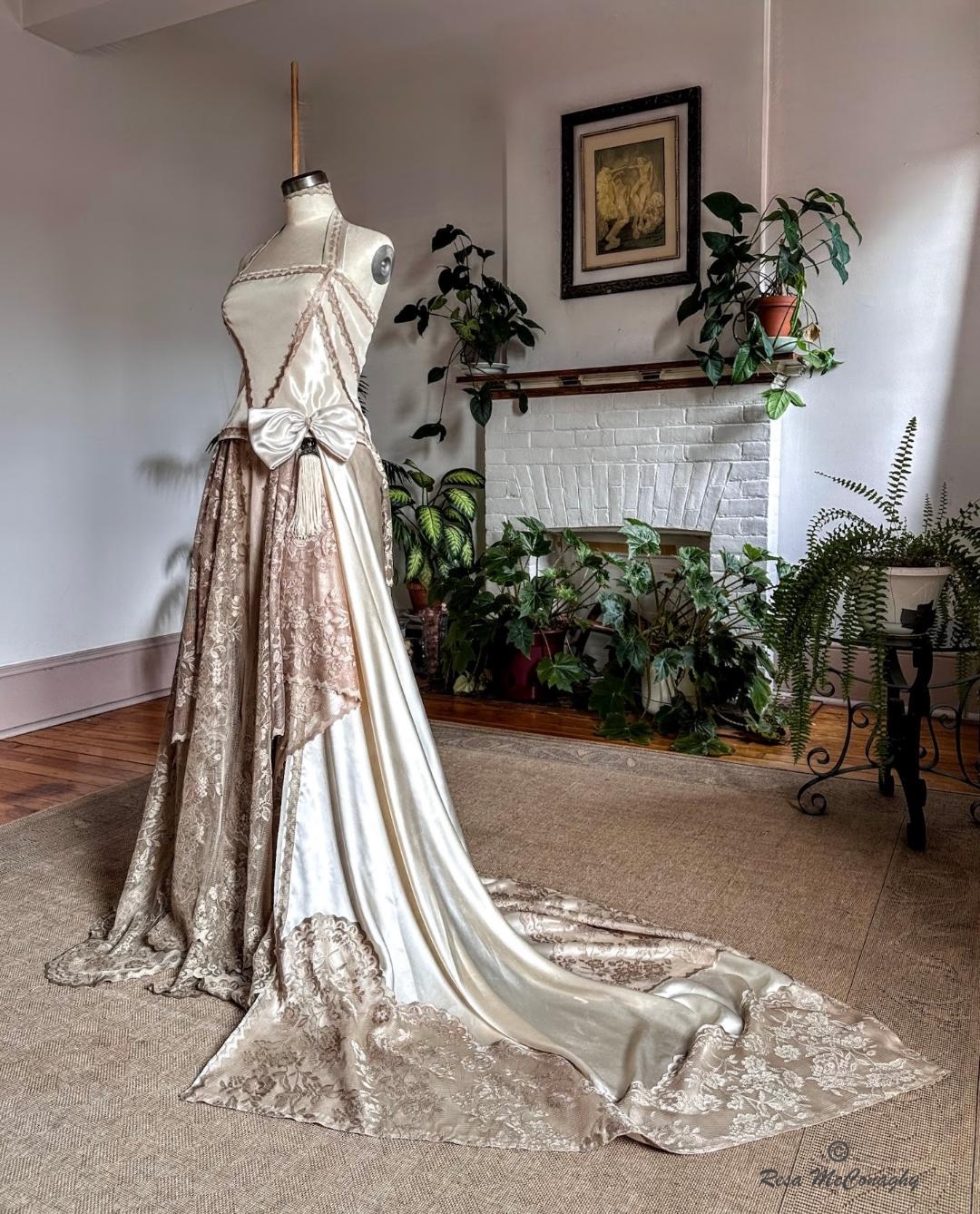
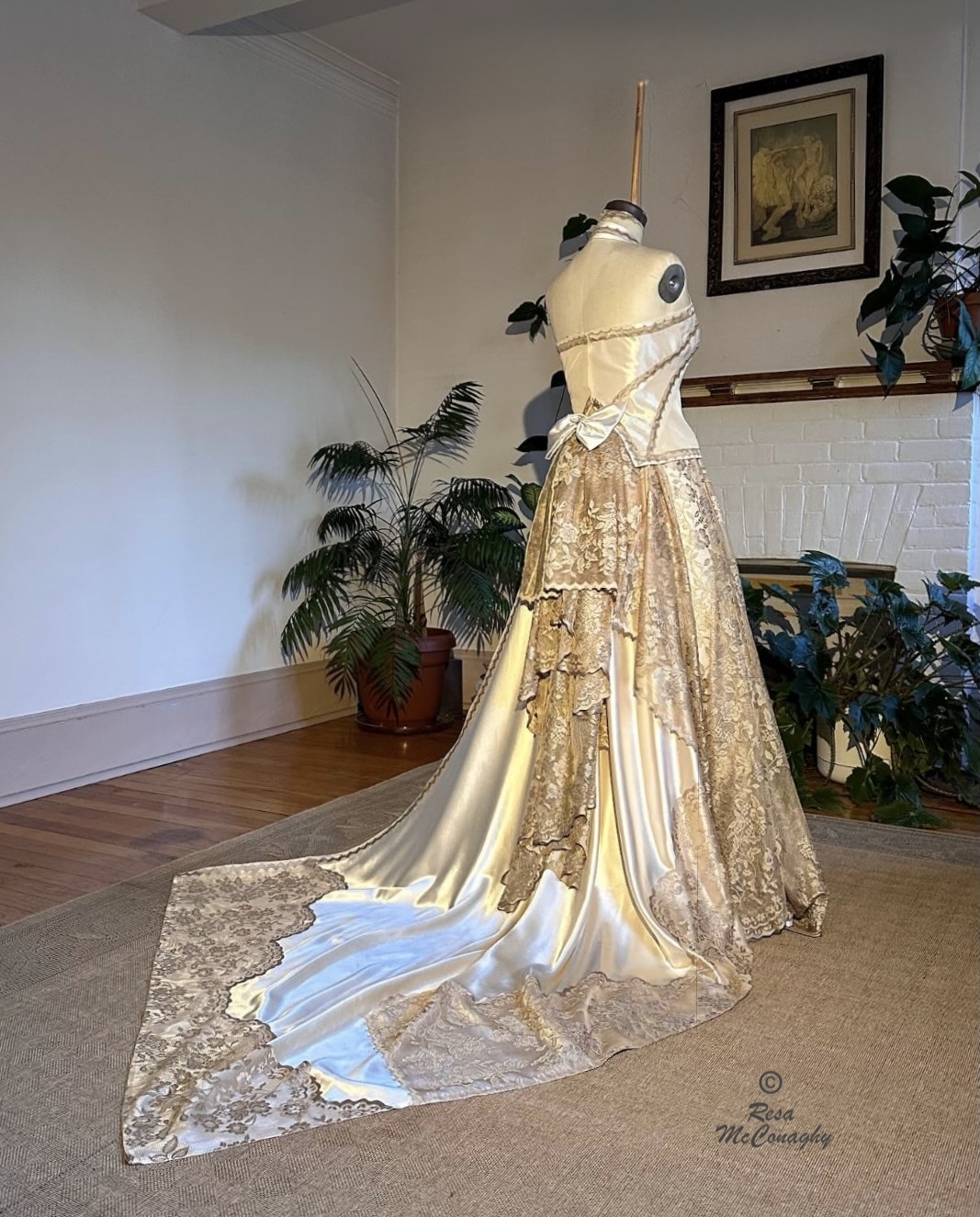
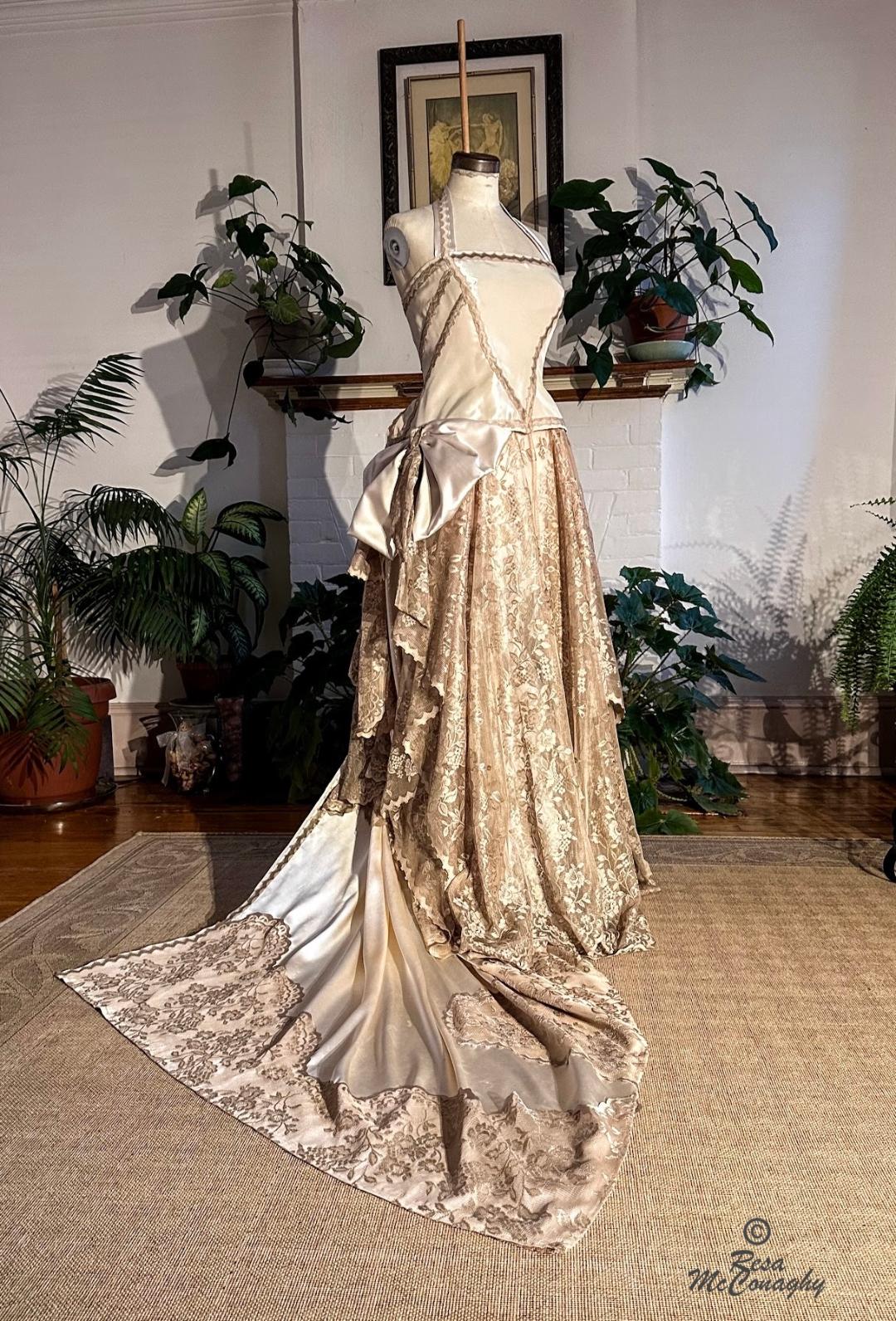
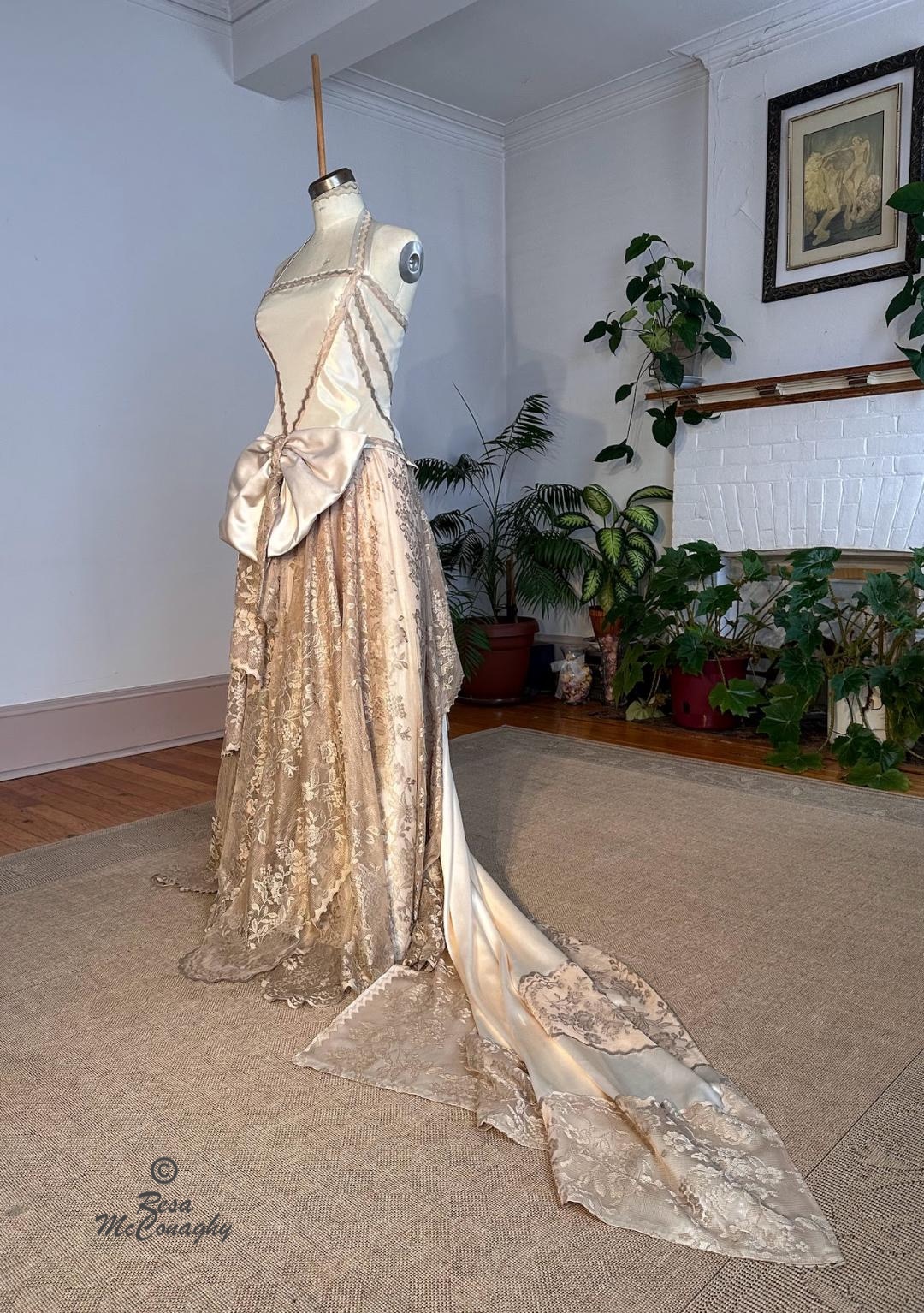
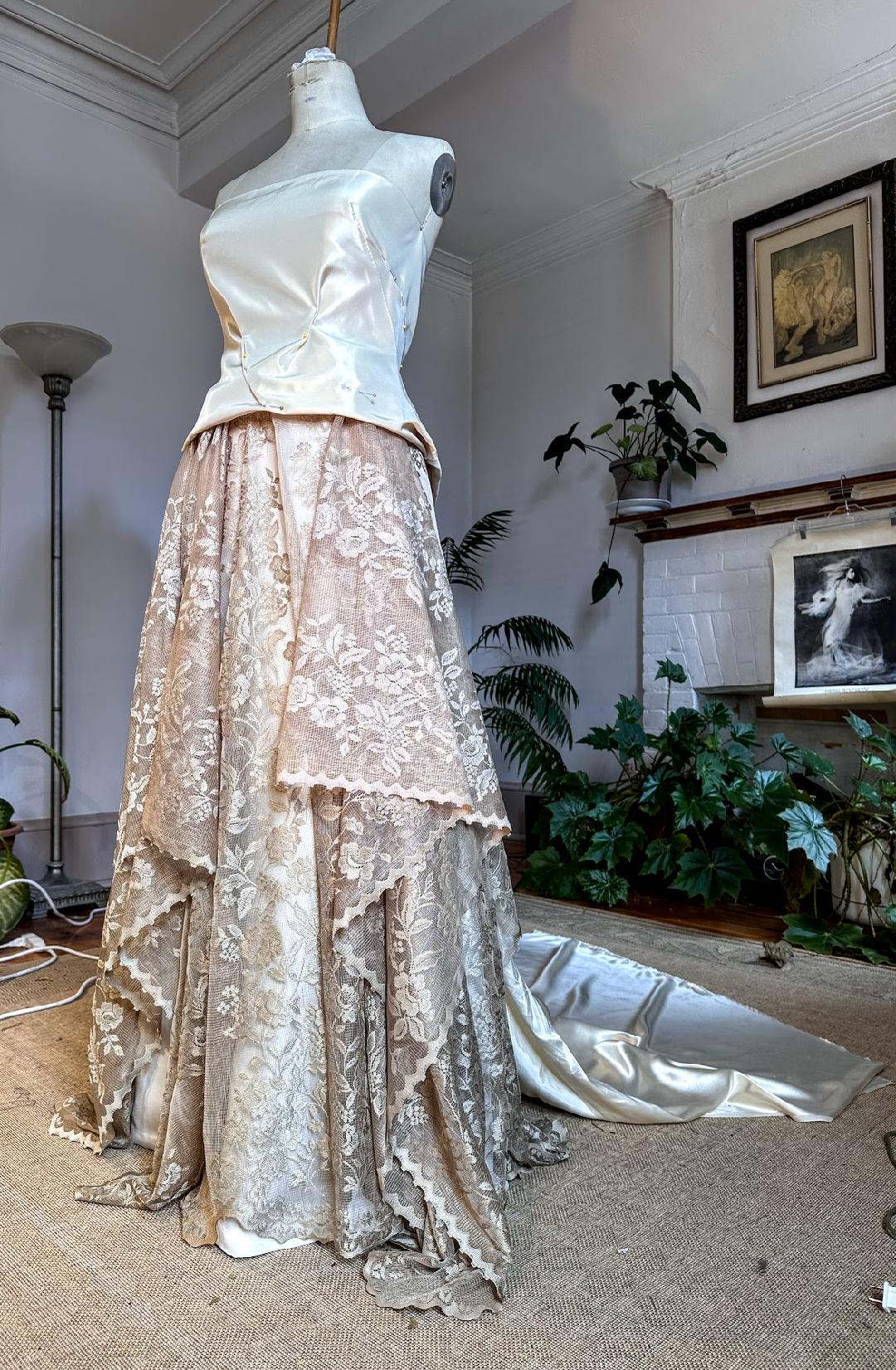
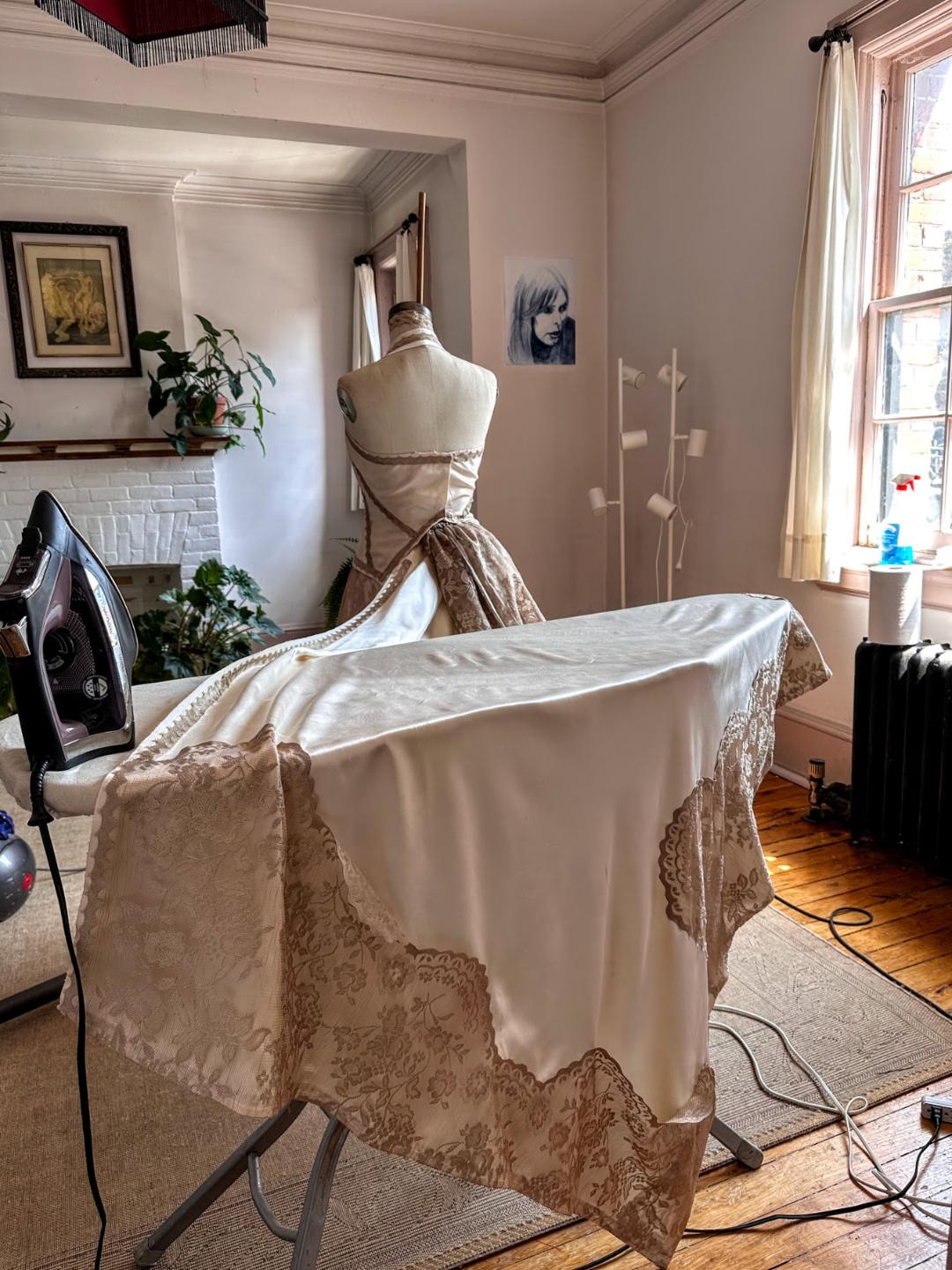
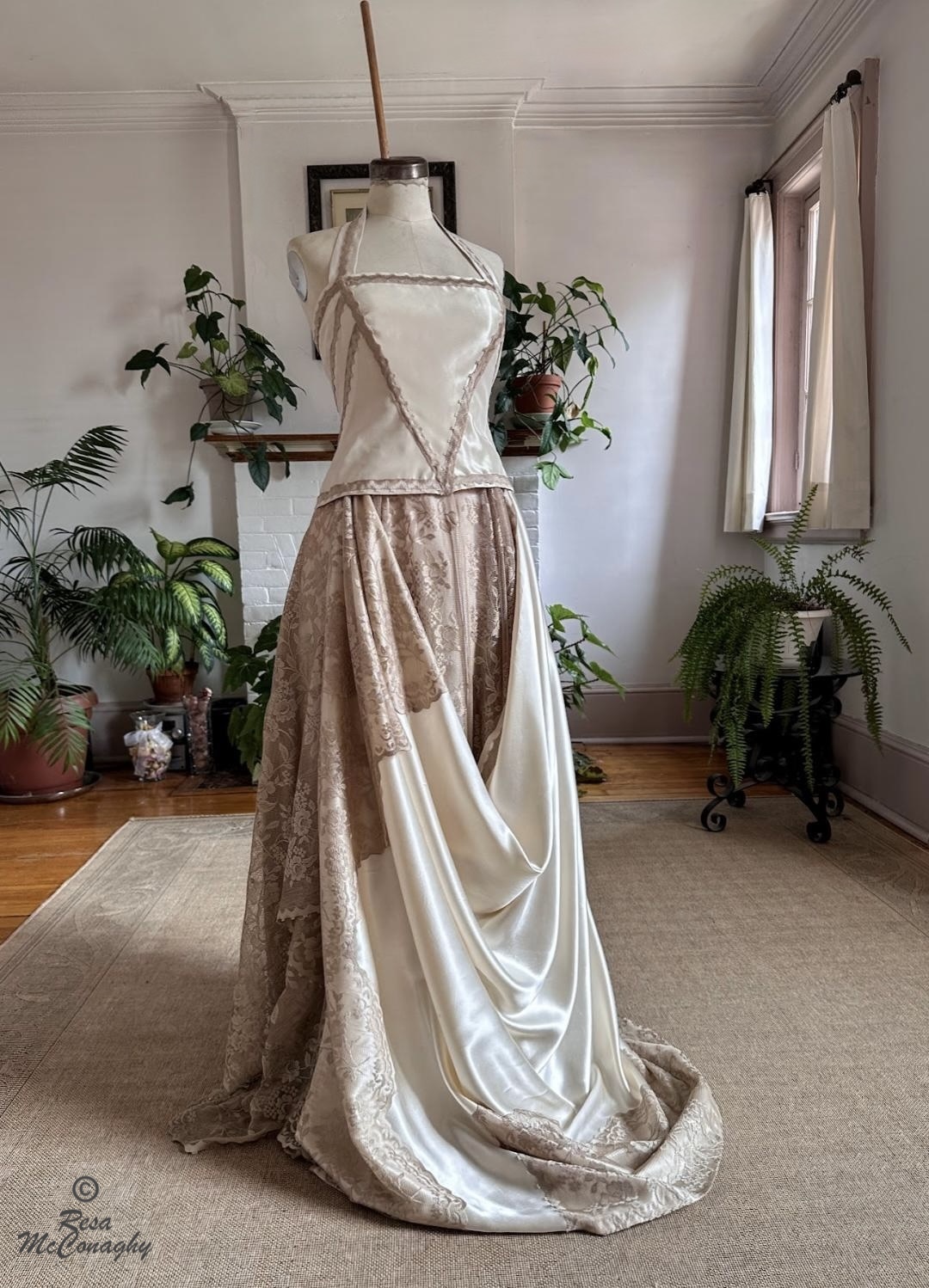
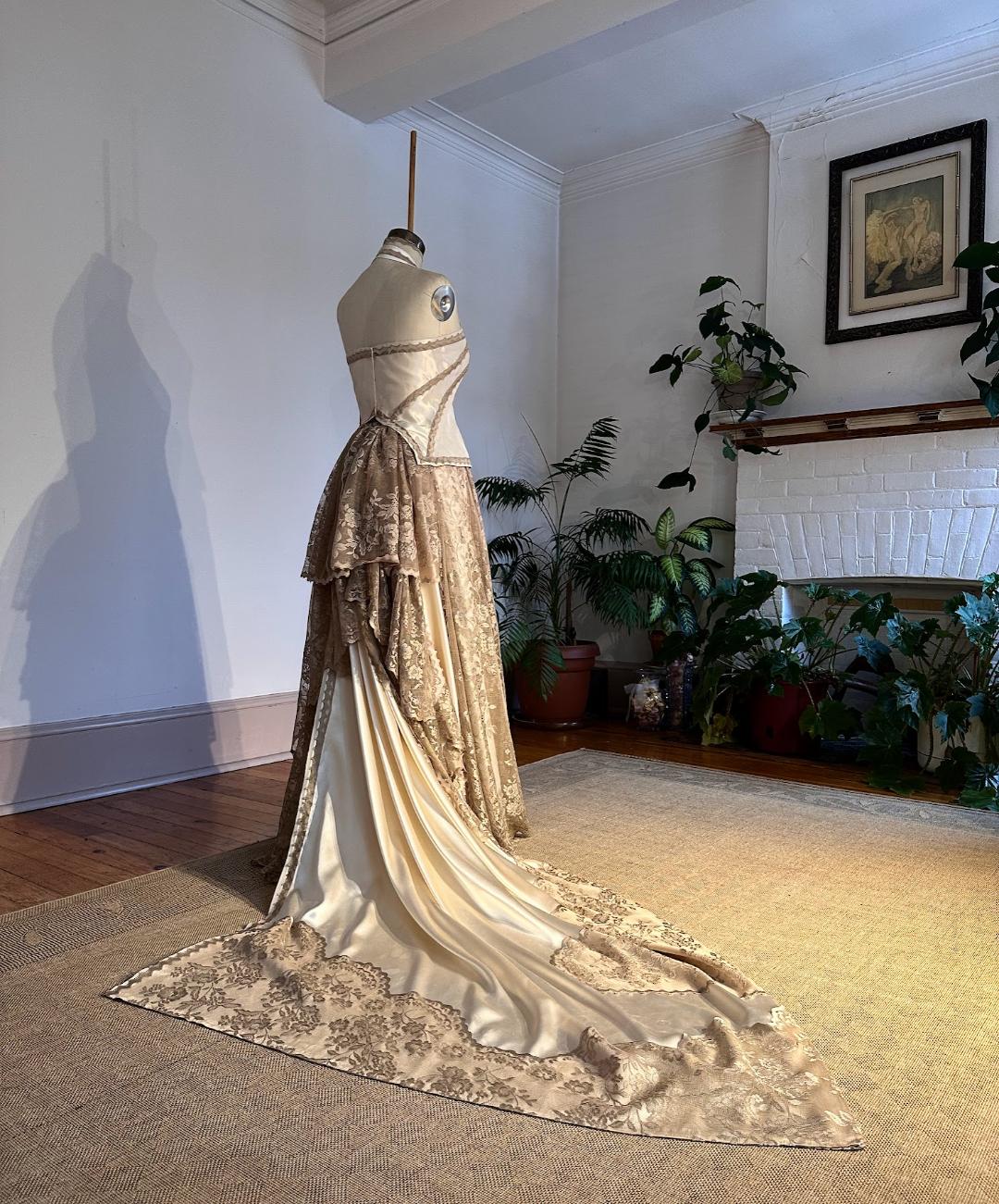
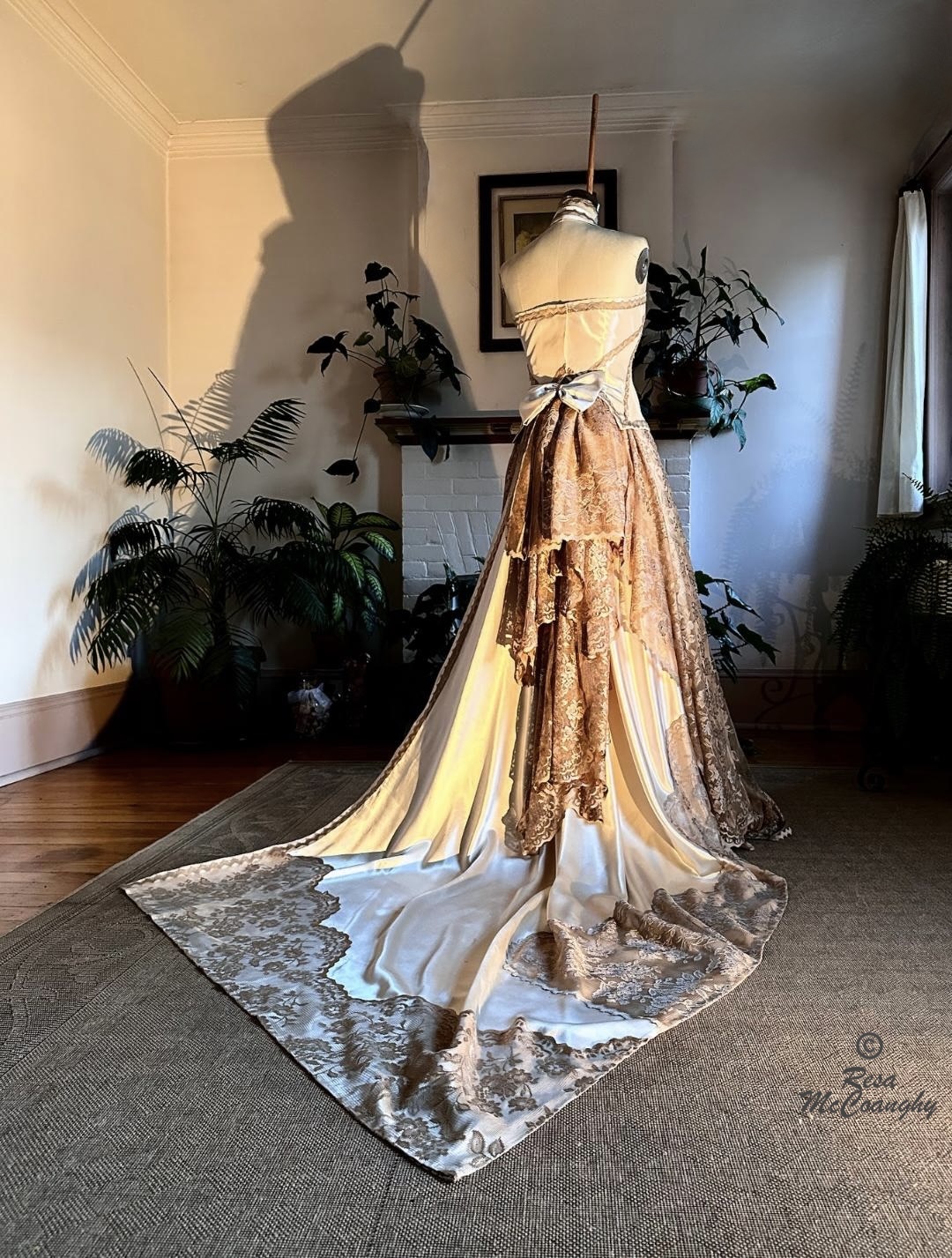
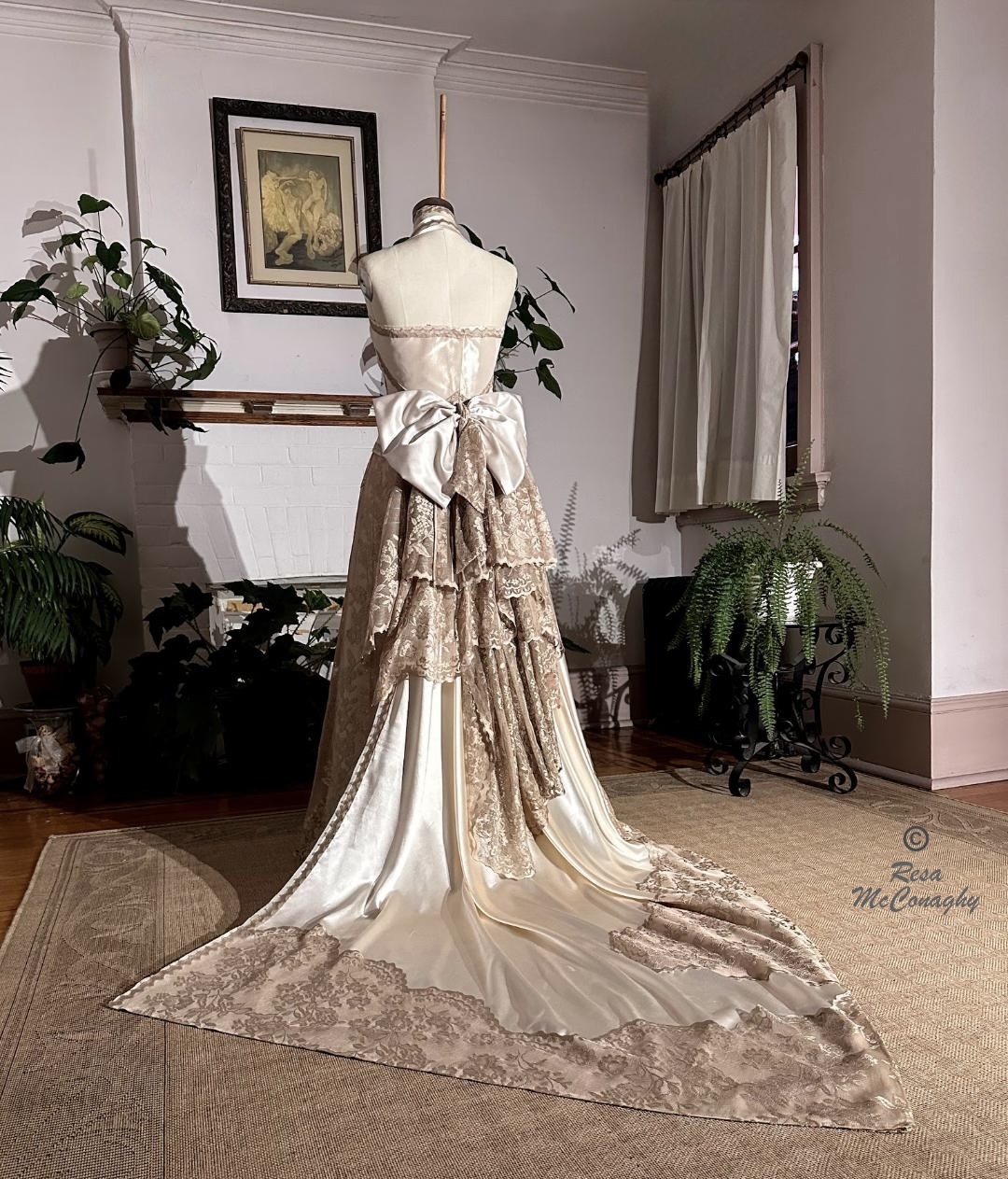
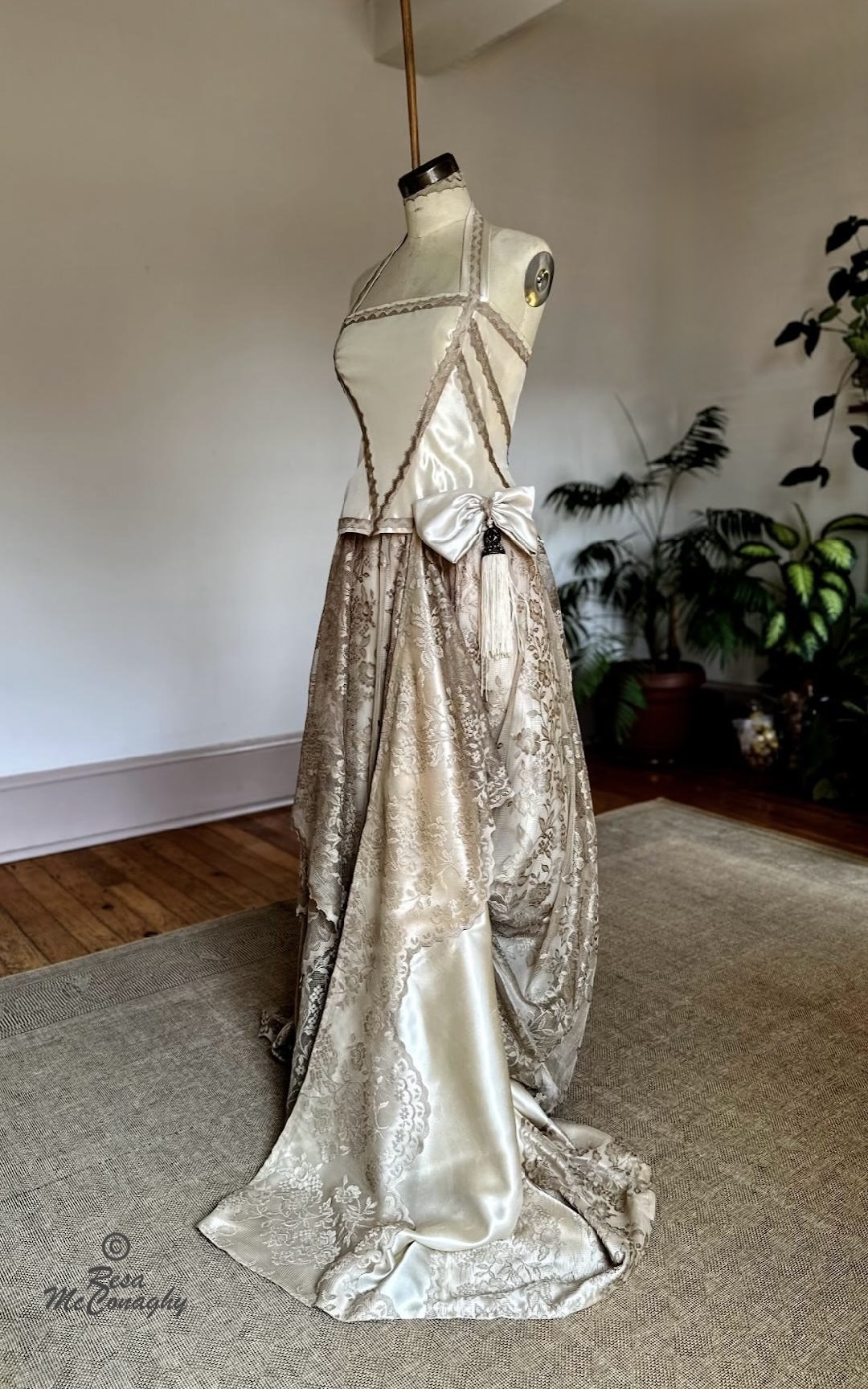
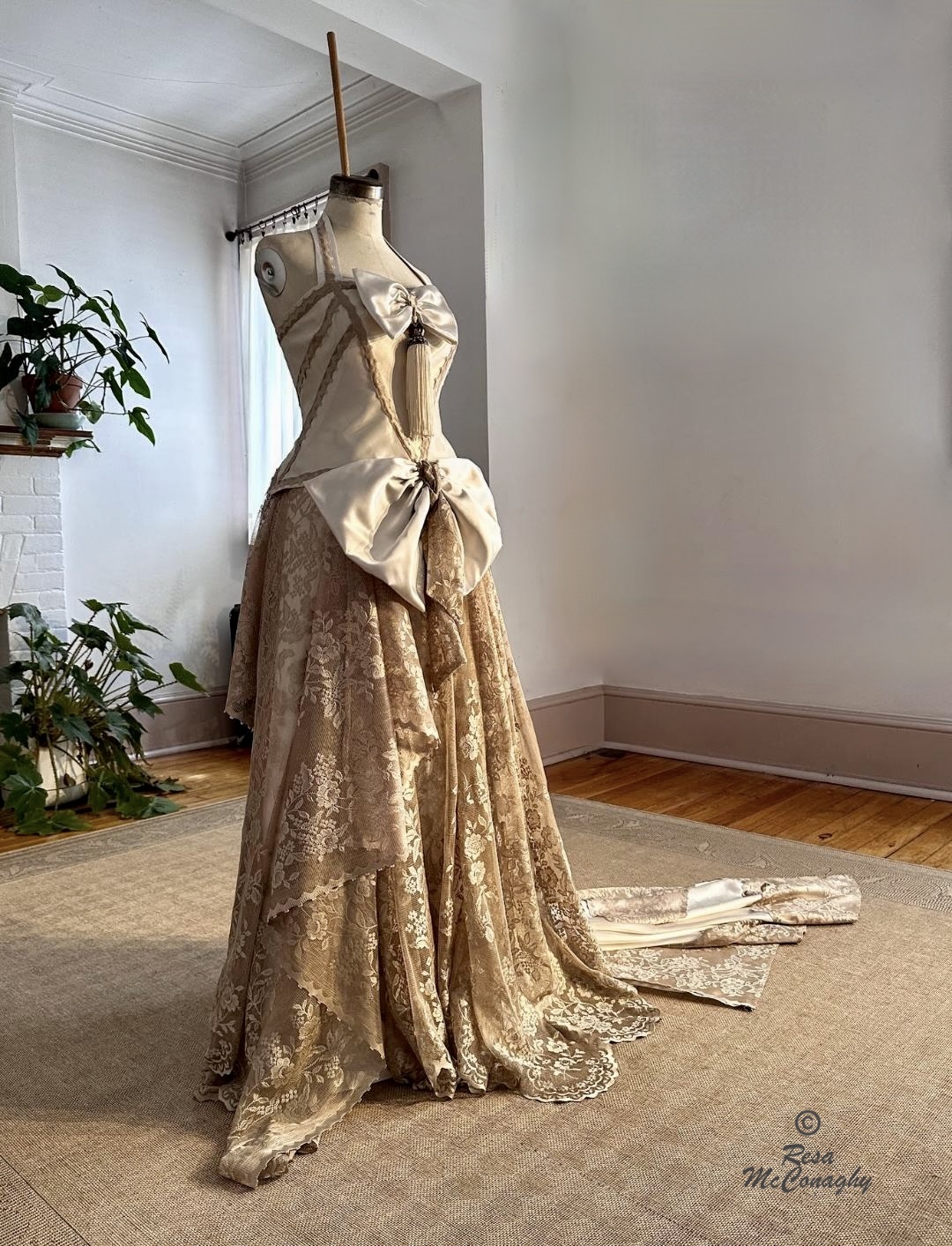
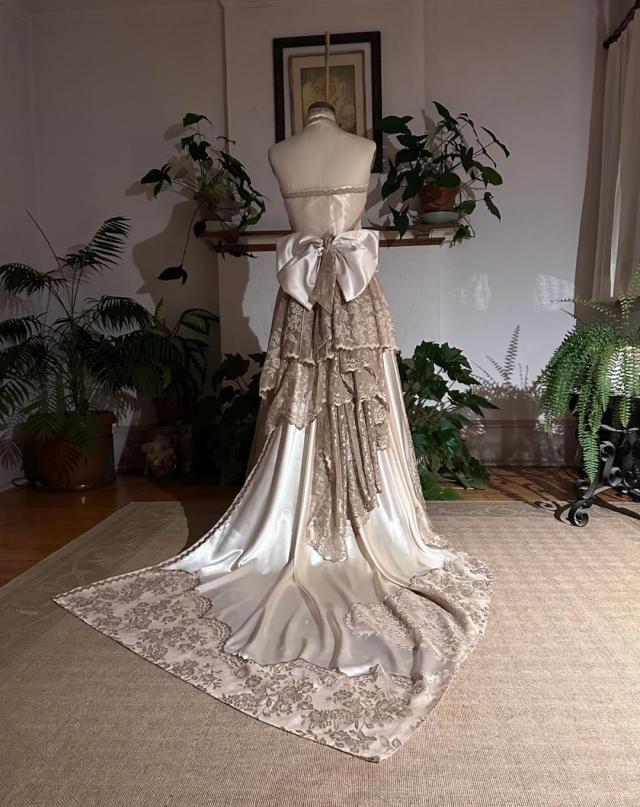
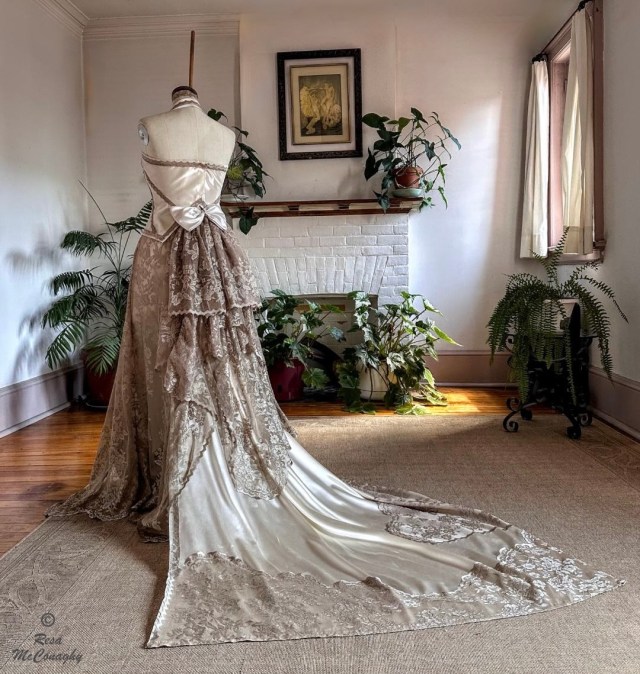
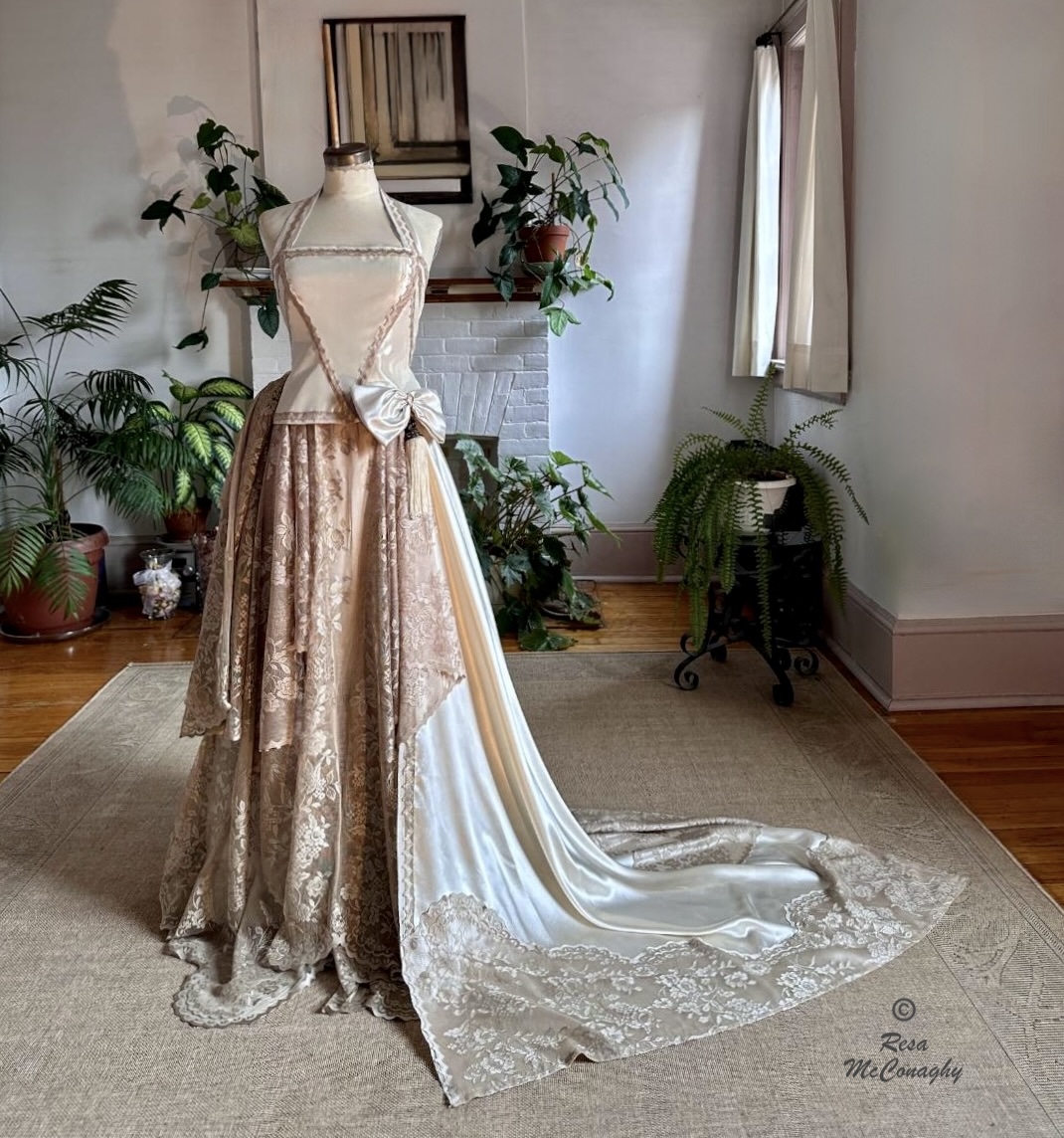
The fabric of 3 panels was cut across the mesh drop out.. A skirt was draped from these. The scallops were used to trim the gown’s tail.
There’s nothing like a creative mess!
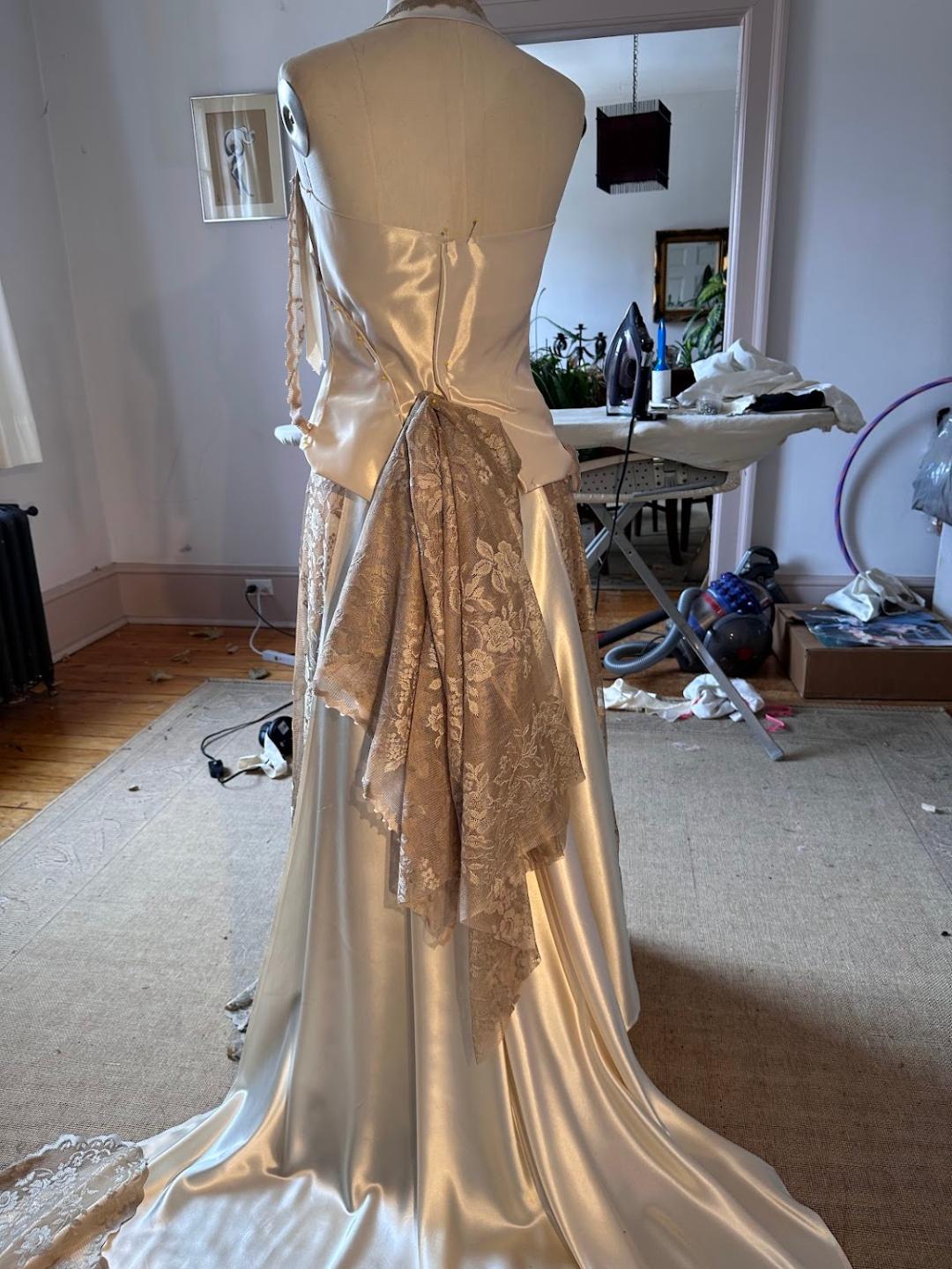
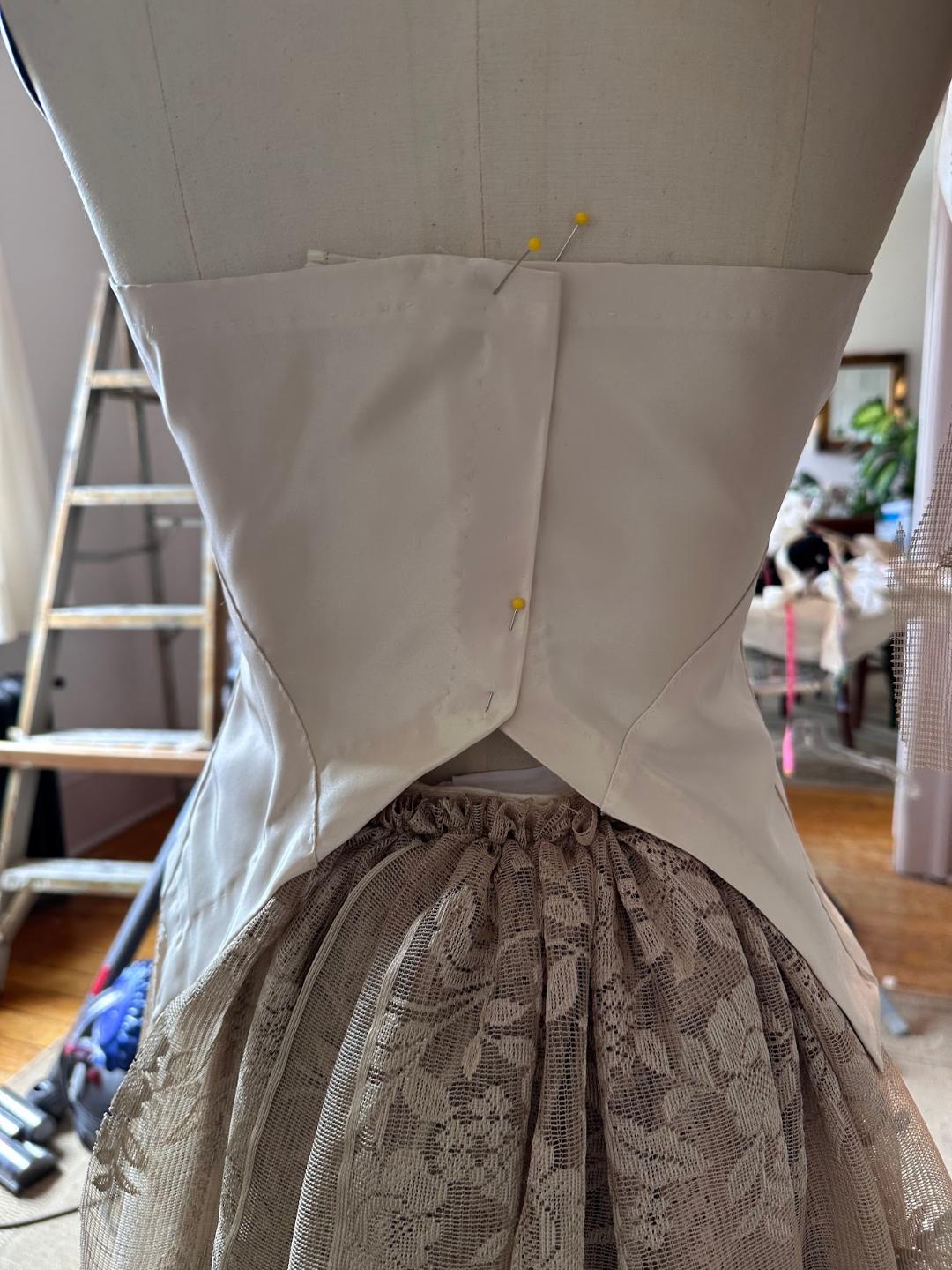
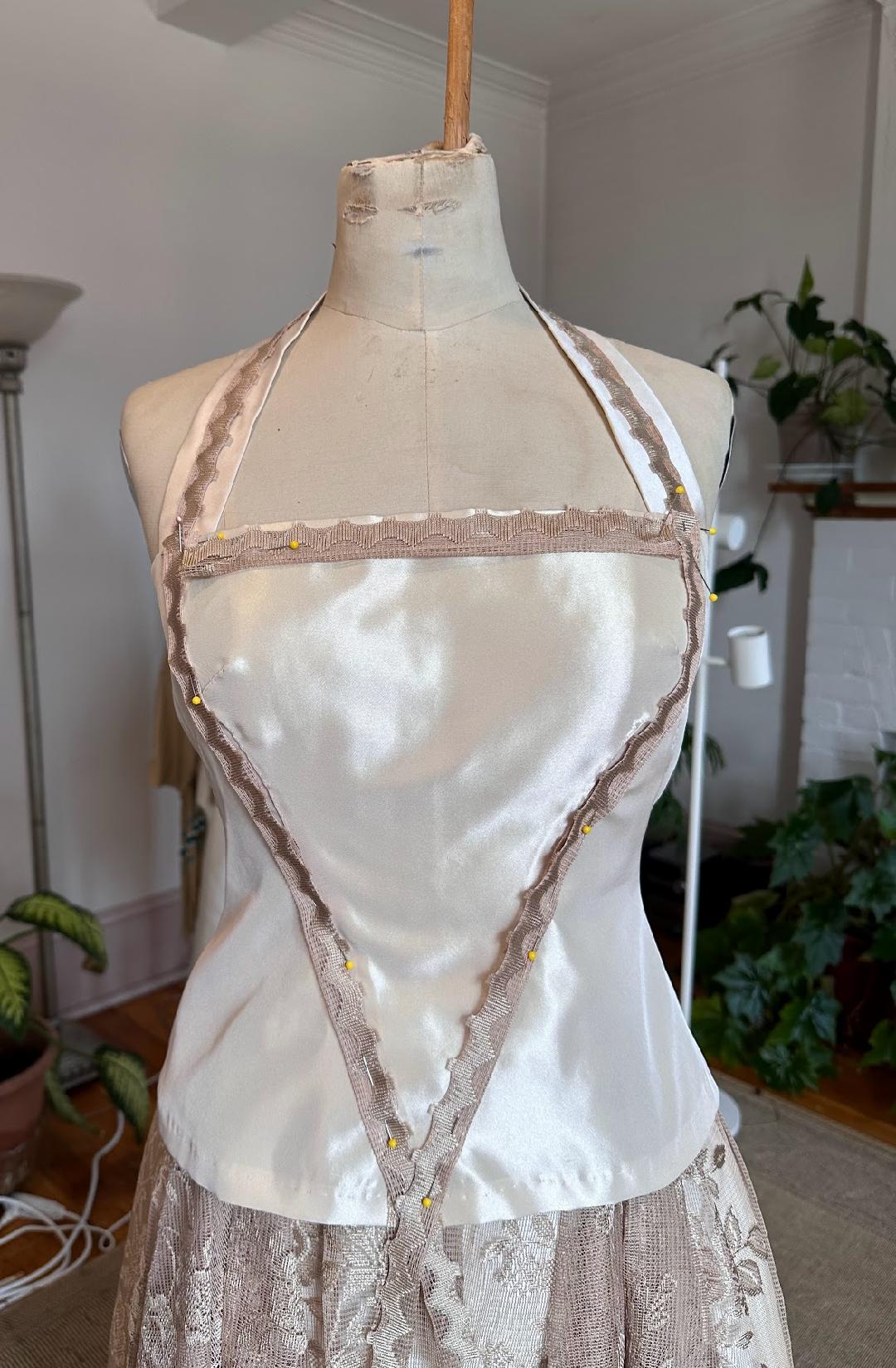
The last panel was cut up for the bussell, and the picot selvage was used to trim the bodice.
The tail is asymmetric due to the shape of the last large scrap of fabric. No waste here!
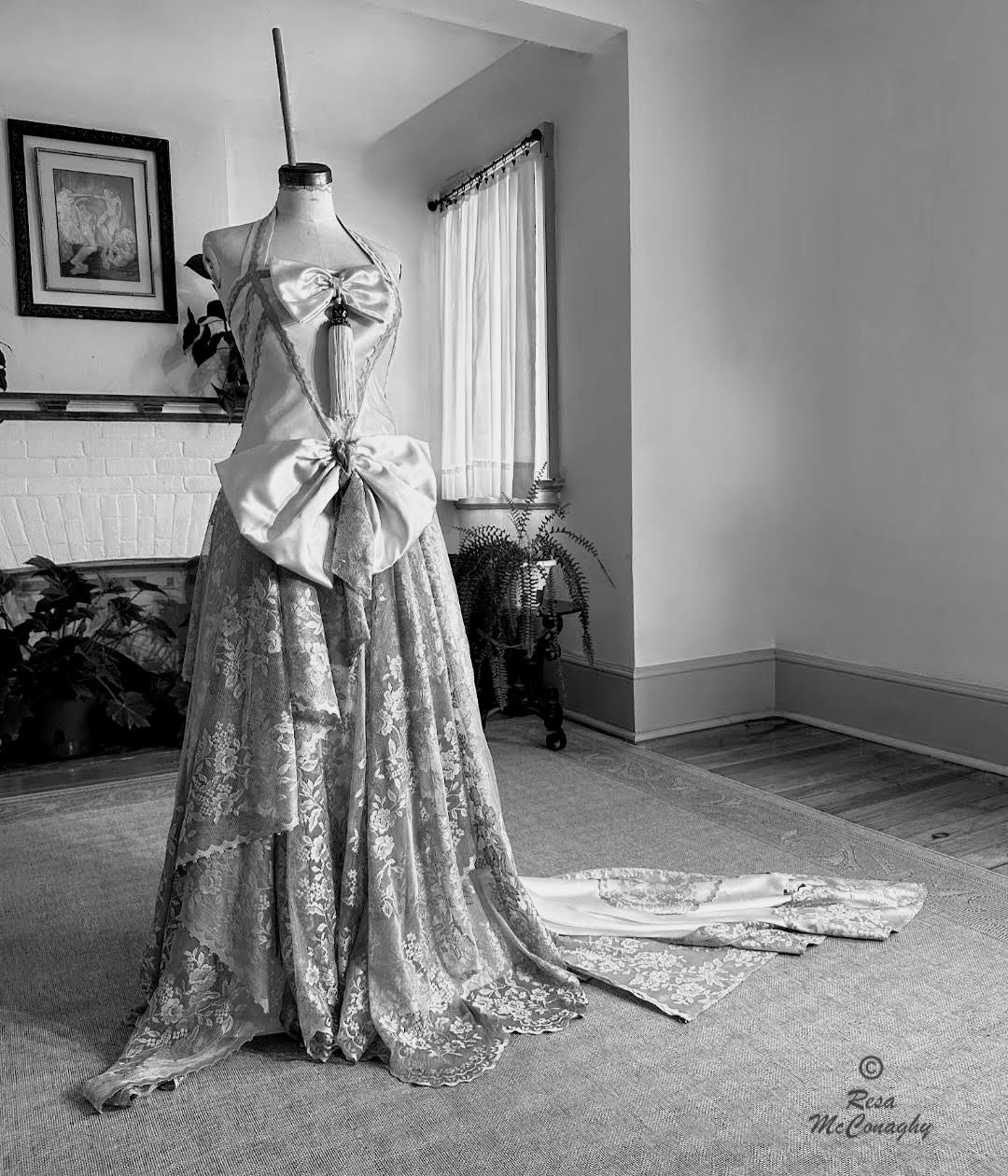
The left over satin became bows.
Her self adorned beauty …
… tried a small bow.
… and a Big Bow
Then a tassel got involved.
The bows and the tassel decided to work together
One bow said to the other bow, “at least we’re not tied up in knots! Even the tassel is hanging around.”
The tassel, dangling a truth, thought;”I’m so glad they’re ribbon each other, because they just drain the colour out of everything when they tangle.!”
Attempts at Novelty Shots & Outtakes
Front lit w/warm floor flood
Back lit w/warm floor flood
Front lit w/ sunny window
Back lit w/ sunny window
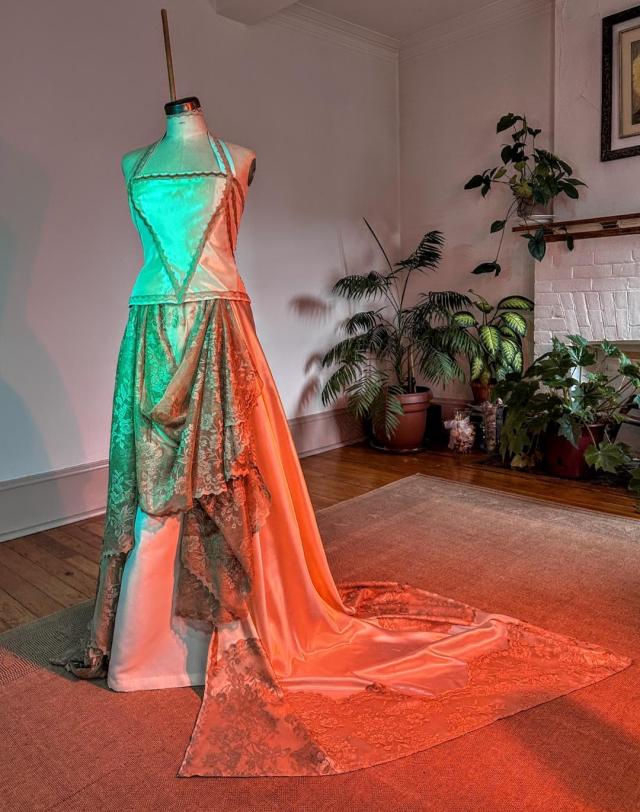
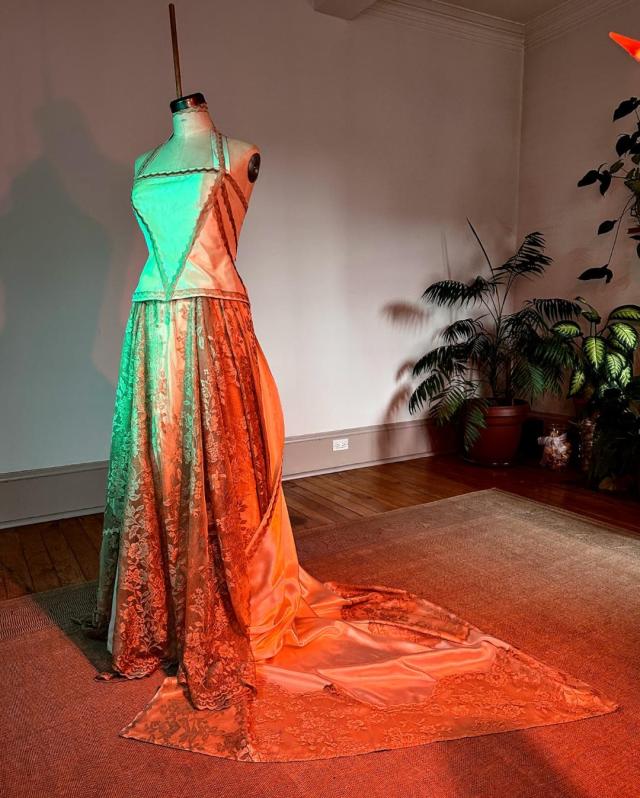
Red & blue gels over warm light
Red & blue gels over warm light
Blue gel over warm light
Lucy Maude Montgomery (1874-1941) is still inspiring 118 years after Anne of Green Gables hit the stands. Her poem was the final inspiration that pulled together the many ideas for naming Maple Moonrise.
Harbour Moonrise

There is never a wind to sing o'er the sea
On its dimpled bosom that holdeth in fee
Wealth of silver and magicry;
And the harbor is like to an ebon cup
With mother-o-pearl to the lips lined up,
And brimmed with the wine of entranced delight,
Purple and rare, from the flagon of night.

Lo, in the east is a glamour and gleam,
Like waves that lap on the shores of a dream,
Or voice their lure in a poet's theme!
And behind the curtseying fisher boats
The barge of the rising moon upfloats,
The pilot ship over unknown seas
Of treasure-laden cloud argosies.

Ere ever she drifts from the ocean's rim,
Out from the background of shadows dim,
Stealeth a boat; o'er her golden rim;
Noiselessly, swiftly, it swayeth by
Into the bourne of enchanted sky,
Like a fairy shallop that seeks the strand
Of a far and uncharted fairyland.

Now, ere the sleeping winds may stir,
Send, O, my heart, a wish with her,
Like to a venturous mariner;
For who knoweth but that on an elfin sea
She may meet the bark that is sailing to thee,
And, winging thy message across the foam,
May hasten the hour when thy ship comes home?

                                                       -Lucy Maude Montgomery
About Rebecca Budd
Of the many blogs Rebecca has and has had over the years, I find myself drawn to her Reading Room, Chasing Art blog and her her podcast –Tea Toast and Trivia.
Via the colour or other comparable aspect of the gown &/or painting – I will first pair a fine art painting from Robbie’s collection, then one from my collection, .
White Gowns
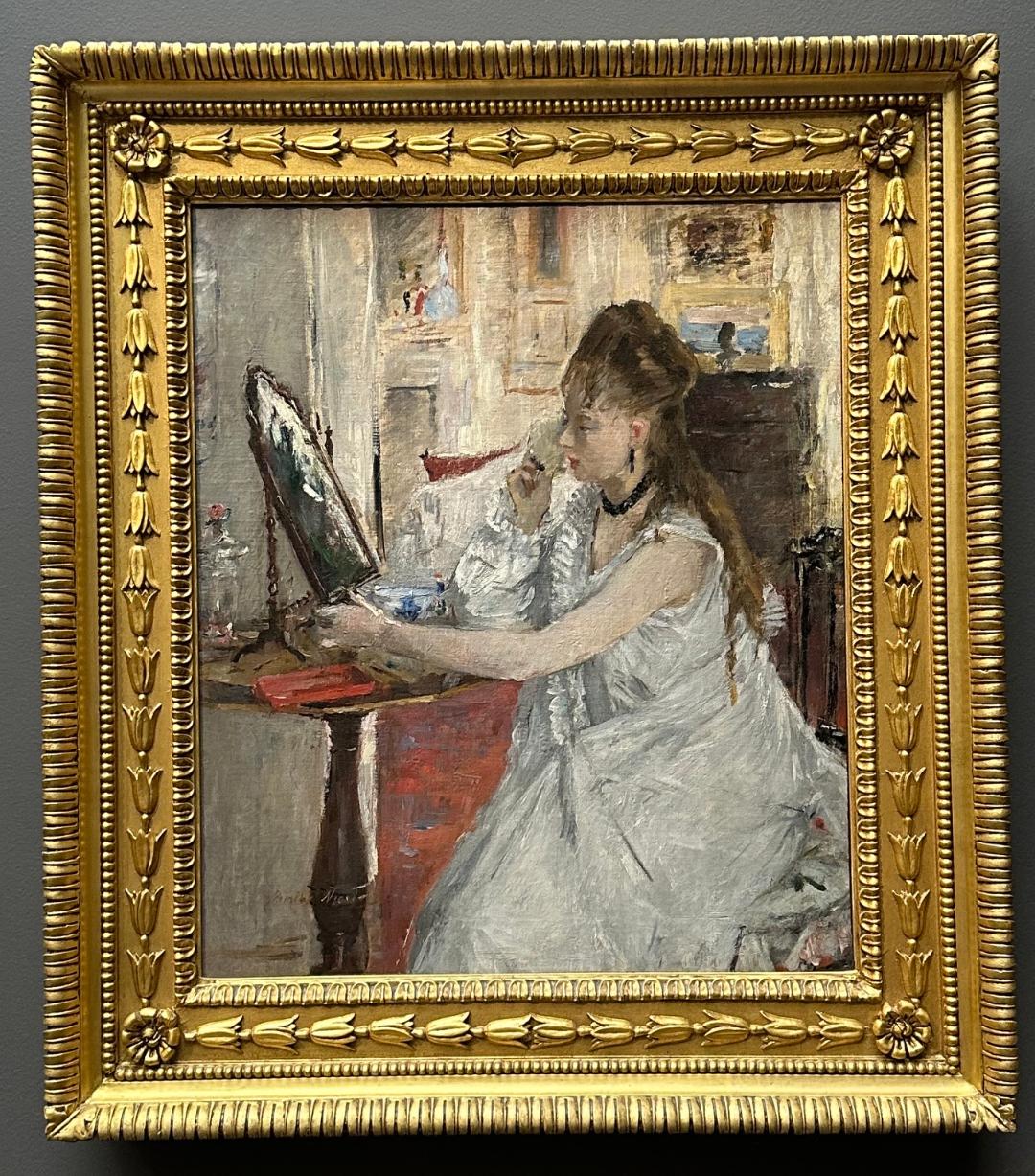
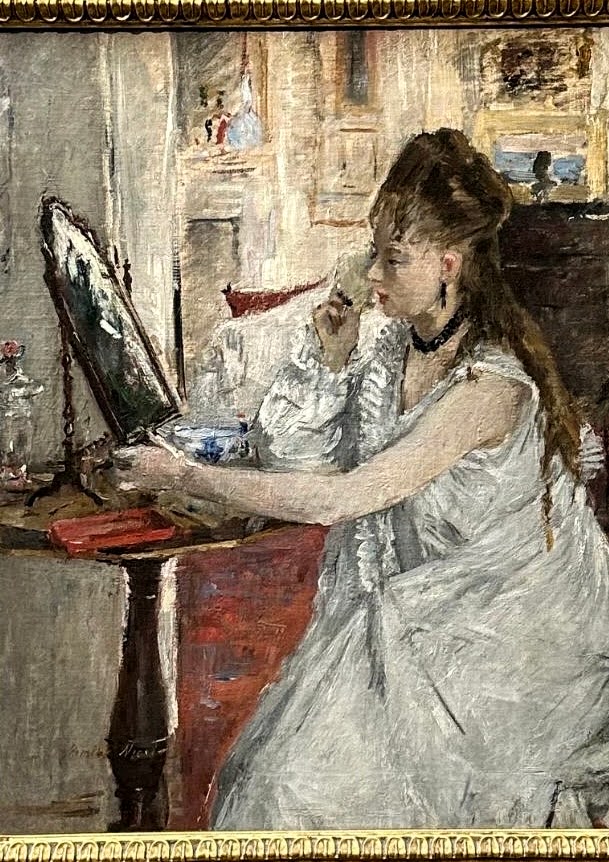
Jeune Femme se Poudrant – by Berthe Morisot – French (1841 – 1895)
Berthe Morisot‘s only daughter, Julie, inspired the many paintings, which documented the lives of women. The painting below is one of those paintings. It hangs in the Musée d’Orsay, Paris.
1887 – Oil on Canvas
Fortunate to have a genuine art education, Morisot studied under Jean-Baptiste-Camille Corot. In the 1860s, Morisot became a professional friend of Edouard Manet.
From1864 – 1870, she showed regularly at the Paris Salon.
In 1874, Morisot exhibited with the Société Anonyme des Artistes-Peintres, Sculpteurs, Graveurs, the first Impressionist exhibit.
In December, 1874 she married Eugène Manet (brother of Edouard Manet).
Achieving significant recognition during her lifetime, in 1887 her work showed at George Petit’s International Exhibition in Parisand Paul Durand-Ruel’s exhibition of Impressionist painting in New York.
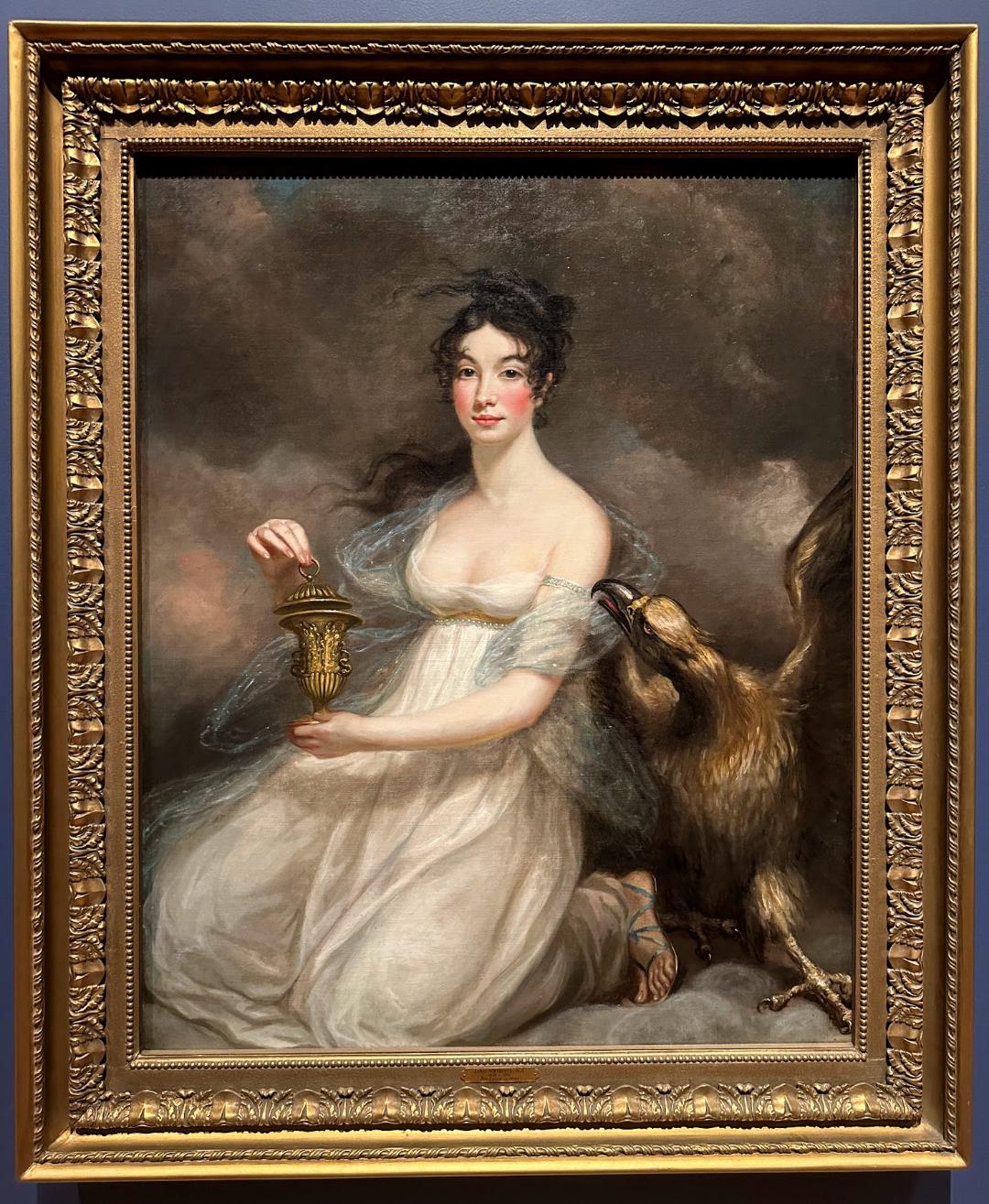
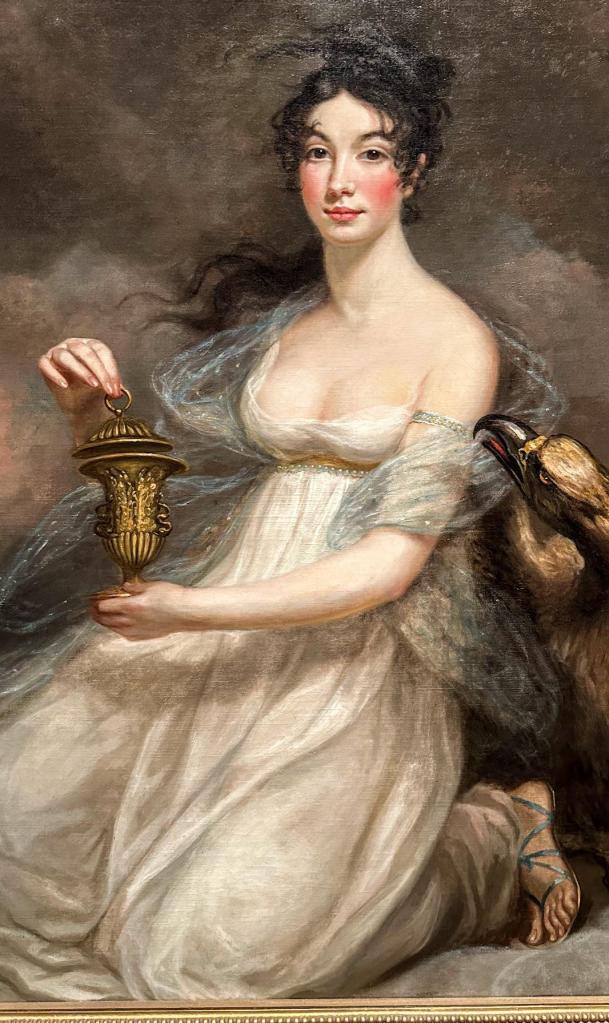
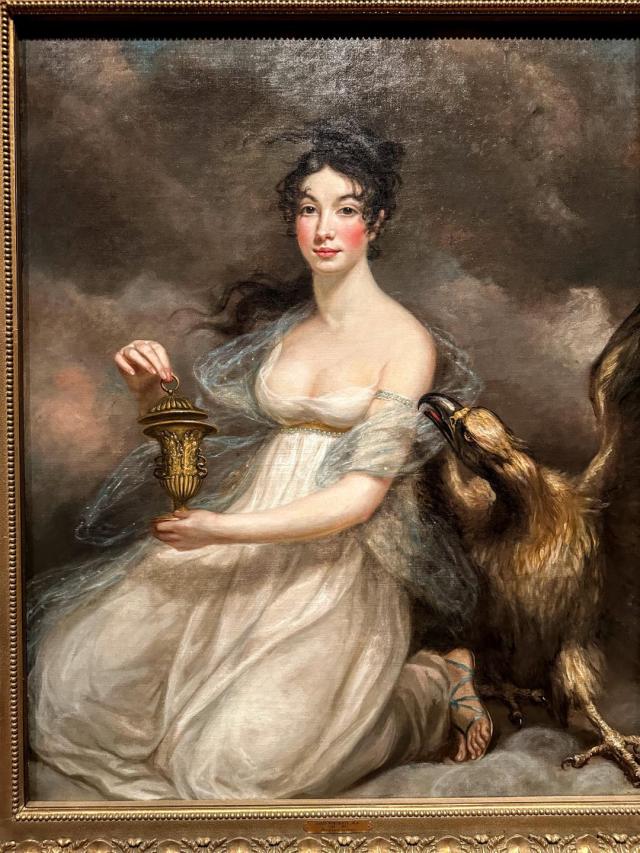
Mrs. Wells as “Hebe” – James Northcote – British (1746 – 1831)
James Northcote was a writer as well as a painter of predominantly portraits. Largely self taught, he studied under and worked for Sir Joshua Reynolds. He became a member of The Royal Academy in 1787.
1805 – Oil on Canvas
At this time in history, allegorical artworks portraying people as mythological or historical figures were the height of fashion.
Mrs, Wells as “Hebe”features British actress Mary Wells (1761-1829), immortalizing herself via this painting.
Zeus’s daughter – Hebe, goddess of youth & cupbearer of the gods, was also the young bride’s patron goddess.
A Child’s Gown
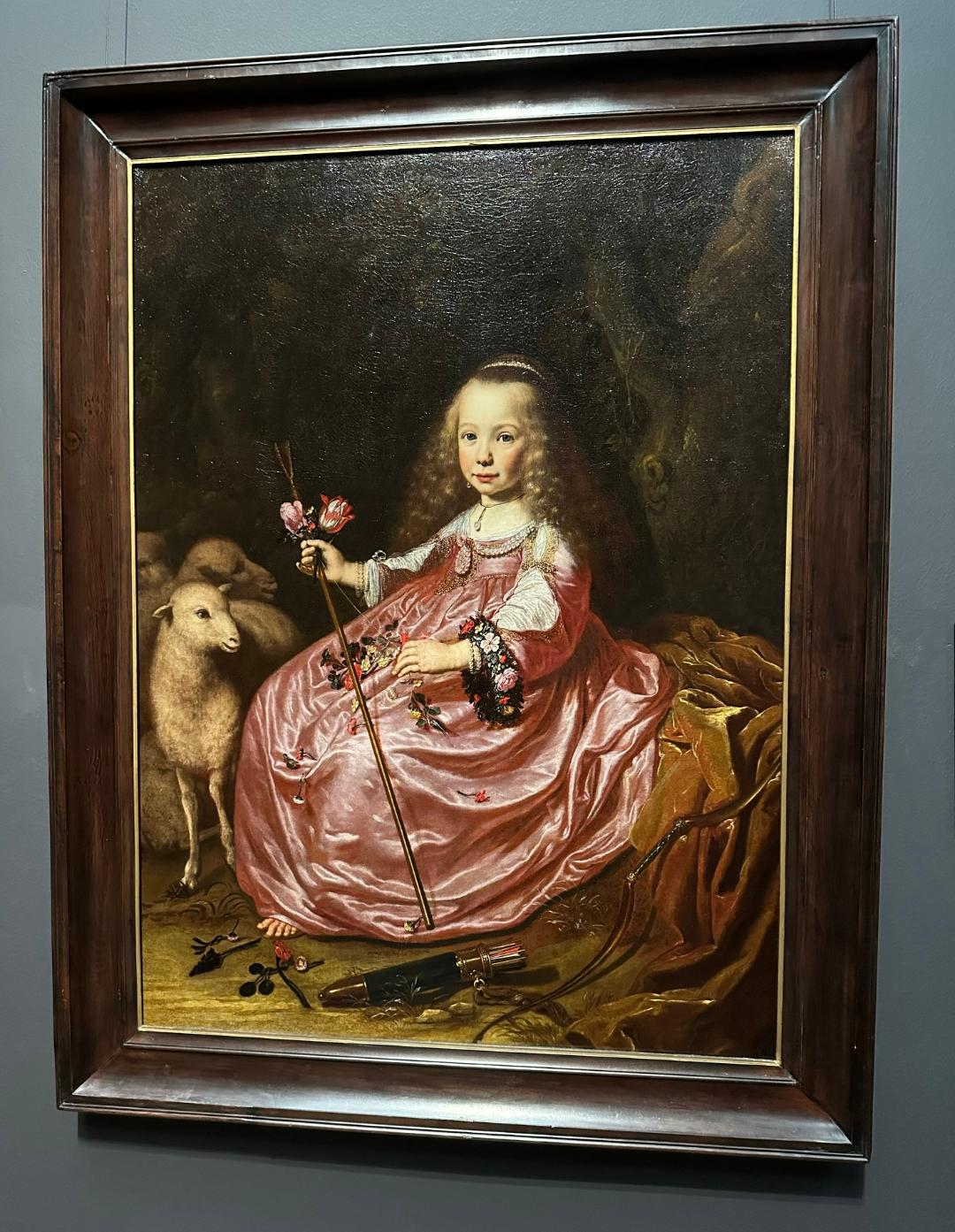
Portrait of Clara Alewijn – Dirk van Santvoort – Netherlands (1610-1680)
Dirk van Santvoort was a prominent painter of children circa the mid seventeenth century. Clara Alewijn, the subect of the portrait below, was van Santvoort’s sister.
Oil on canvas – 1644
He likely studied under his farther – Dirck Pietersz. Bontepaert. None of the father’s work weathered time. After becoming wealthy, Van Santvoort ceased painting. He became the Dean of the Painters’ Guild and was an assessor of paintings.
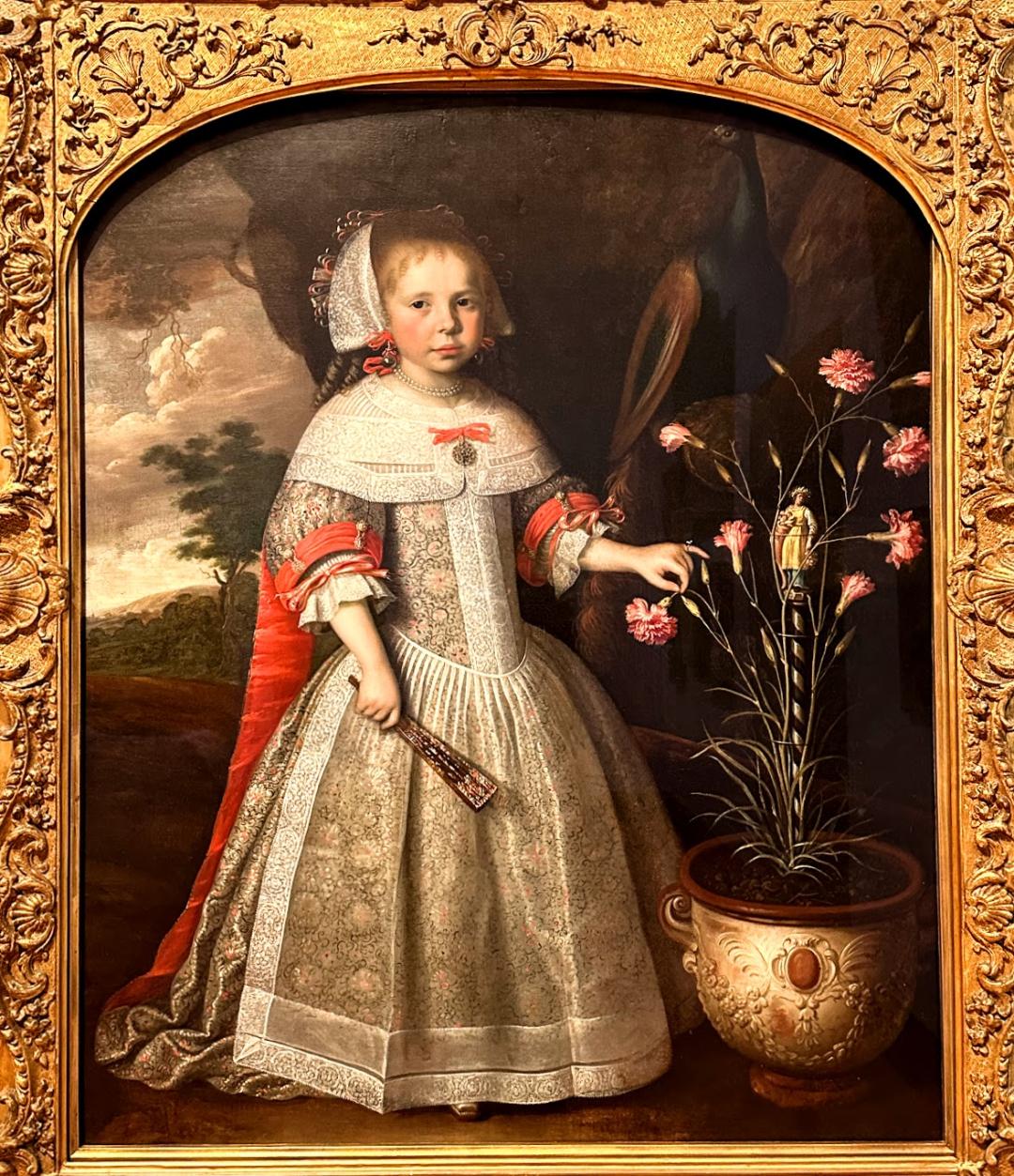
Portrait of a Young Girl with Carnations – Jan Albertsz. Rotius – Netherlands (1615-1674)
Jan Albertsz. Rotius (aka Rootgies) was a portrait and still life painter
Oil on Canvas – circa 1663
He had 7 children, of which only 3 survived to adulthood. His son Jacob Rotius, became a successful painter of flowers.
Feels Antediluvian
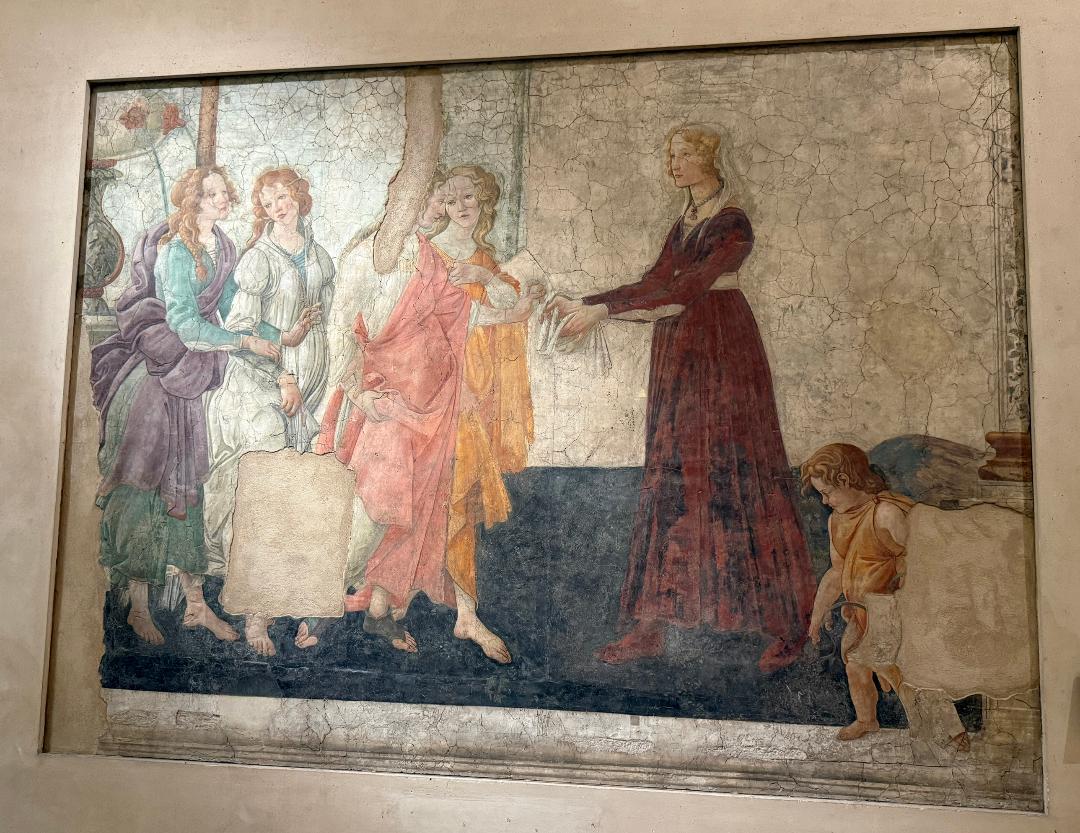
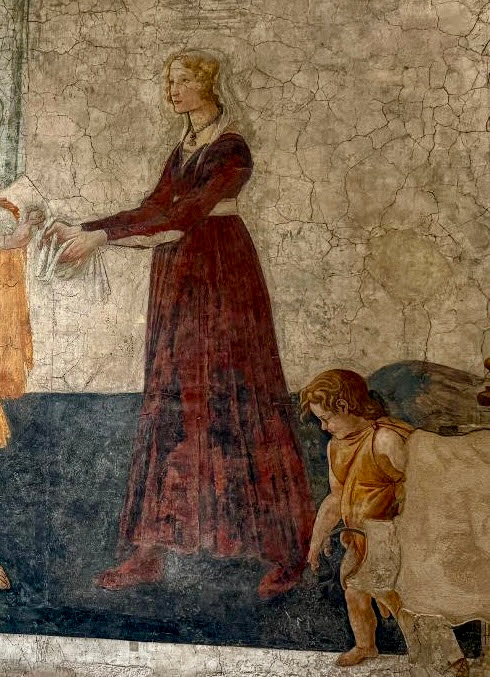
Venus and the Three Graces Presenting Gifts to a Young Woman – Sandro Botticelli – Italian (1445-1510)
Botticelli, a draughtsman and painter, began painting religious frescoes before opening his own studio circa 1470.
Fresco – circa 1484
Prior to opening his studio he apprenticed in the studio of Fra Filipo Lippi, then worked with Antonio del Pollaiuolo. Botticelli spent most his life in service of the Medici family and their clique.
Aka Gioo degli Albizzi Receiving a Gift of Flowers from Venus, this fabulous fresco resides in the Louvre since 1882.
Found again in Italy in 1873, it is believed he used the patron’s daughter, possibly on her wedding engagement, for this allegorical image.
Botticelli’s name almost vanished from art circles until the late 19th century. At that time an esteem for the Florentine arts and culture renewed a look at his creations.
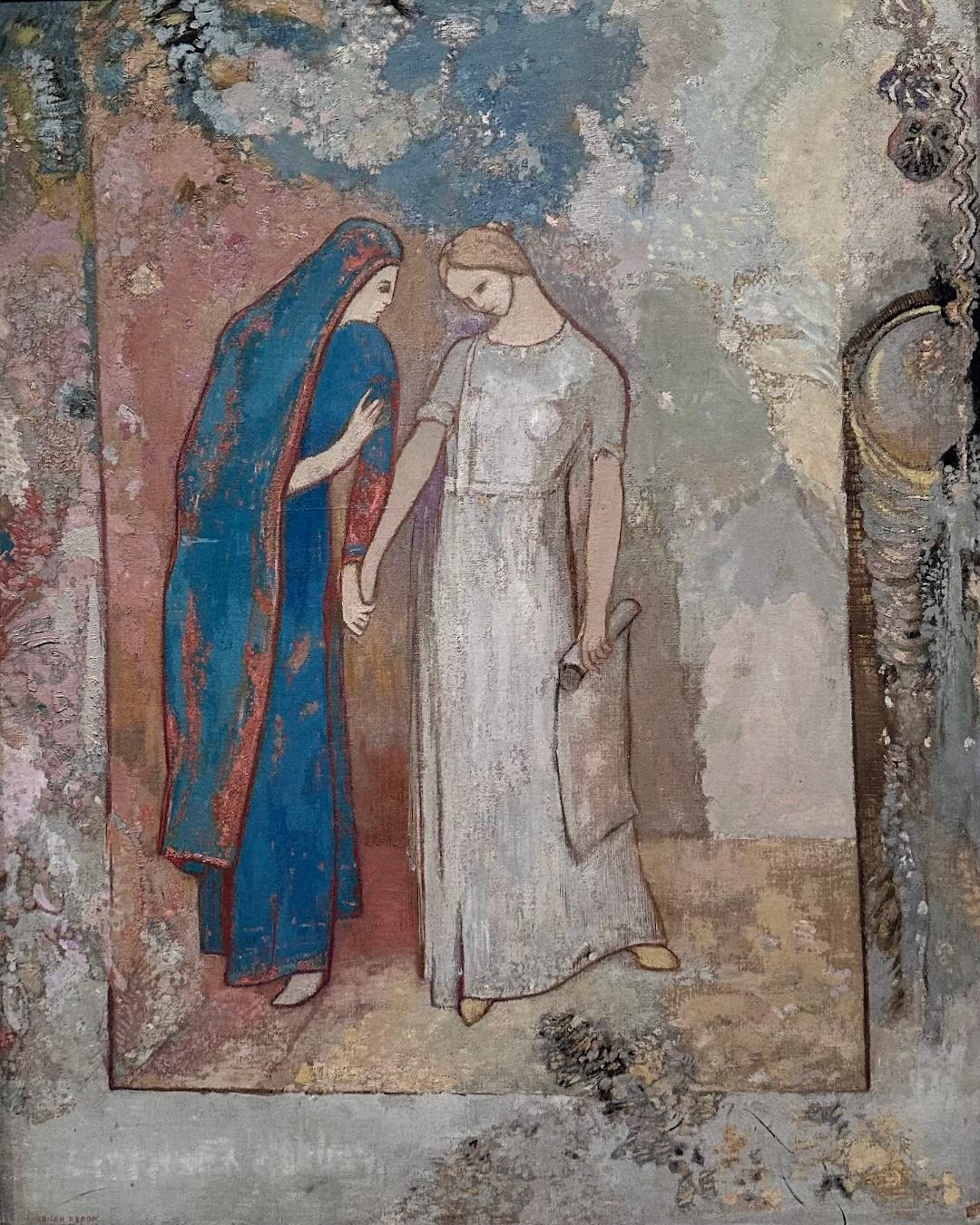
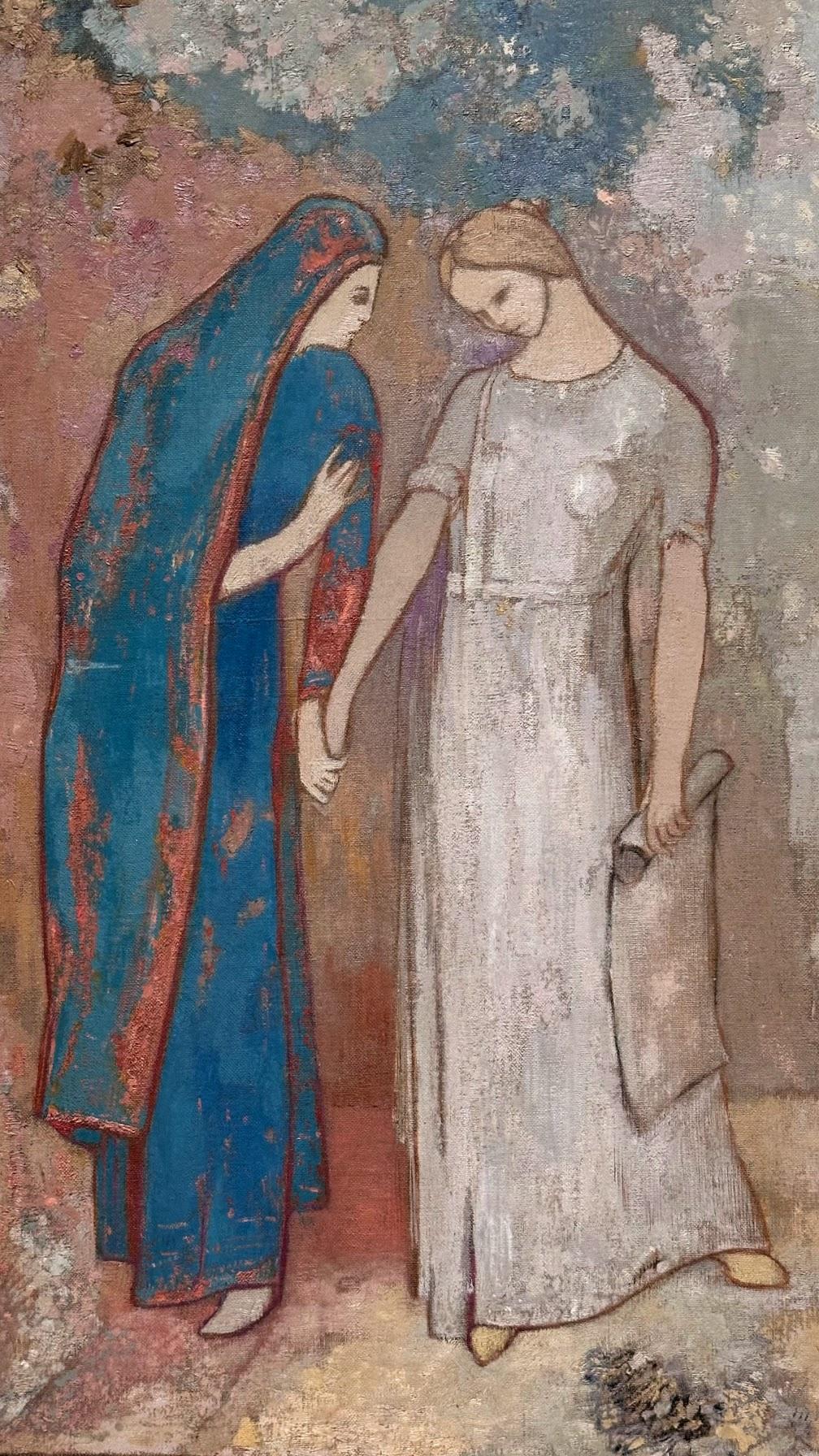
Initiation to Study – Two Young Ladies – Odilon Redon – French (1840-1916)
Bertrand-Jean Redon was a Symbolist painter, as well as a print maker.
At 15, his father made him switch from drawing to architecture. Later, he enjoyed sculpture and was instructed in etching and lithography by Rodolphe Bresdin.
He joined the army during the Franco-Prussian War, putting his career on hold.
Redon was still mostly unknown until in 1884, when a novel by Joris-Karl Huysmans titled, À rebours, featured a debauched aristocrat who collected Redon’s drawings.
A catalogue of his etchings and lithographs, published in 1913, caused his popularity to increase.
“My drawings inspire, and are not to be defined. They place us, as does music, in the ambiguous realm of the undetermined.” – REDON
The Lady Wears Black
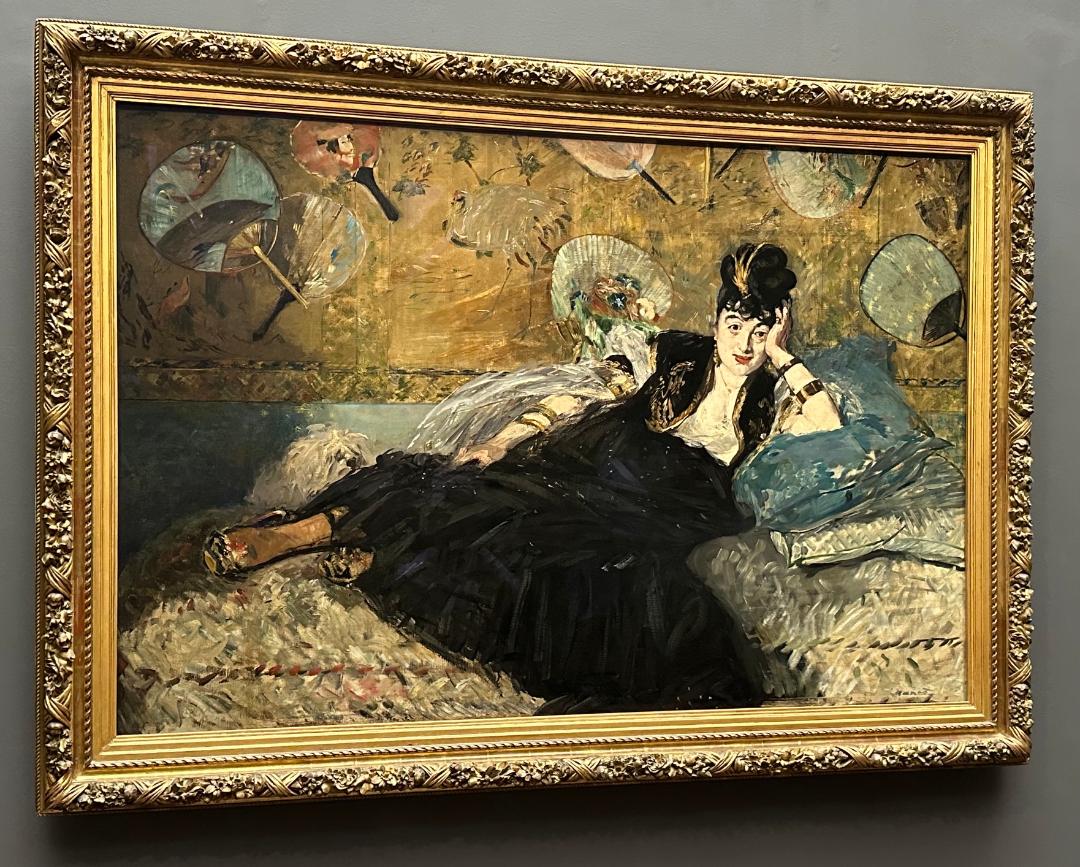
La Dame aux éventails – Édouard Manet – French – 1832-1883
Manet emerged from wealth. He studied at the studio of artist Thomas Couture, then began copying paintings at the Louvre. Manet, inspired by the work of Spanish painter Diego Velázquez, chose a non academic free manner of loose brushwork.
He married Suzanne Leenhoff in 1863. She modelled for at least 13 of his paintings, but not for Olympia. Exhibited at the 1865 Salon, this parody of the classic Venus created a vicious scandal, making Manet the de facto leader of the avant-garde.
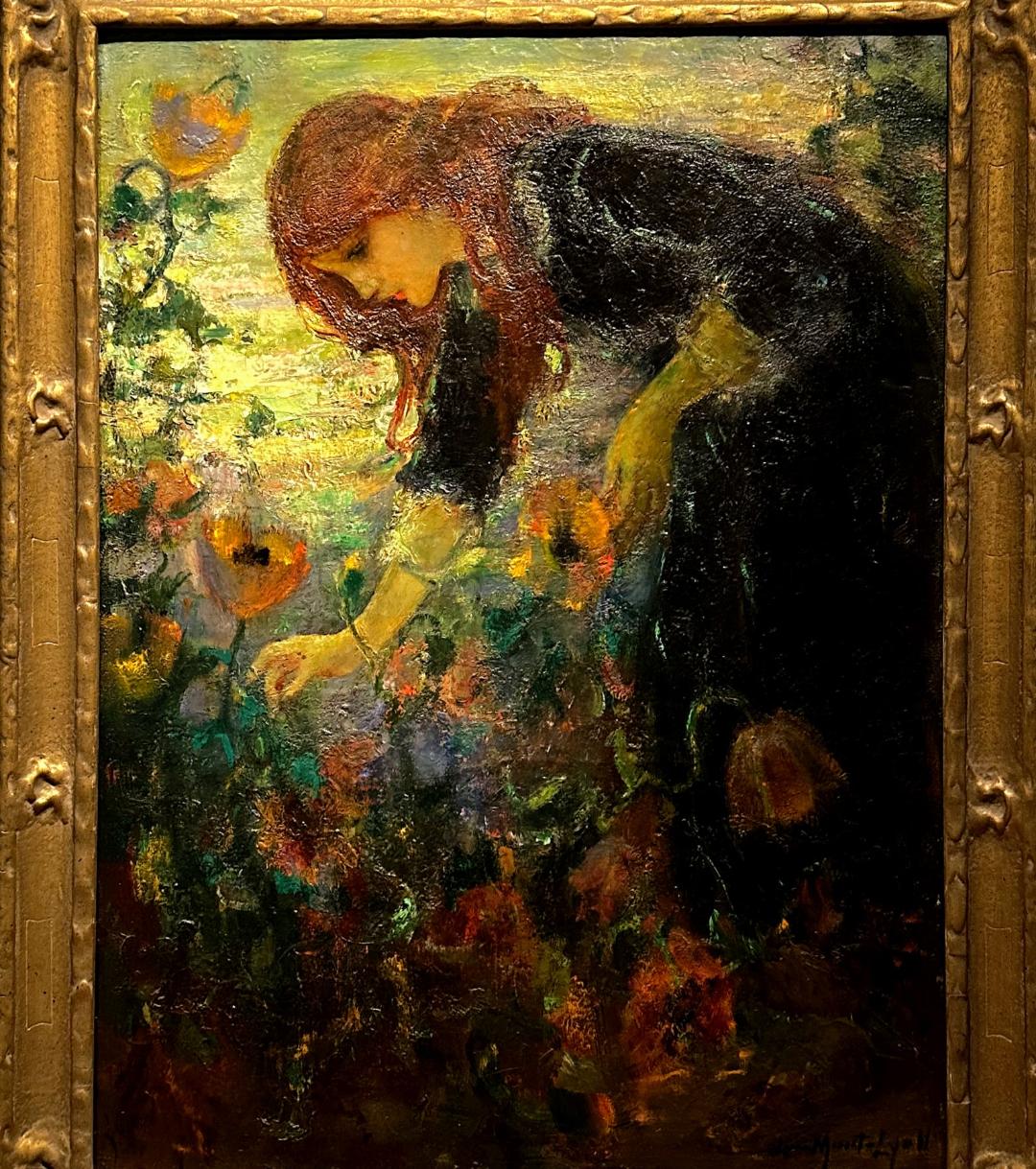
Oriental Poppies – Laura Muntz Lyall – Canadian (1860-1930)
Born in England, Laura Muntz Lyall immigrated to Canada at the age of 9 years. The first Canadian artist to receive honourable mention at the Paris Salon, she is also the first female Canadian Impressionist artist to have her work become part of the National Gallery of Canada.
Oil on Canvas – circa 1915
Laura Muntz-Lyall studied in London, Toronto and Paris. She supported herself in Paris by teaching English. Prior to moving to Montreal in 1906, where she ran a prominent studio at Beaver Hall Square, she taught art at Toronto’s Havargal College.
The Red Gown
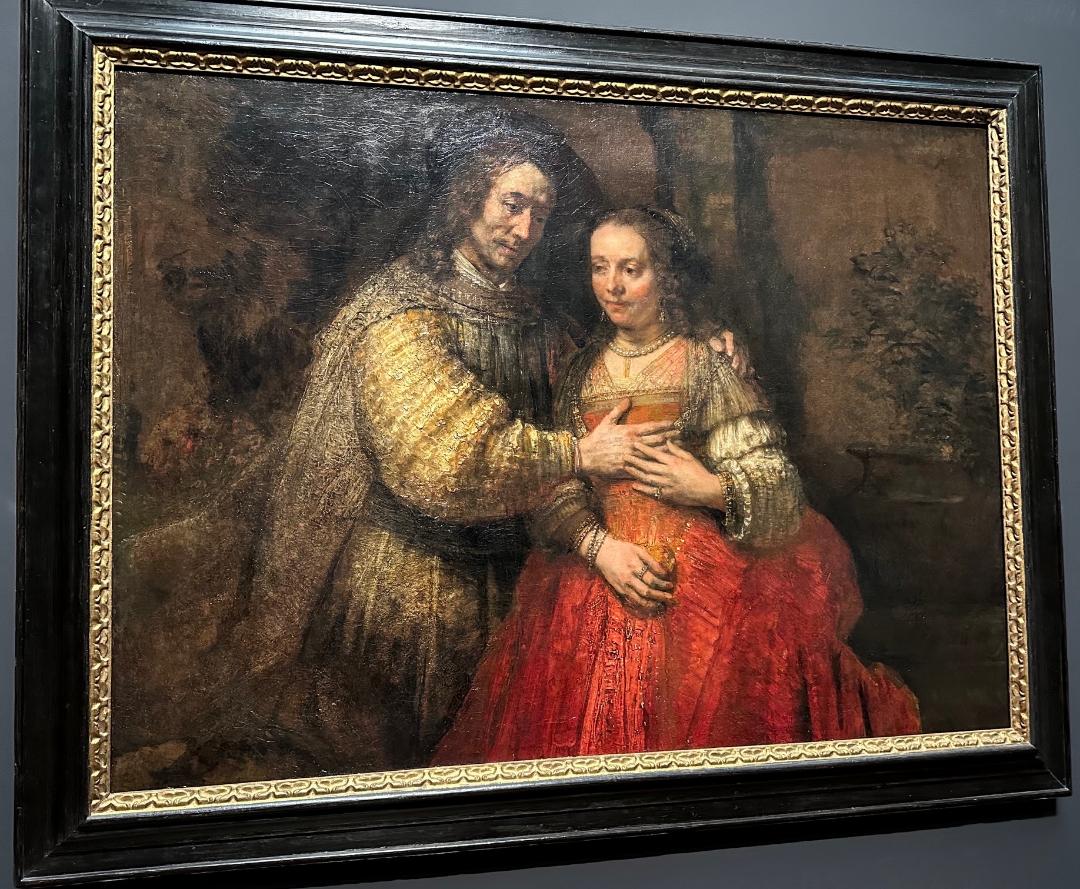
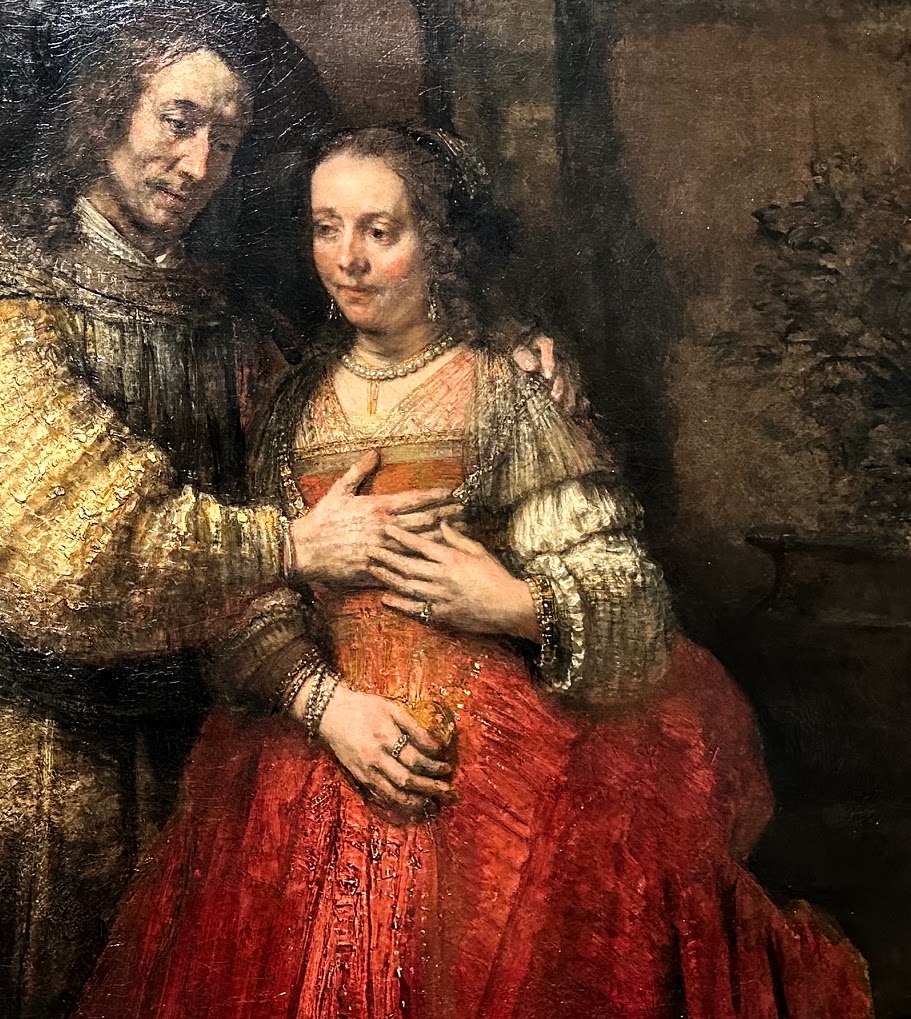
The Jewish Bride aka Isaac and Rebecca – Rembrandt van Rijn (1606-1609)
Rembrandt attended Leiden University. Here he studied literature and history. He learned painting from Jacob Van Swanenburgh, then apprenticed in Amsterdam with history painter Pieter Lastman.
Oil on Canvas – Circa 1665-69
Later in his life, Rembrandt’s wife and some of their children died, leaving him in a state of loss. Demand for his work declined, and he declared bankruptcy.
This canvas, which he said brought him to tears, was painted later in Rembrandt’s career, when he was considered in artistic decline.
Ironically, this era yielded many of his most revered works, when rich earth tones ran from thinly painted areas to thick impasto.
“…Hang this picture in a bright light and in such a manner that it can be viewed from a distance. It will then sparkle at its best. “ – Rembrandt
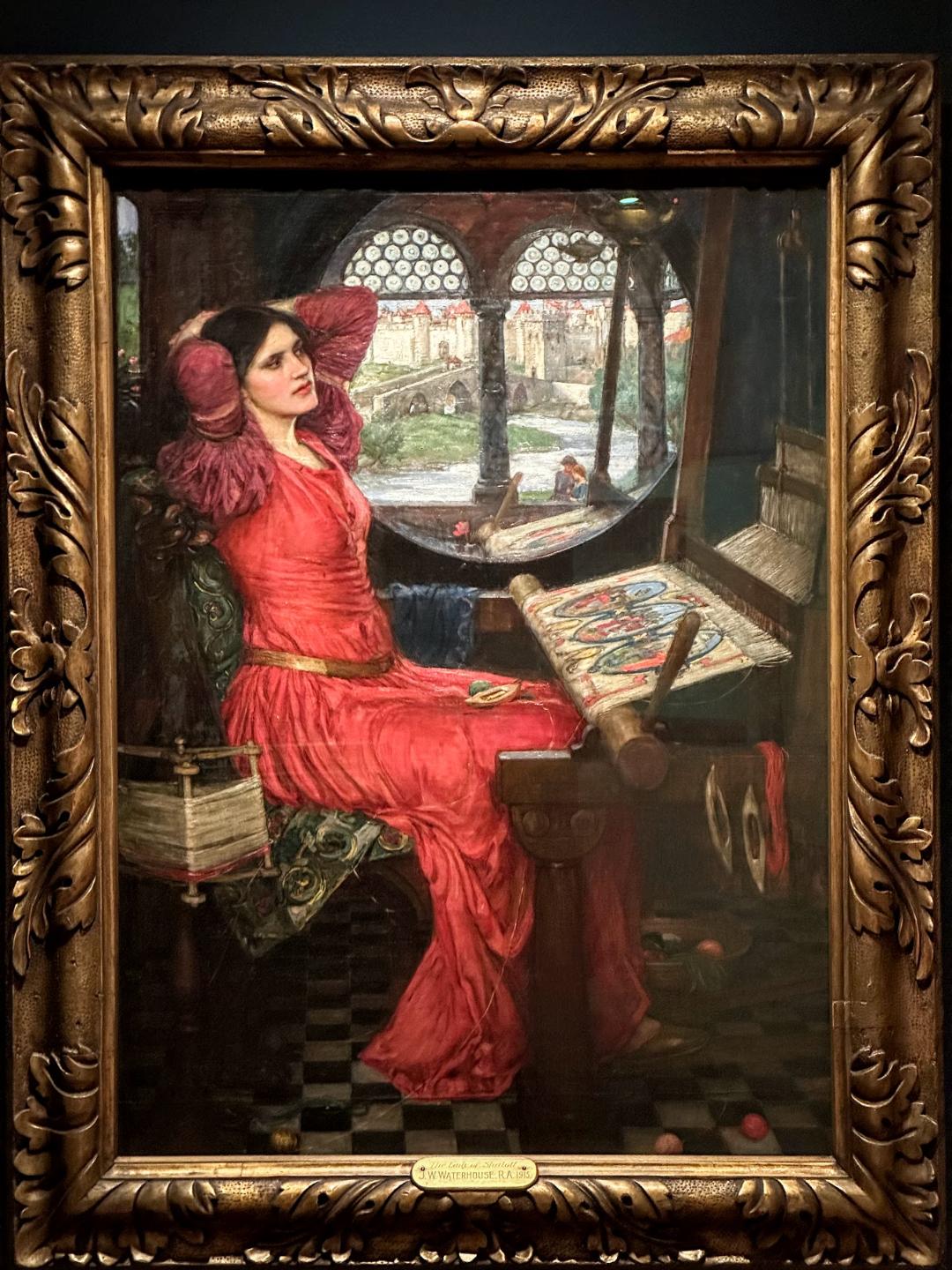
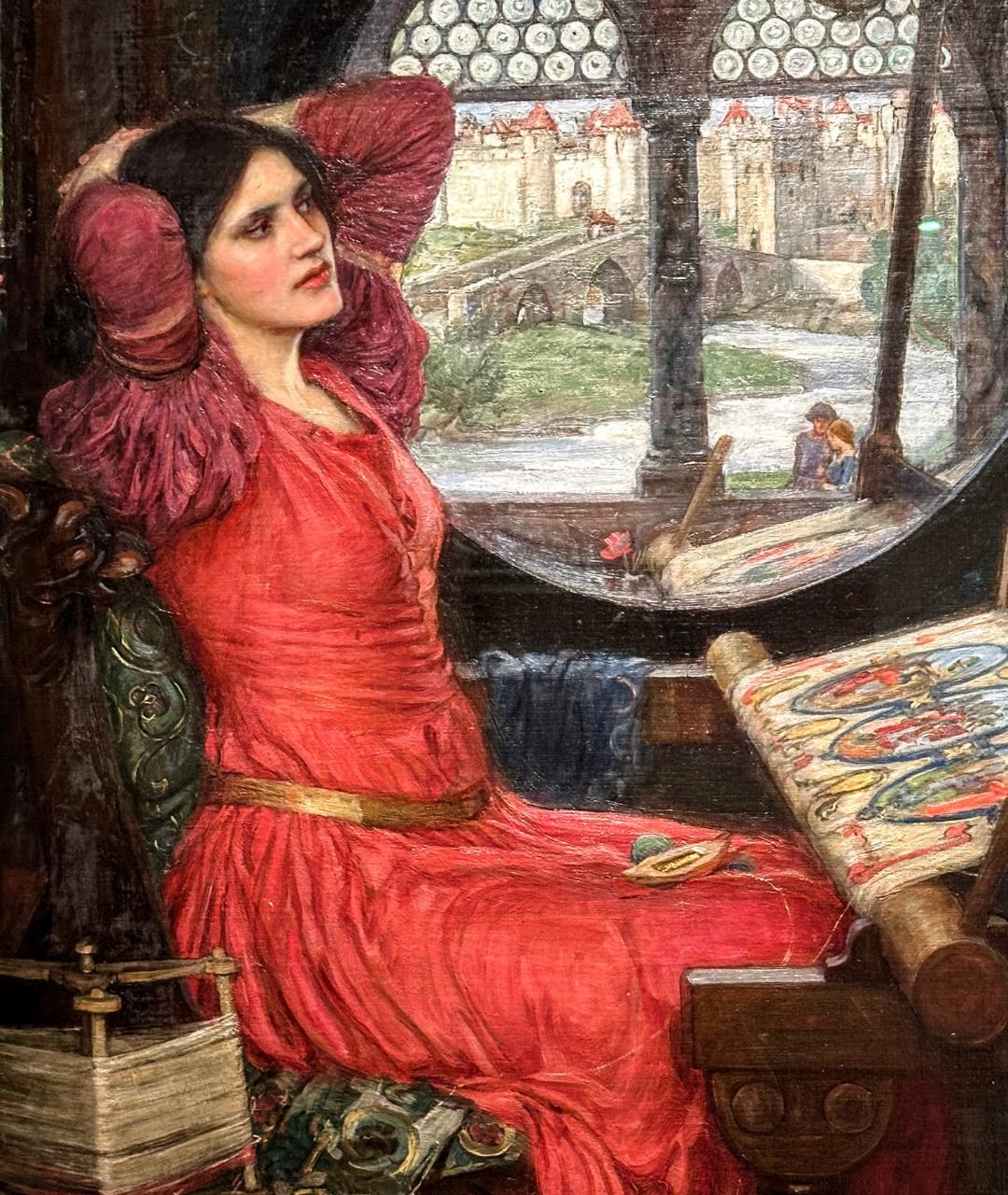
I’m Half Sick of Shadows, Said the Lady of Shalott – John William Waterhouse – English (1849-1917)
John William Waterhouse was born in Rome, prior to his parents moving back to England in the 1850’s. His paintings’ early classical themes gave way to genre paintings in the late 1870’s.
Oil on Canvas – 1915
By 1888, Waterhouse’s paintings reveal a growing interest in Pre-Raphaelite themes. He developed a penchant for ladies of tragic circumstance or femmes fatales. In 1901 he joined the St John’s Wood Arts Club. Here he served on the Art School advisory council.
Based on Lord Alfred Tennyson’s poem – “The Lady of Shalott” is from the legends of King Arthur and his court at Camelot. The Lady of Shalott, aka Elaine Astolat, suffers a curse. Trapped in a tower, she may not look out the window. She observe’s the world through a window-facing mirror, weaving what she sees.
Waterhouse and his wife, Esther, married in 1883. She outlived him by 27 years.
“I’m Half Sick of Shadows, Said the Lady of Shalott” is inspired by the first 2 verses in part II.
PART II

No time hath she to sport and play:
A charmed web she weaves away.
A curse is on her, if she stay
Her weaving, either night or day,
To look down to Camelot.
She knows not what the curse may be;
Therefore she weaveth steadily,
Therefore no other care hath she,
The Lady of Shalott.

But in her web she still delights
To weave the mirror's magic sights,
For often thro' the silent nights
A funeral with plumes and lights
  And music came from Camelot:
Or when the moon was overhead
Came two young lovers lately wed;
"I'm half sick of shadows," said
The Lady of Shalott.
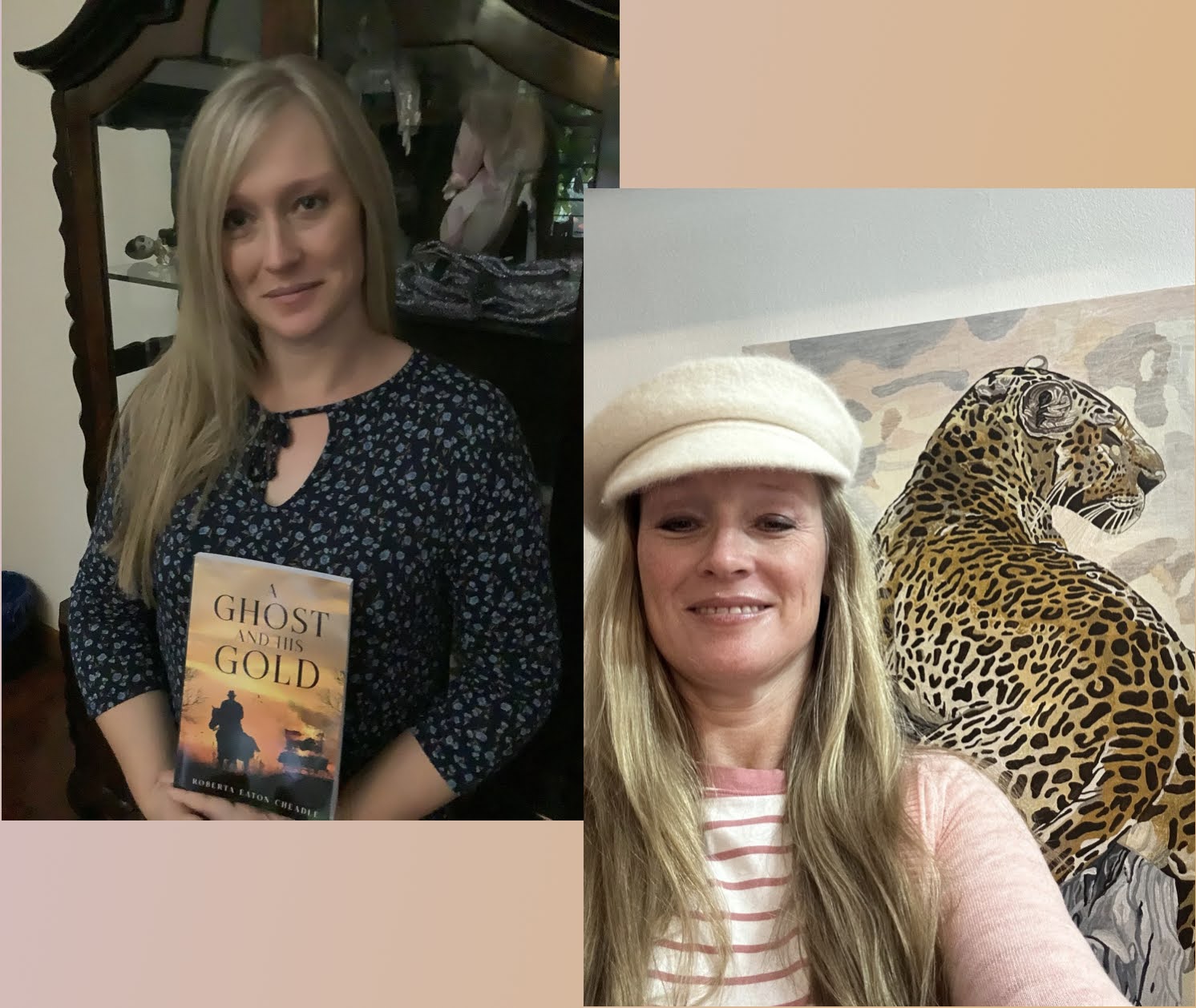
A prolific creator of art, poetry and prose, Robbie is the Bloggers’ Blogger. Her 2 blogs Roberta Writes and Robbie’s Inspiration will not just entertain, but sweep you around the blogiverse, where she shares a multitude of topics with her many blog pals. – Resa McConaghy
Harriet Boulton Smith (1825-1909) willed her art collection and residence, The Grange – “to serve as the first home of the Art Museum of Toronto. Built in 1817, the Grange is a national historic site,” – now part of the AGO
Please click on the below painting by Louise-Adéone Drölling, to view all research links.
NO AI was used in the research or preparation of this post.
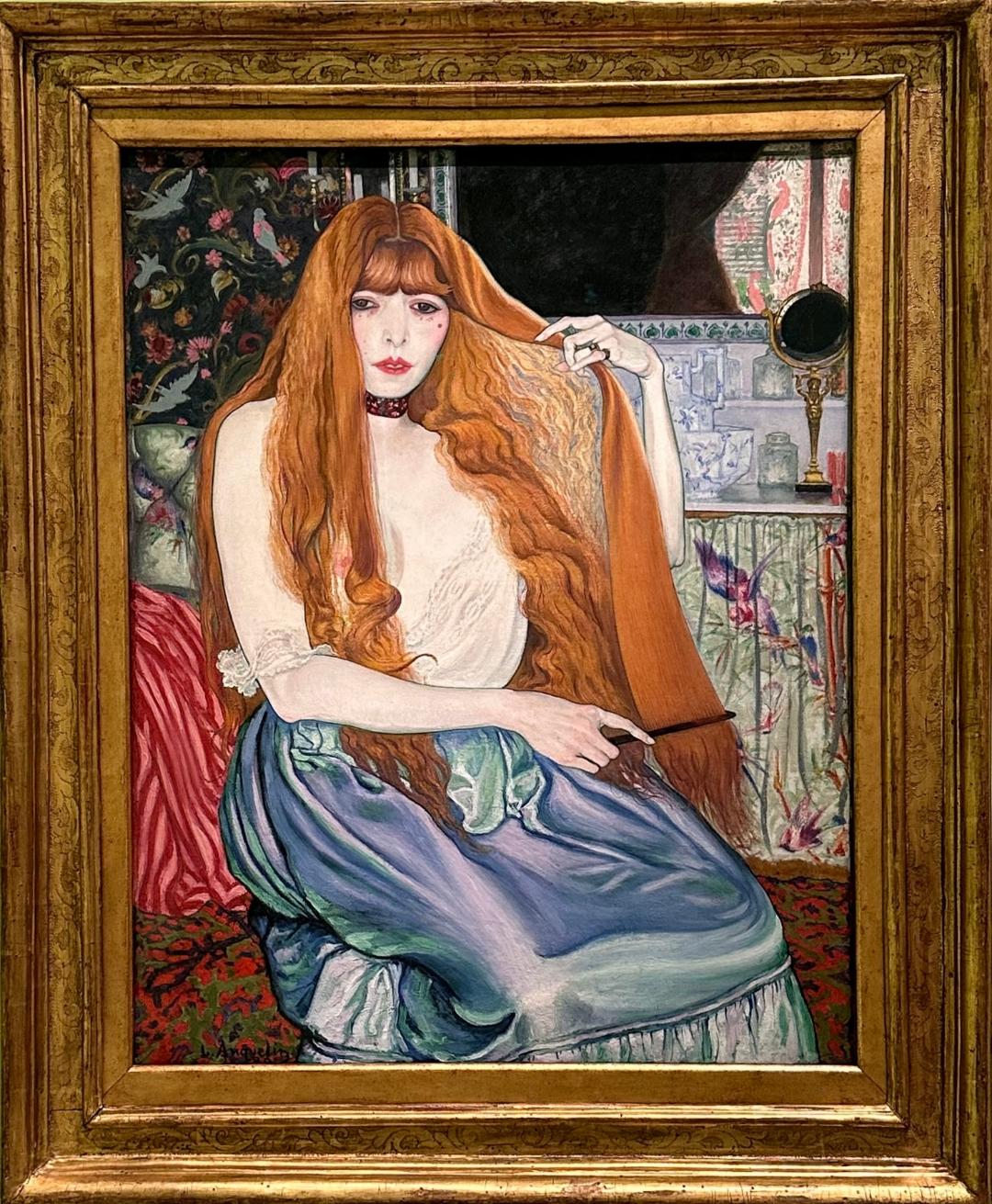
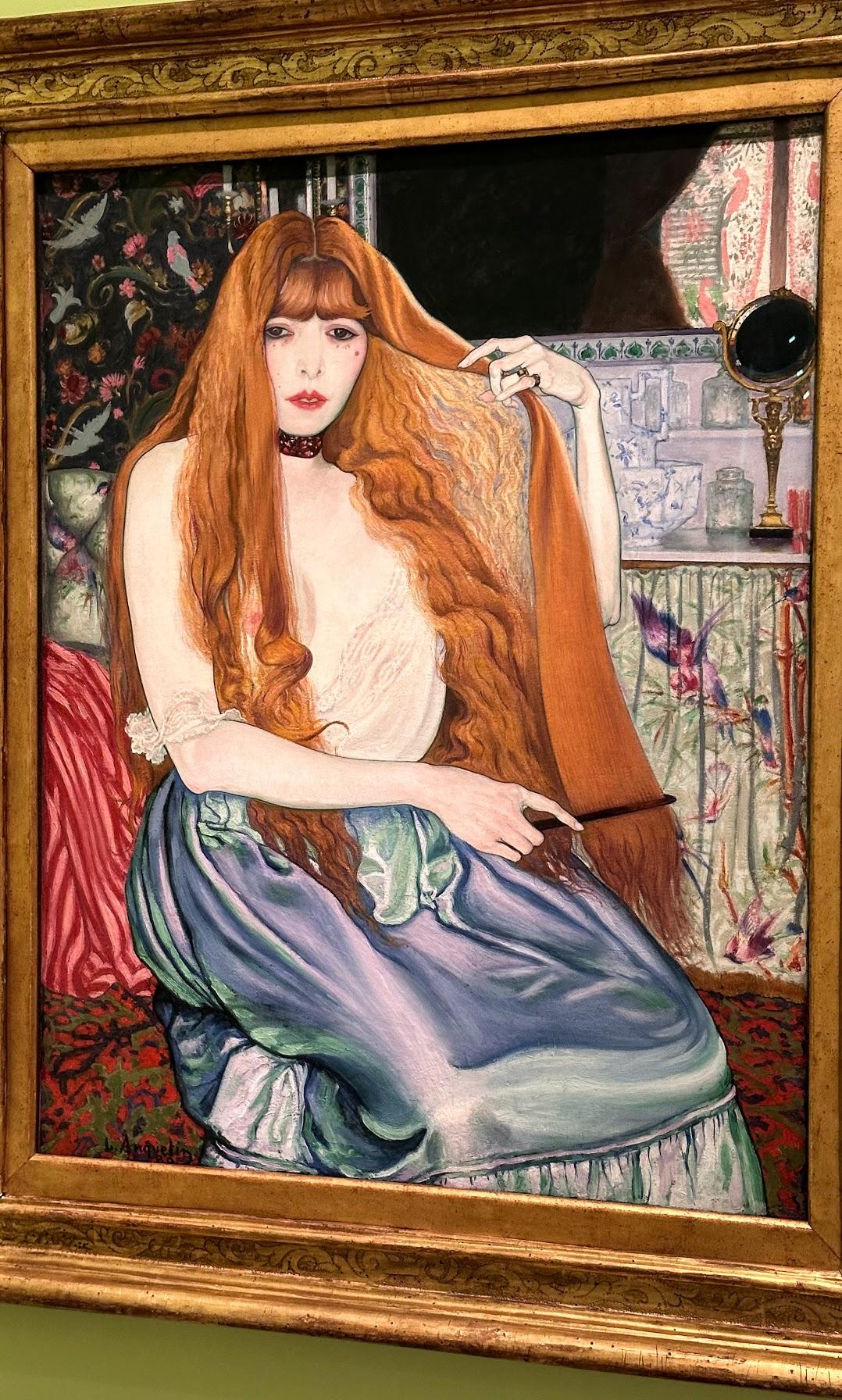
The painting mesmerized. Couldn’t tear myself away. In a spell, my thoughts were of Holly and her Sad Café.
Oil on canvas (1889)
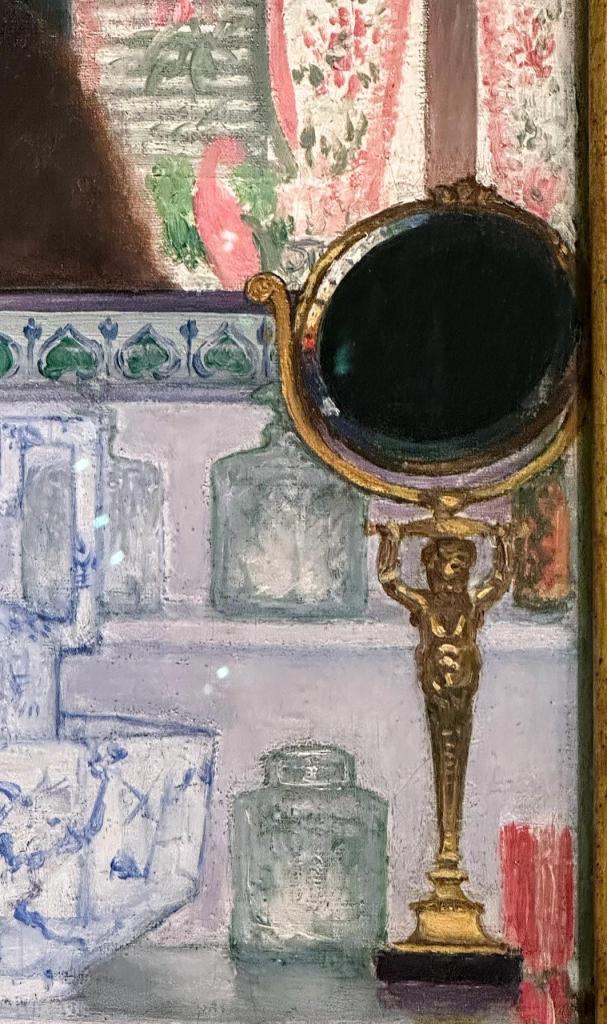
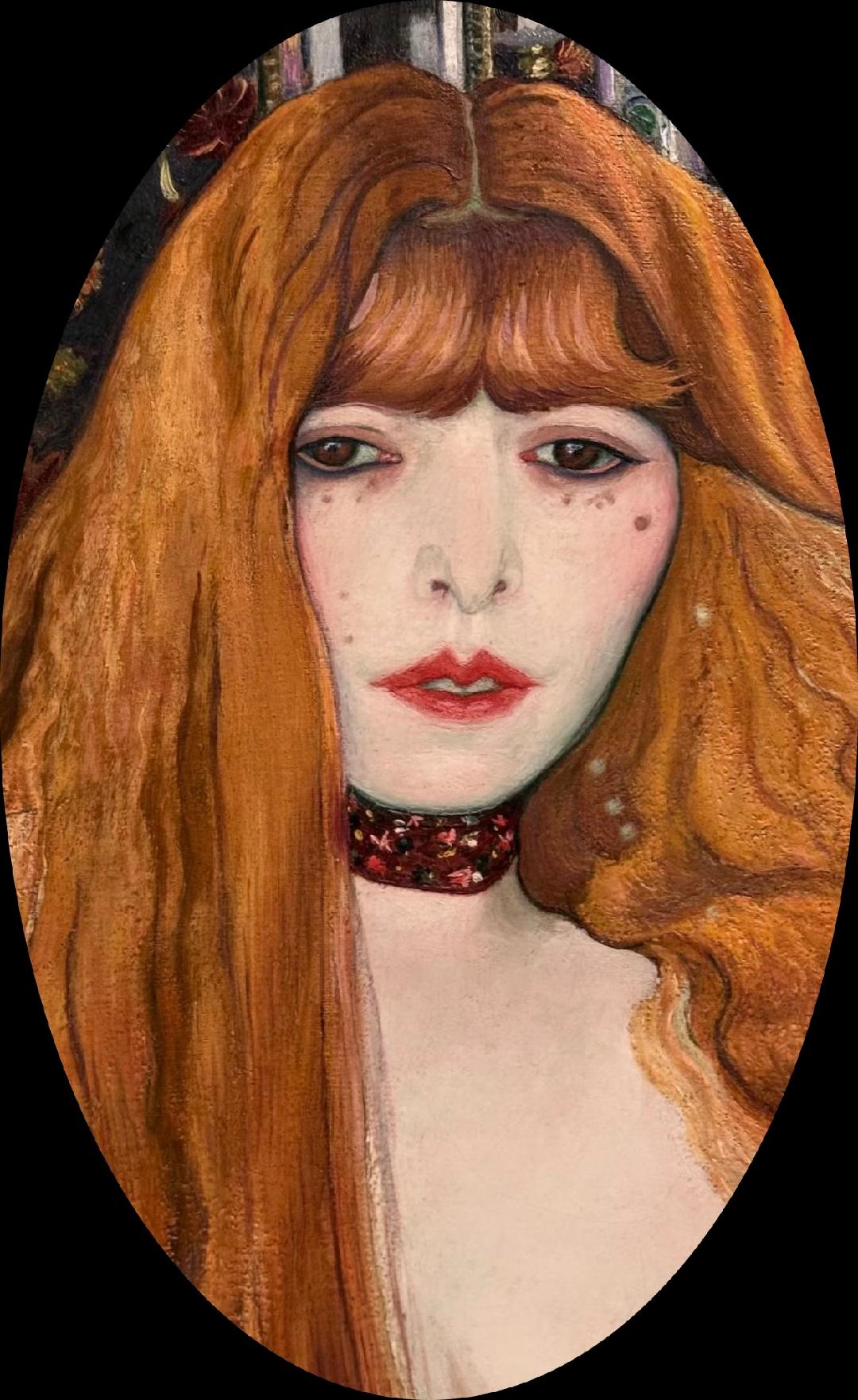
Woman at Her Toilette : Louis Anquetin – French (1861-1932)
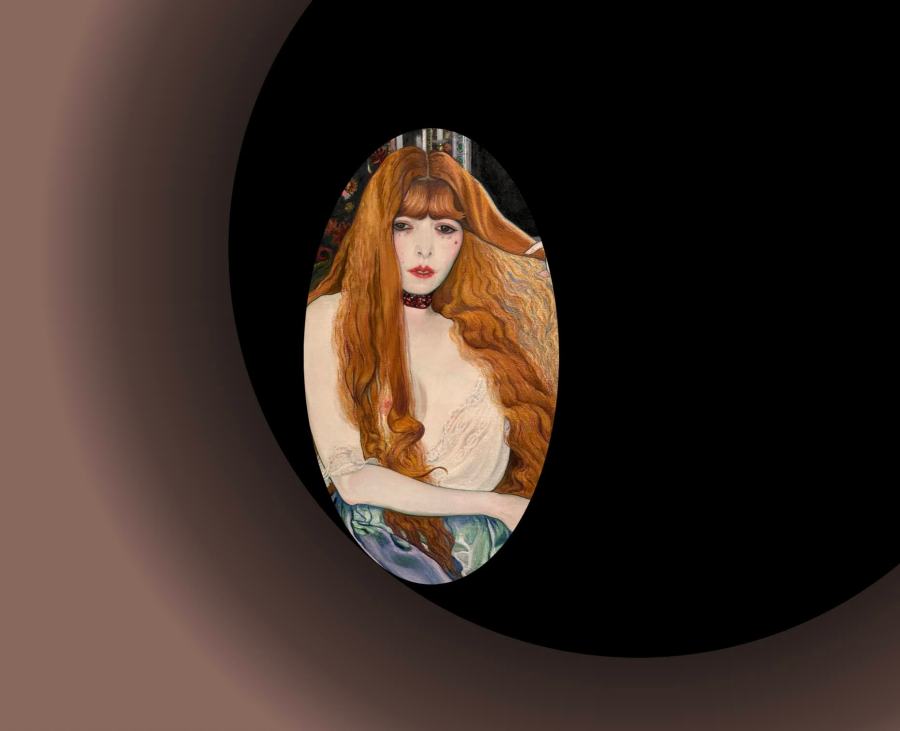
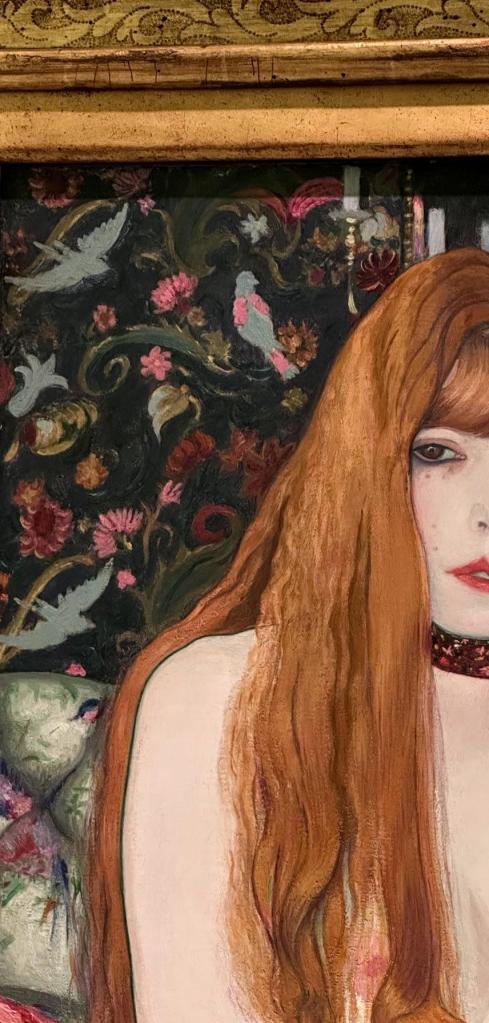
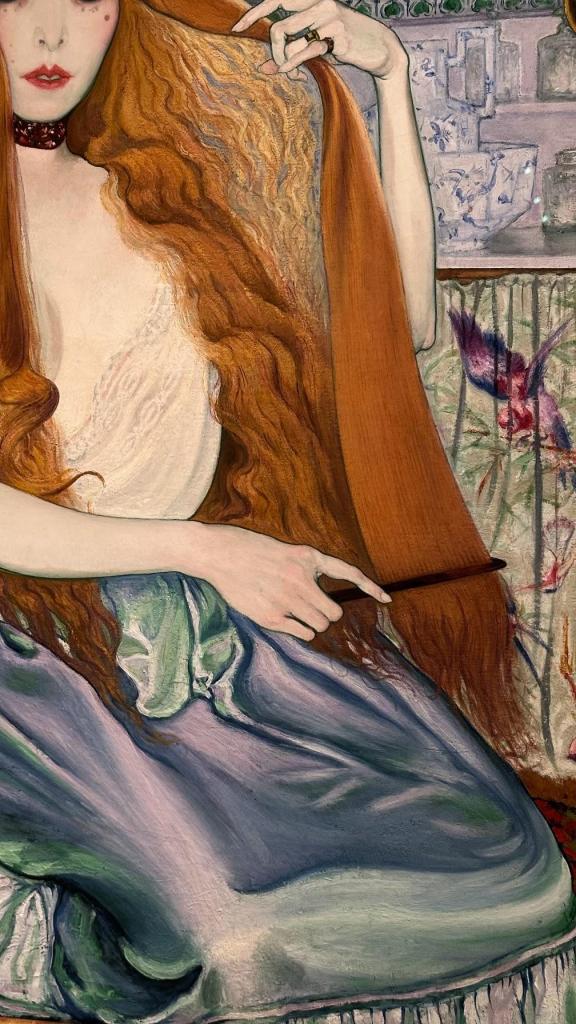
It was in the Salon titled Post Impressionism at the AGO. I was floating after having just seen Monet’s Water Lilies. Then I saw her, combing her long red hair.
At my mirror I braid silver thread through my hair.
“- though images of women dressing, are traditional within European art, the figure’s direct gaze and pronounced makeup suggest the she is a courtesan, a sex worker who catered to upper class patrons.“
My skin smells of yesterday’s perfume mingled with the haunting presence of strong cologne and the sweet scent of sweat and rope.
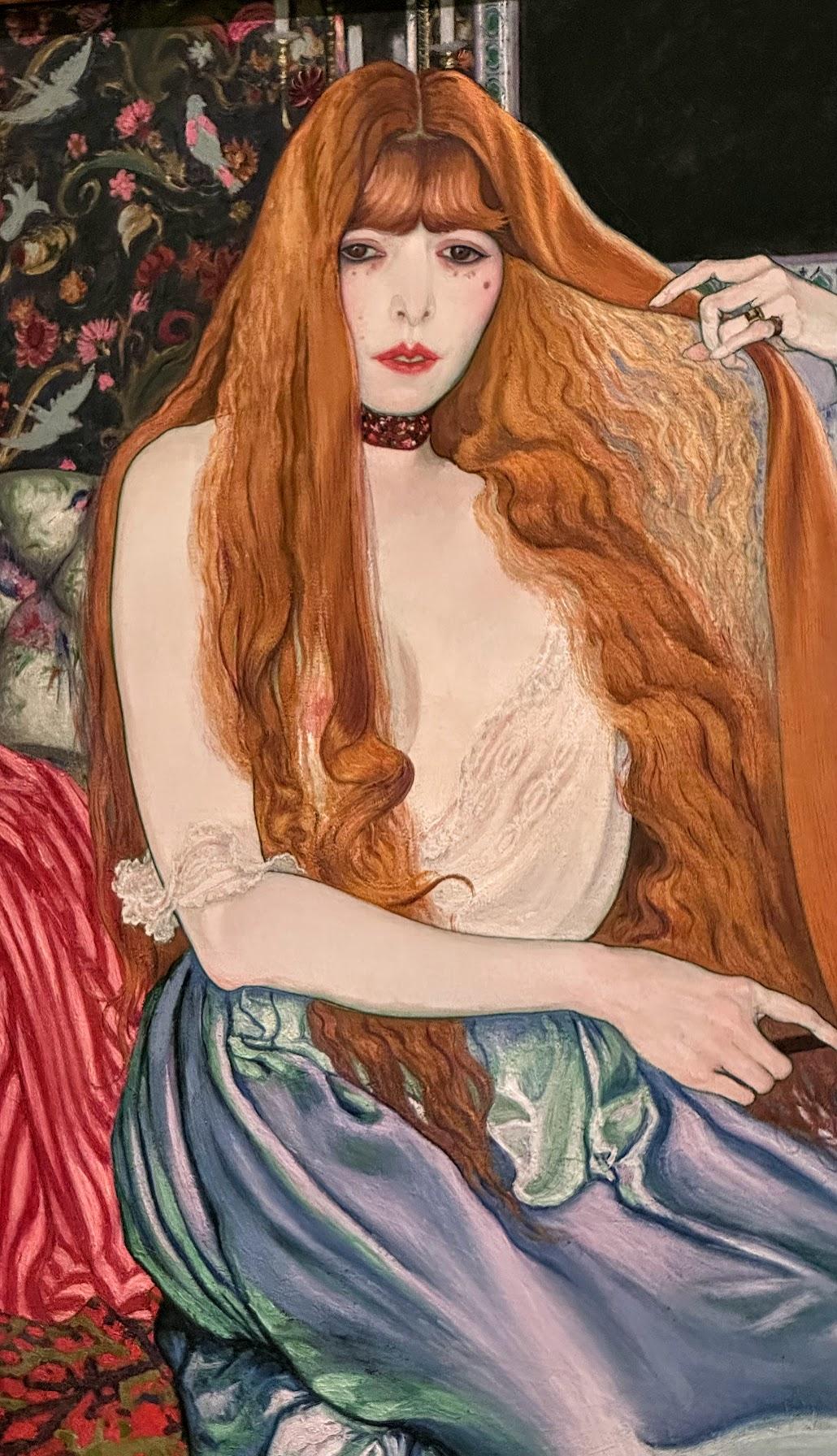
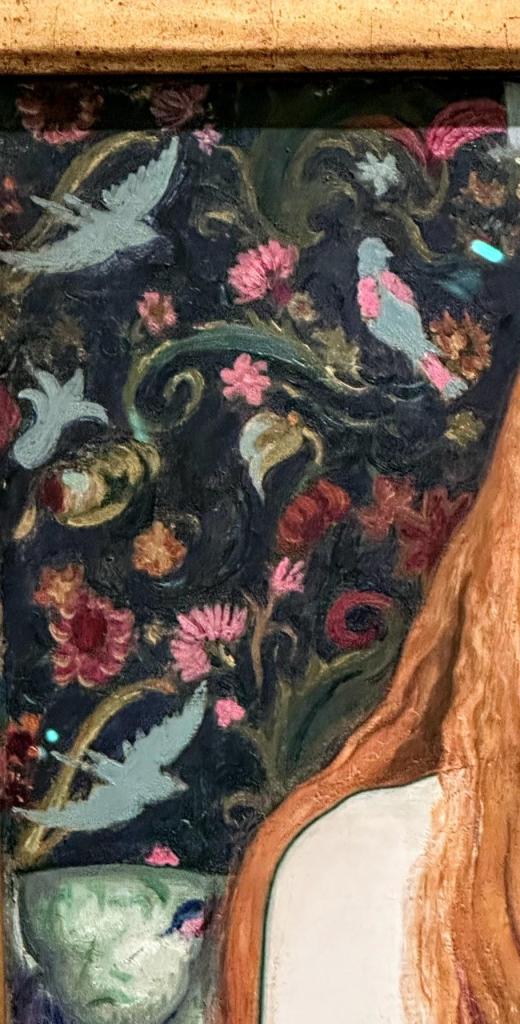
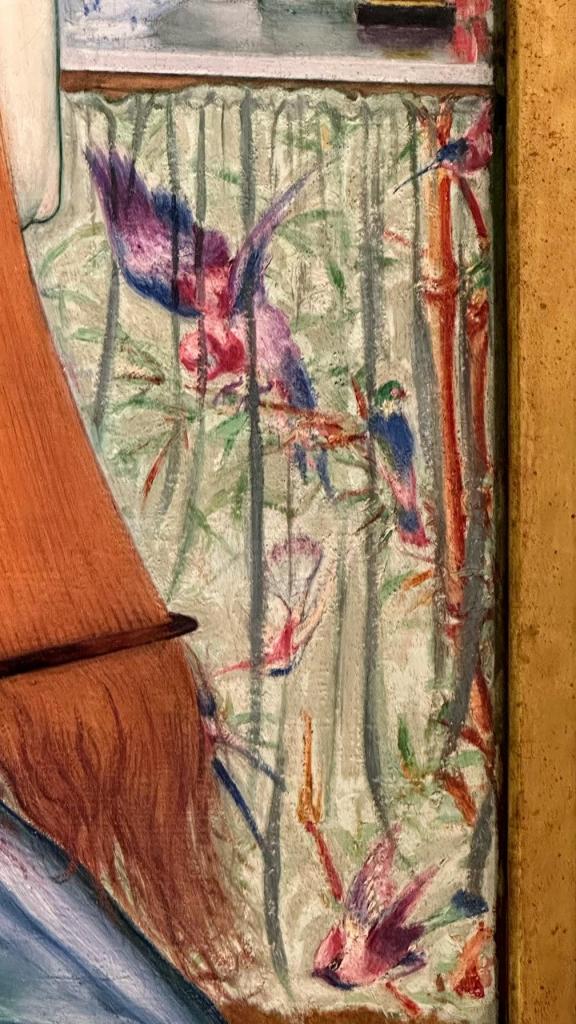
The details in this painting are luscious. I got in with the camera, as close as was allowed. The slideshow highlights shots of this Cloisonnism style work of art. The details are “Imitating medieval stained glass windows, cloisonné enamel and Japanese woodcut prints.”
“Cloisonnism features flat areas of solid colour enclosed by curving outlines, such as the green contour that encircles the woman’s porcelain skin.”
Cloisonnism was a bold new style invented by Anquetin, with his friend Émile Bernard.
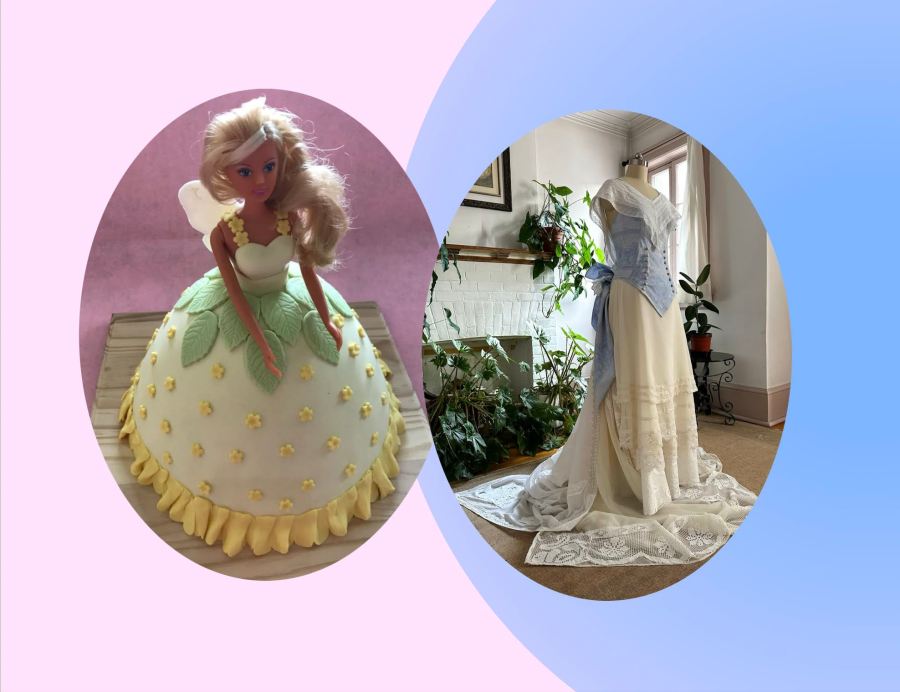
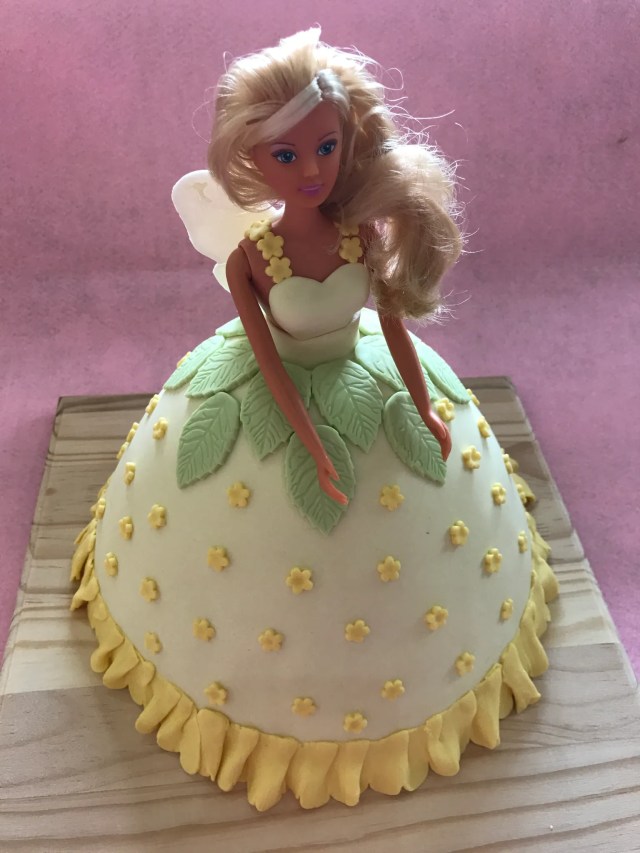
Robbie Cheadle made a fun and gorgeous wedding post on Latinos USA with Art Gown Victorian Sonnetand her fabulously creative cakes. Pop on over for a taste of beauty!
By the way,
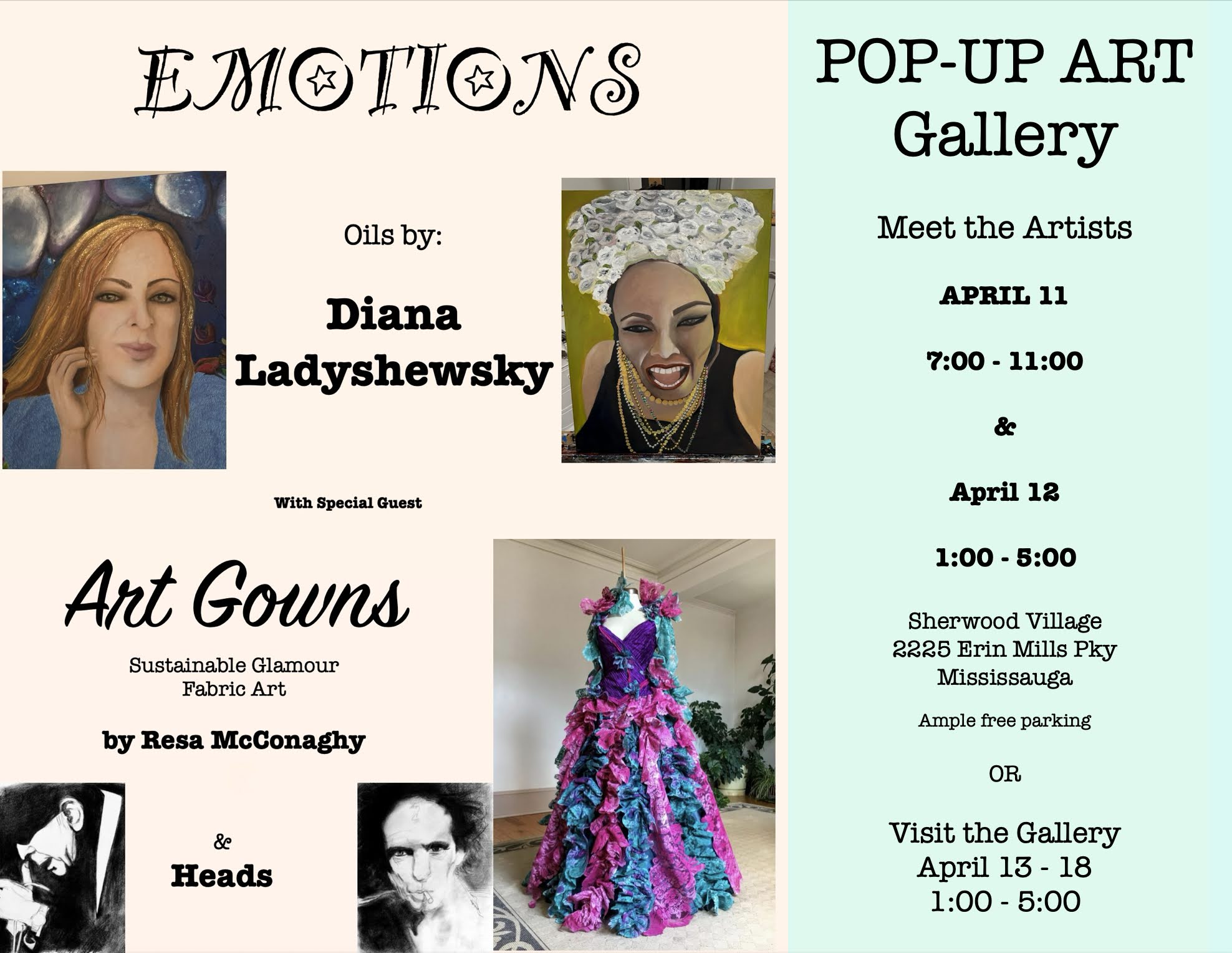
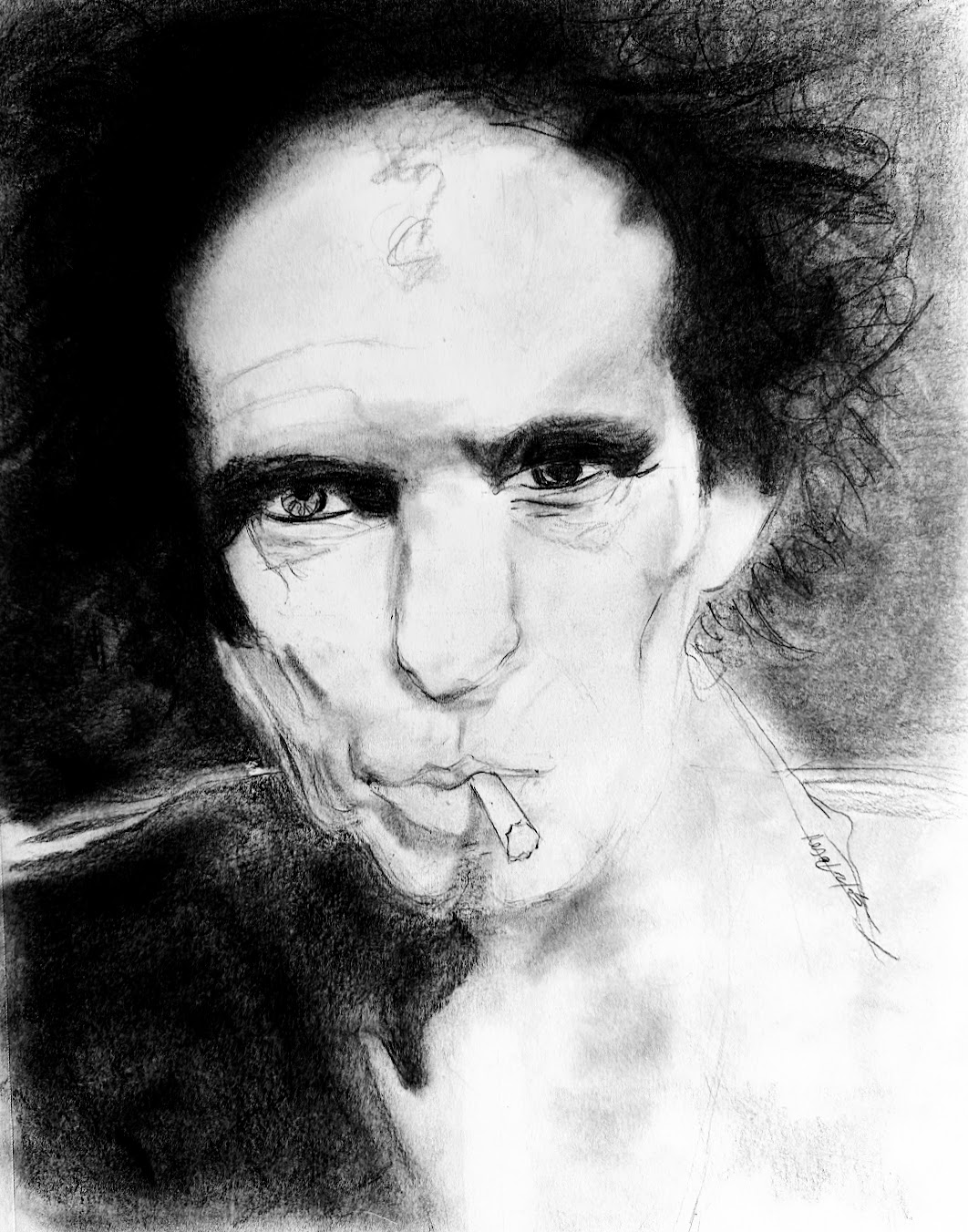
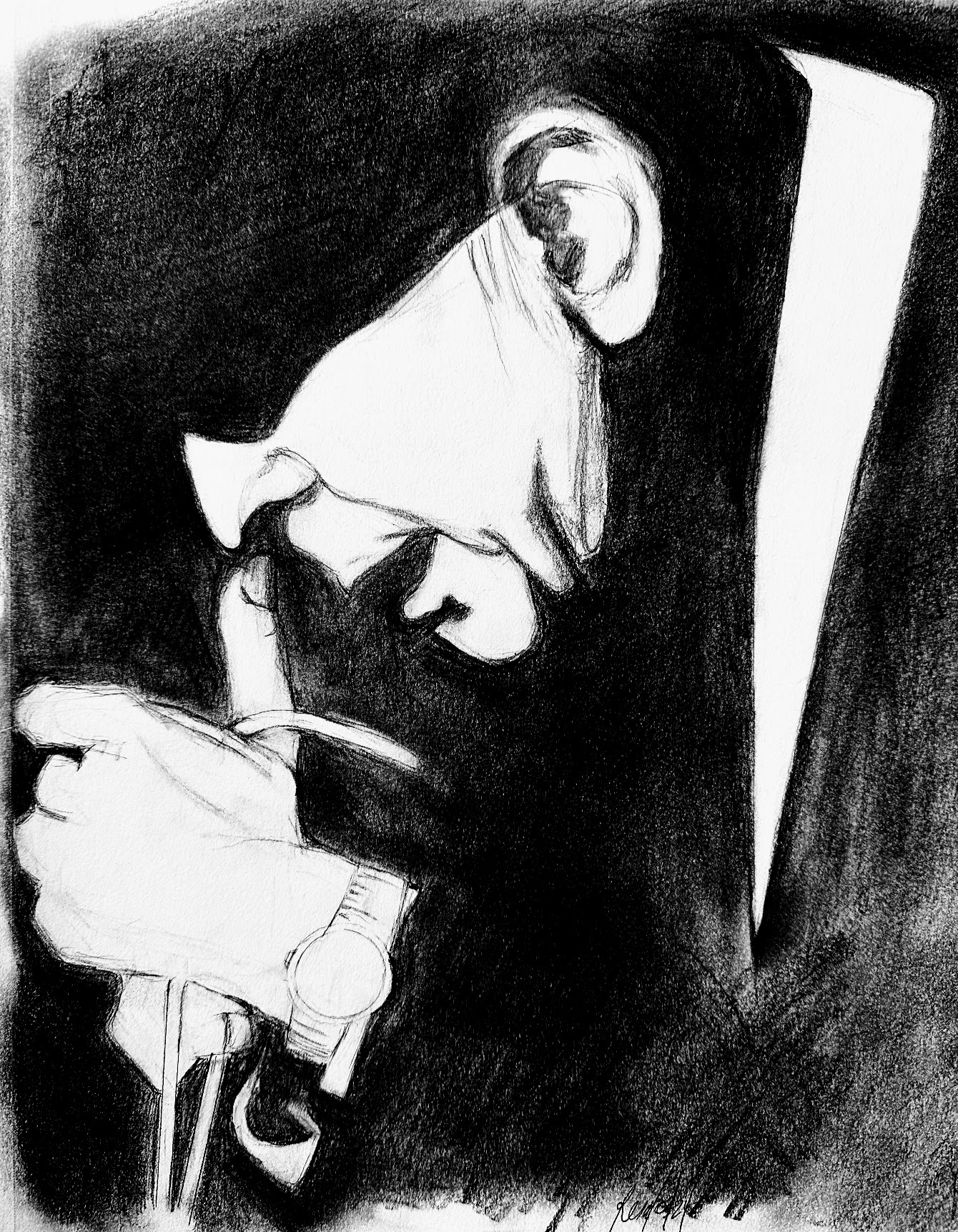
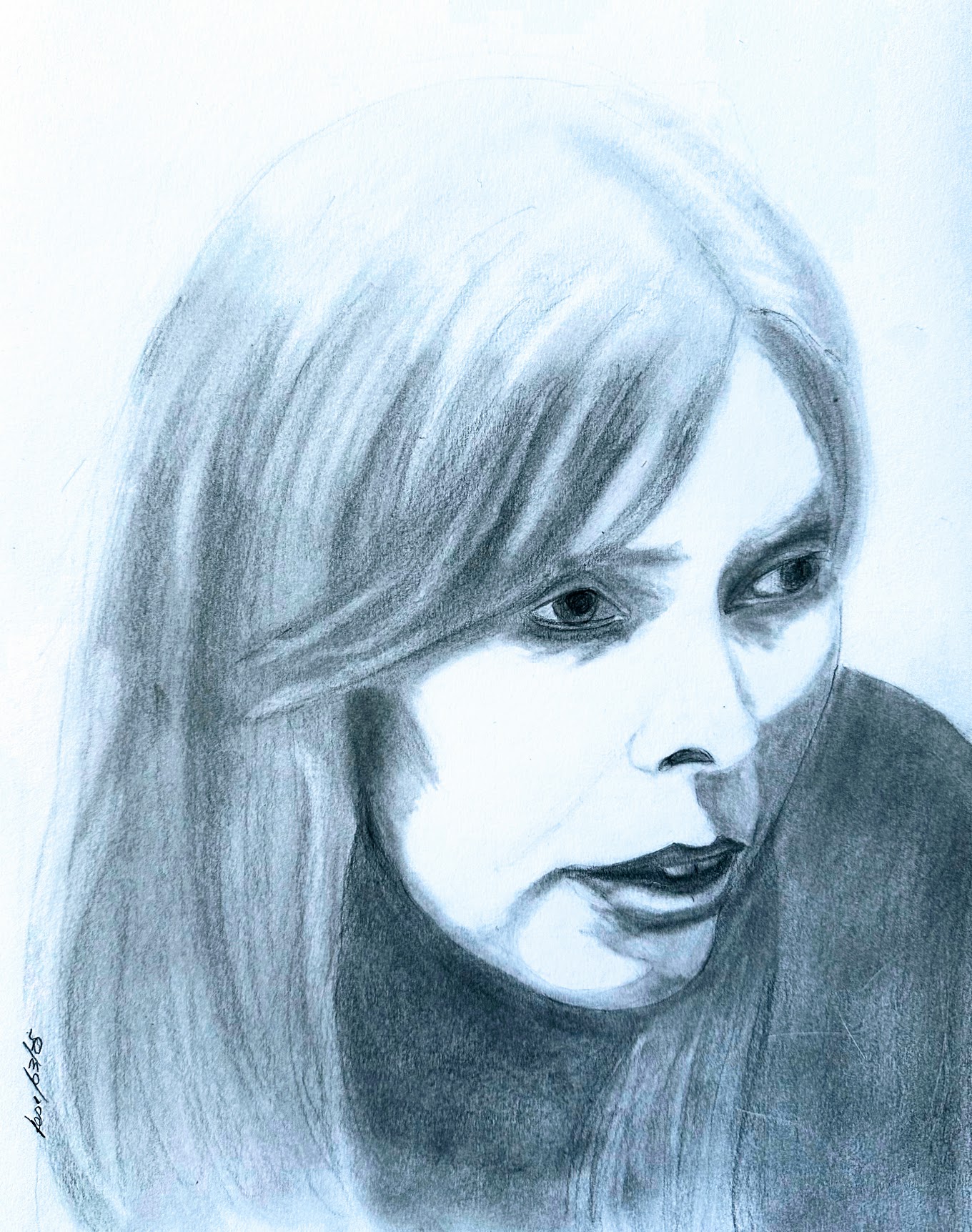
As a guest artist at my friend’s Pop-Up Art Gallery Show, I have space to show 2 Art Gowns.
A few Art Gowns pics printed on faux canvases, then painted over selectively with iridescent paint, will also be there.
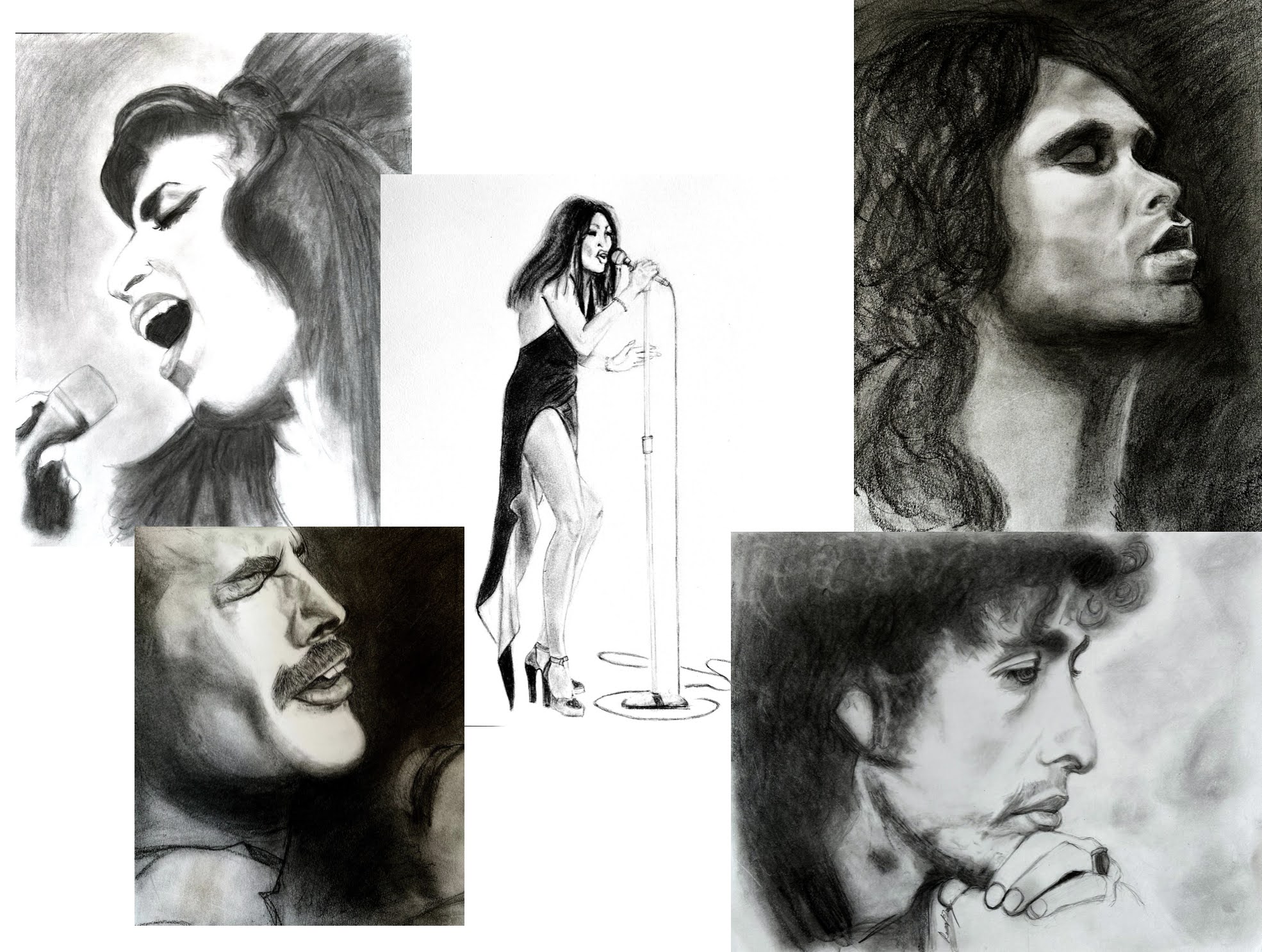
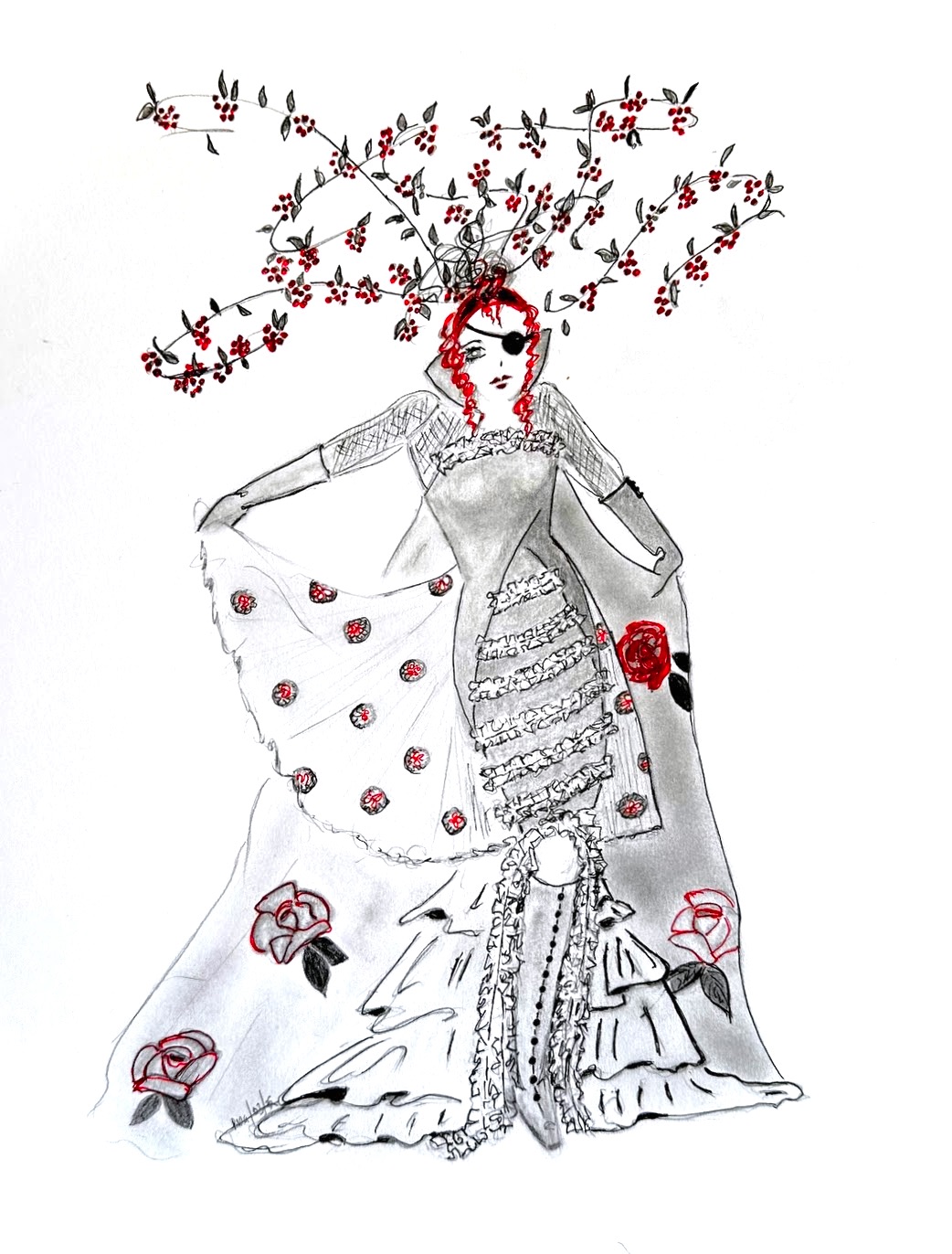
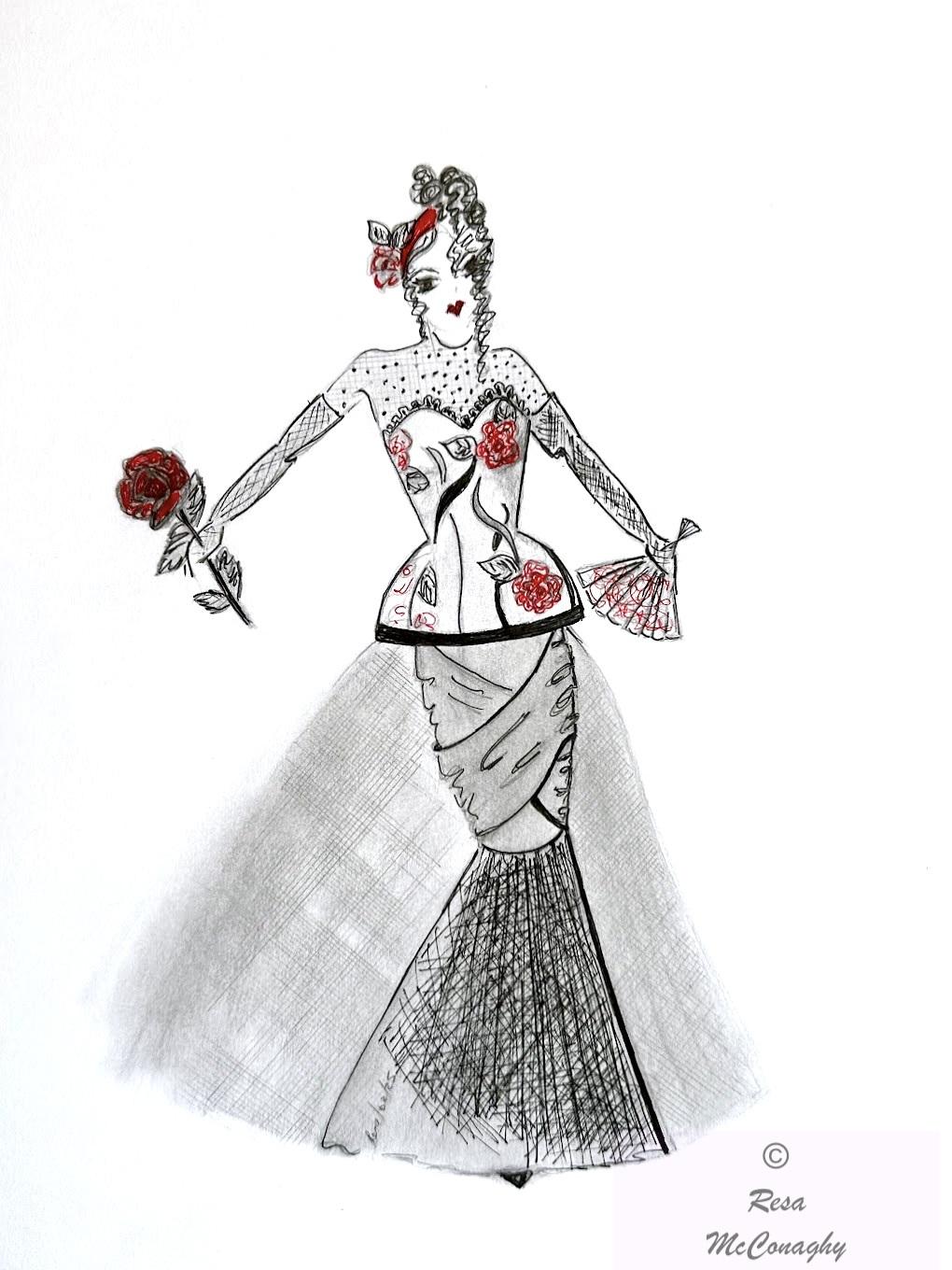
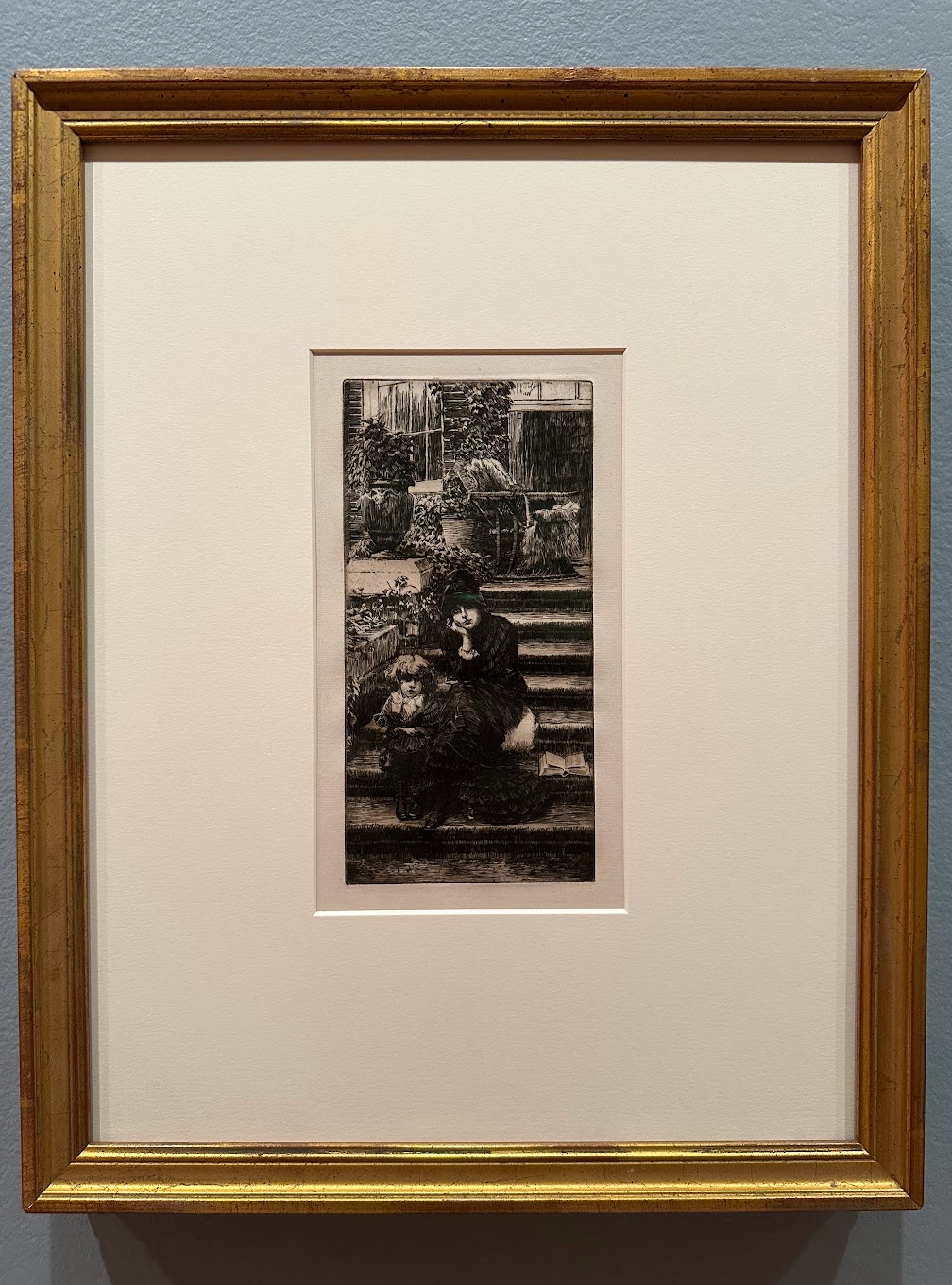
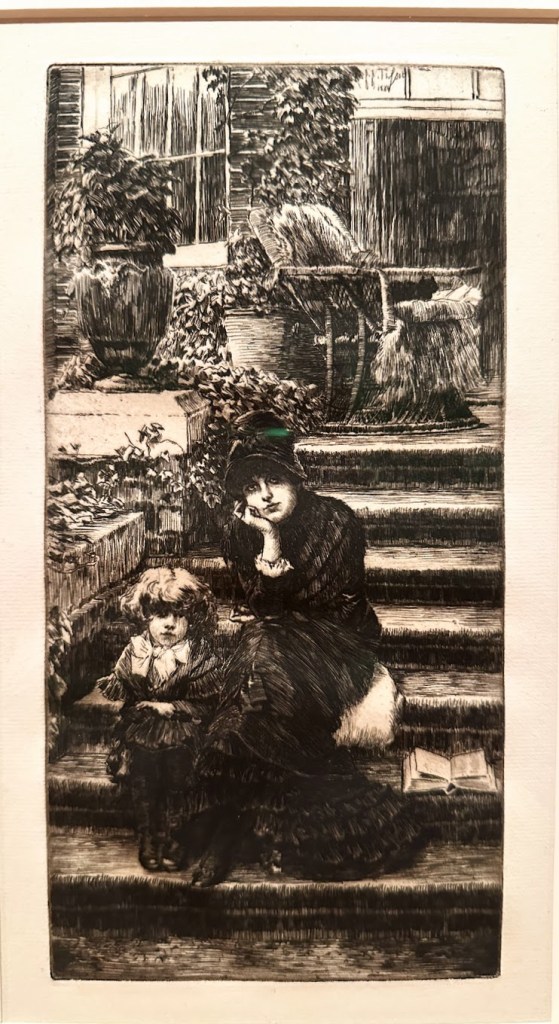
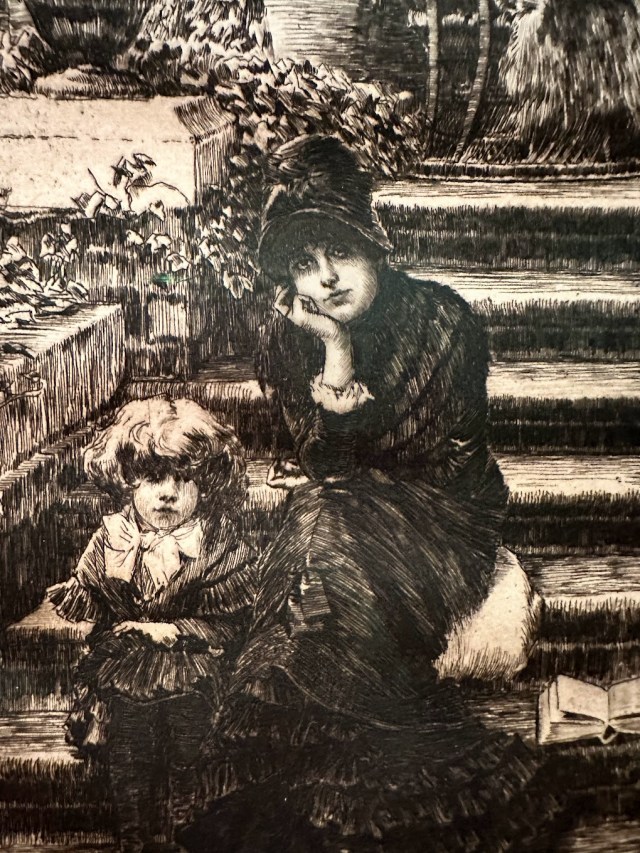
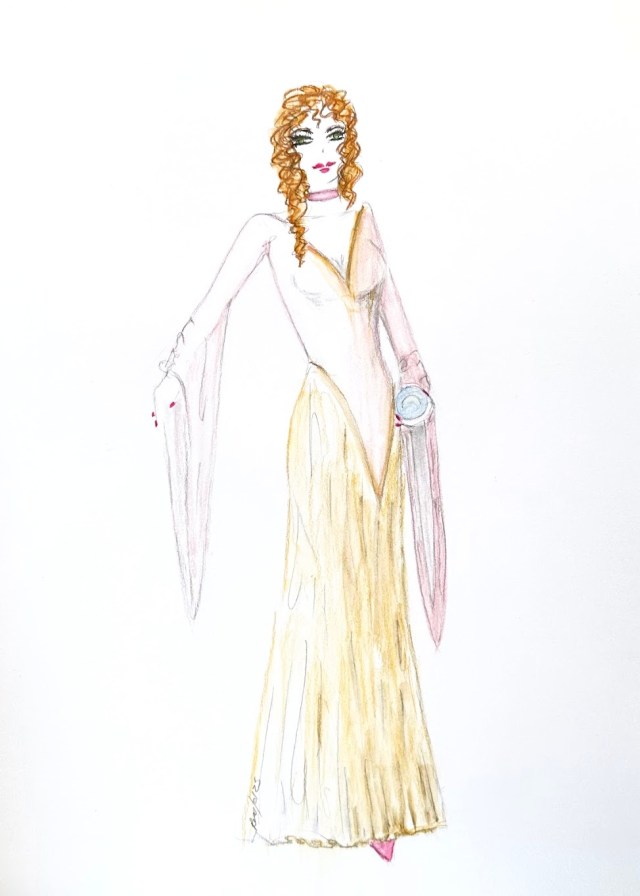
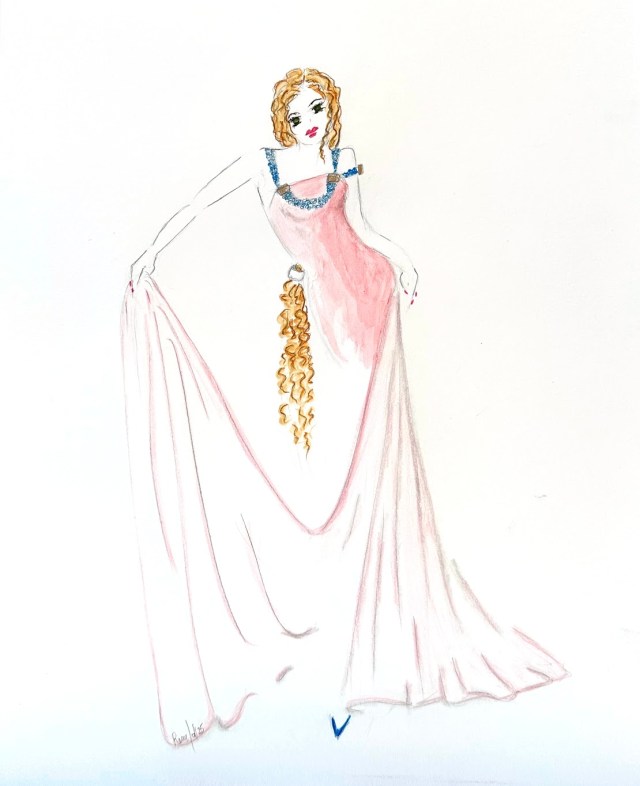
Additionally, five portraits will be on a slice of wall. The 4 below are now framed.
One of the drawings below will be the 5th. If you’re leaving a comment, let me know which one you’d pick!
This is my first time showing in public, and it is a small sample try. If you are already in Toronto, pop by if time allows!
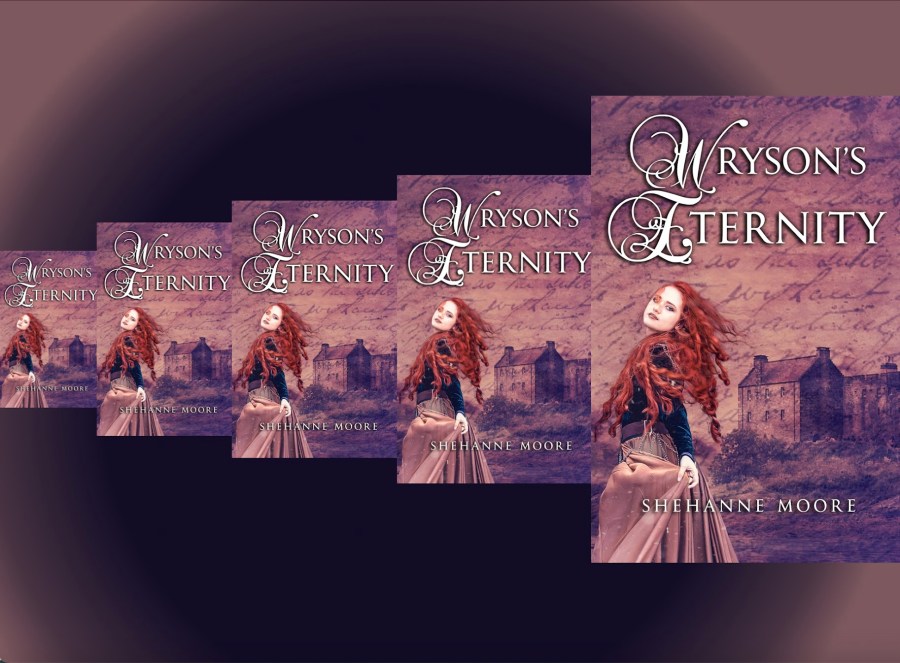
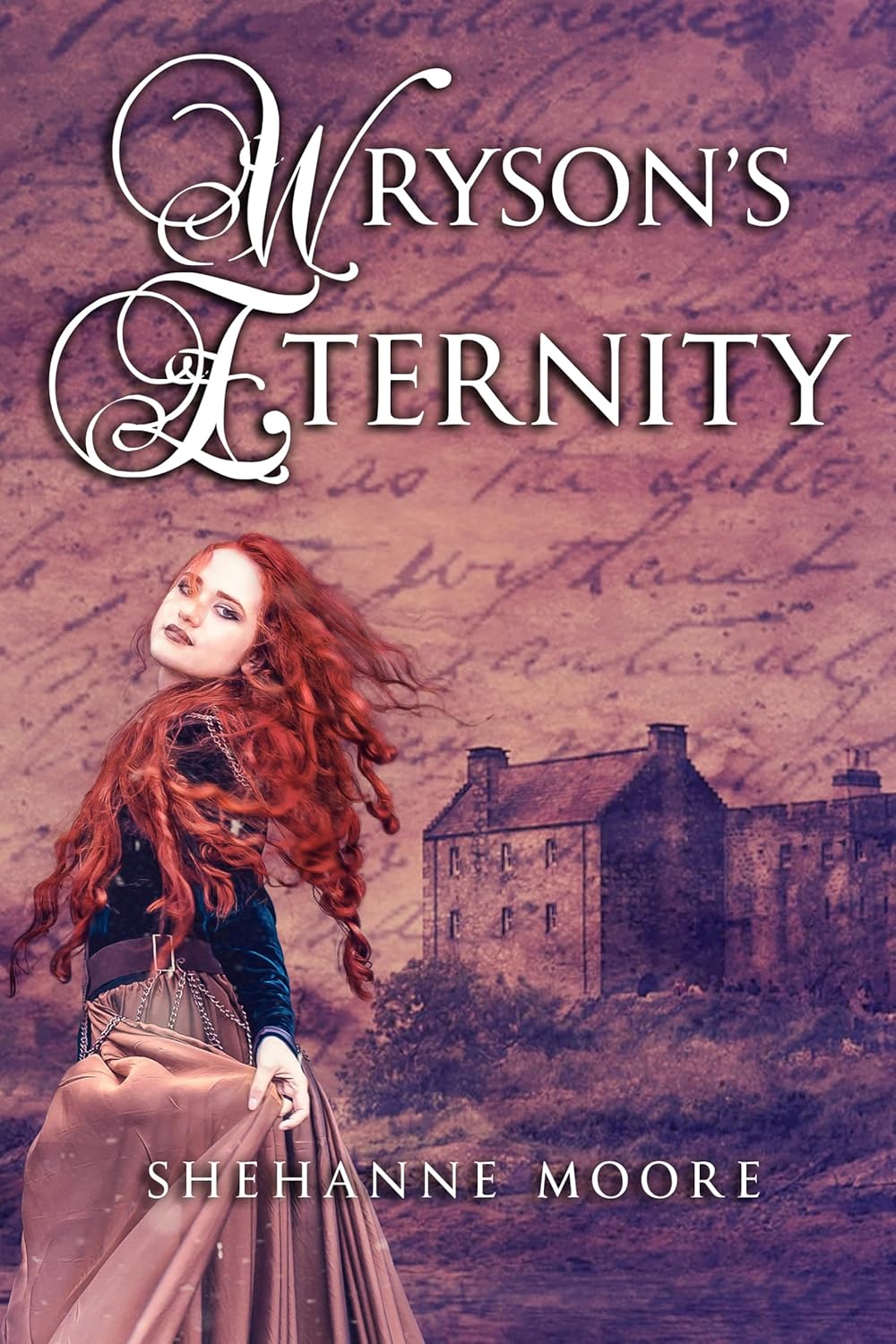
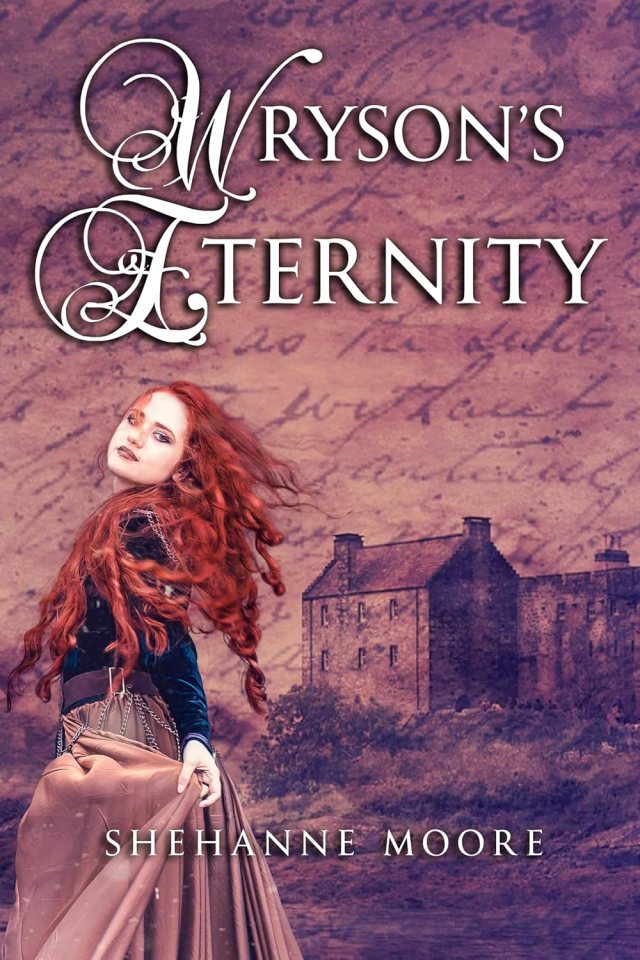
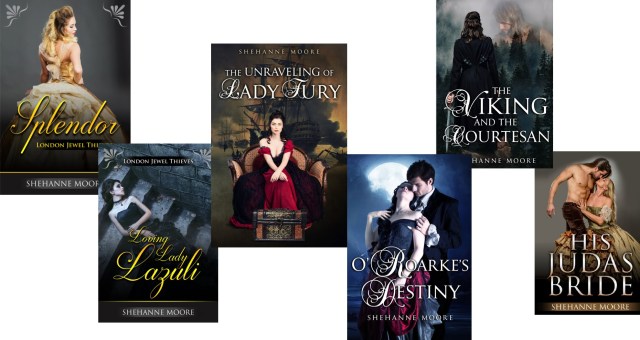
As a huge fan of Shehanne Moore’s spirited, independent female characters in her period romance novels, this book has been long awaited.
“If it is worth having, it is worth waiting for.” –Oscar Wilde
The “Nicking Coat”
Oppressed & beaten by a beastly husband (Baronet Byron Jones), Lady Jones flees. To afford her vagabond lifestyle, she engages in petty thievery, lying, sleeping in forests and dealing with the less than savoury.
I now realize the hat is scripted black.
As she uses her coat like a tote bag for her nicked loot, I figured a man’s frock coat would have large pockets and the roominess required.
Shehanne – I just love the coat and hat. So her. I do love you calling her coat the ‘nicking coat.’ The woman lived rough for a bit.
Resa – Then one day, she haps upon a deserted cottage; where Gil Wryson haps upon her.
Shehanne – And that was it, but she had to like the wee life she’d set up for herself in Pencliff enough not to bolt and go back to the awfulness of life on the road. AND everything…even the way the mail worked and money worked with regard to banks in these days– all the things that made her life so difficult on the run– fitted..
The Ball& the Gown
In terms of defining what Eternity might wear, I looked at the out going Georgian era and the incomingRegency era.
Resa – I was tortured waiting! Was the ball in, or out? Why did you end up putting the Ball in, and how did it serve the story?
Shey – … Okay Resa, well the simple answer to why I put it in, having decided for her to leave beforehand, is YOU. Yeah, there you go. I thought about the fact that I’ve a ball or a dance/party, or a feast/dance in quite a few books and these are tied with pivotal moments in the plot.
I also thought if she leaves after saying she’s going, then he is going to find it hard to forgive her–they have somehow come together in the planning and prep for this ball. And she has a huge reason to quit while she’s ahead here in terms of news she gets that very day. But then I thought of you and the beautiful gowns you have designed for my ladies down the years and I thought what is a book without a ball and what is a ball without one of your gowns?
My first thought of the ball gown.
Shehanne -I also thought when it comes to Wryson ever forgiving her, when it comes to her thinking, she just might have got something in the bag, with regard to ‘the future?’ Him too. ’Well? That ball then sets up everything in terms of her state of mind as she goes to tackle what she must tackle. It paves the way for how she is only paying half attention to what she really needs to have her eyes fully on because she’s let something into her life she can’t let in.
Shehanne – It let me trowel on a bit of passion and anguish and quite a mess, shall we say, regarding what happens next? Things she feels responsible for, secrets she is going to have to keep, things about herself, she doesn’t know she can overcome. SO yeah, I think sticking to my original plan would have been wishy washy.
Resa – When her ball gown was first spotted in Gonetta’s, before I read on to any description of the gown, I immediately saw the green one in my mind.
Shehanne – OOOOHHHHHH… the one Wryson had to pay from Gonetta’s cos she’d have nicked it otherwise.
Resa – YES, the one Wryson pays for – BUT – it is the image I got in my mind (being a costume designer) before I got to the parts where you describe the gown – a backless cream gown. . Can you believe how different our visions are? What do you think about that?
Shehanne – I think it is great actually that the visions were different. It said to me that you were really picturing her–and green is a noted color she wears. I imagined she was drawn to the shop and it reminded her of past balls, even if the main one she remembers was the night she got pitched into a Turkey oak, after first chucking herself at the man she loved.
--this is backstory before Wryson lands on her doorstep--

It reminded her of not living  hand to mouth on the road. So she wandered in and got herself a fitting with the intention of   dancing  on her own in Dark Falls--which we know she does-- in that gown.

Alas it defied her nicking abilities. But she probably told herself she could maybe nick the dosh. She’s very good at NOT getting things done too. But being her she probably got fitted for more than one.

So it was kind of deliberate on my part not to describe the gown at that point, because she is also capable of going there and nicking some other  gown off a rail of made but not paid for gowns.
Resa – I honestly like your gown better. What do you think about that?
Shehanne – What can I say but awwww…. truly, and you know a description can always be changed in a book.
Resa – Well, I am thrilled you had a ball. It is a pivotal bit, and if it was a movie, the big money beauty scene. Of course the carriage bit is the big money stunt scene.
Shehanne – Alas, I always see book scenes as movies. One of my fav freelance regular writing gigs ever was for girl’s comics for DC Thomsons. YOU HAD TO WRITE IN STORYBOARDS. YES!! So many frames per episode, dialogue/thoughts and instructions to the artist only on each frame. Always end with a cliff hanger.
Back in London
Resa – Here are the drawings, for court & carriage! The full skirt outfit would have already been in her closet before she escaped. The other, would be a new dress, the latest Regency fashion.
Shehanne – Yes, I forgot she has a fancy new coat for the court scene, her ‘other’ fellah having had enough of her special one.
Shehanne – It is what I imagined… Fashionable, dressy because she would need to be both and not look like a ragbag.. There is the bit about Billy having taken her famous coat —obvi she left the cottage in that coat and he would have seen to it that she got some decent clothes in London. And yes the first would have been the kind of dress she’d have worn to balls before and during Byron.
Inspirations
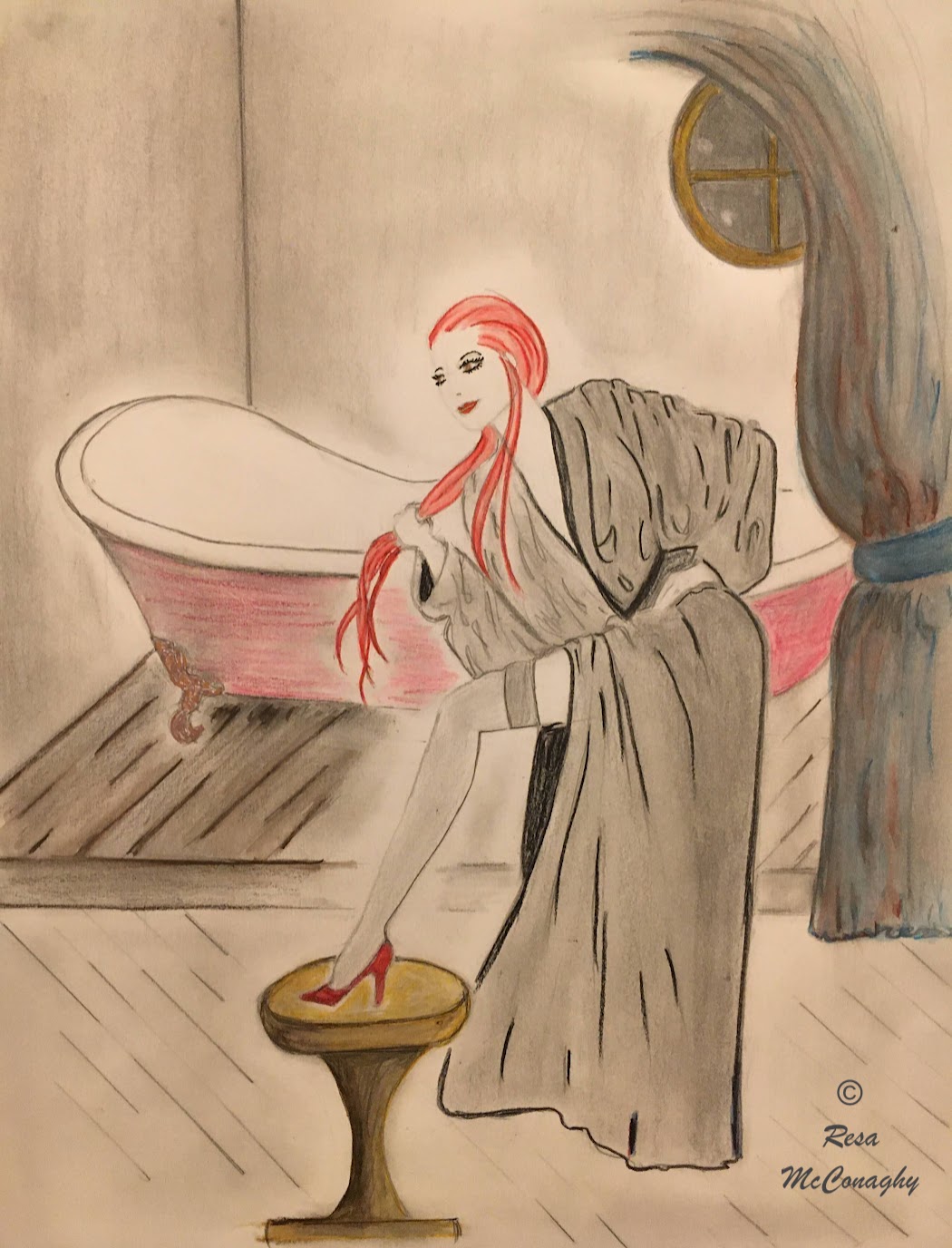
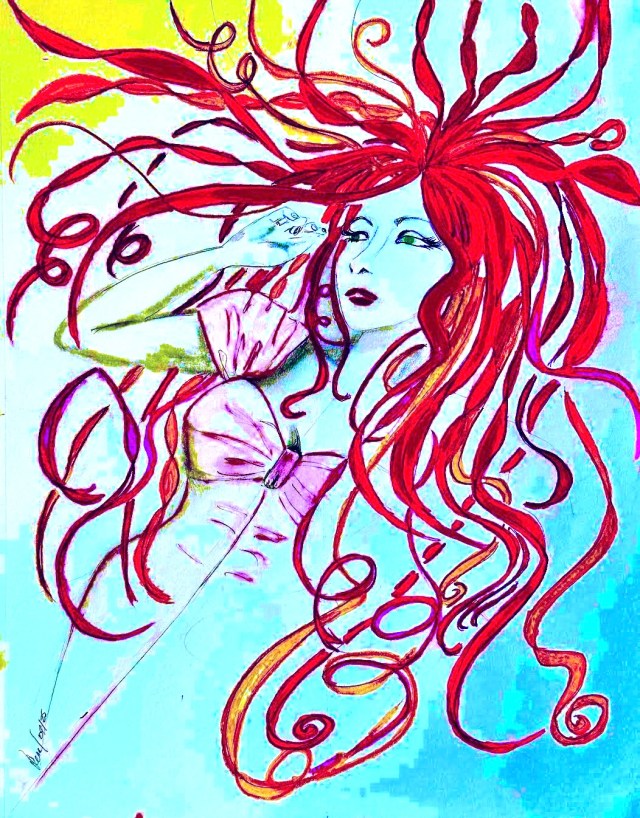
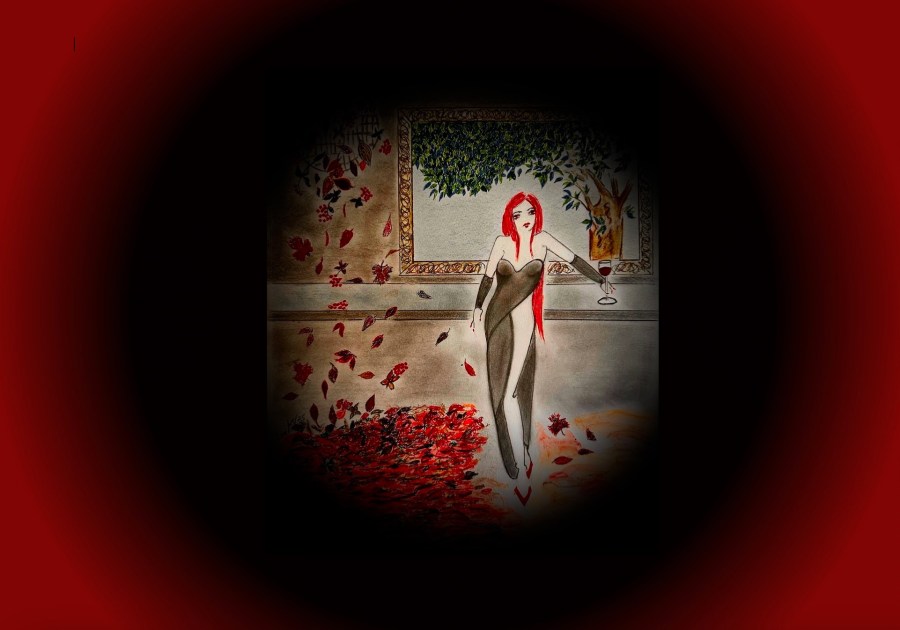
Resa – So I was inspired to draw Eternity in a metaphoric sense. I had thought “Hair of flames” because what comes out of her mind and mouth is so fiery, literally, but this came out of me. Did I capture her in that metaphoric sense?
Shehanne – You have captured her perfectly. You always have the sense of my ladies but she’s off the scale in many ways.
She’s wild, she’s free, she’s guarded, she’s bruised, she’s moody, she’s mouthy. She walks tightropes when it comes to functioning. She is her own worst enemy, Above all else she is a survivor and it has been of some horrific things. She is really very difficult and you have amazingly captured all of that. Wryson is of course not in the best of places himself, but even if he was he’d still be emotionally confused by her.
Resa – You recently posted about Mary Eleanor Bowes, the great-great-great-great-grandmother of Queen Elizabeth the Second. At 11, she was left the richest heiress in England, between 80 and 120 million in today’s terms. Twice married, she was beaten, burned and more by her husbands.
Shehanne – I thought I’d blog a little of some of the inspirations cos I started as I aye do, with no plot just the idea of picking up the woman who makes a very fleeting, at a distance, appearance in “O’Roarke’s Destiny” and setting her in an abandoned house cos I love abandoned houses.
“Suppose she is sitting there and passing herself off as whatever and then Wryson turns up and says it’s his house,” I thought. Then I obvi had to suss it out from there and I also thought at that point of the dreadful hubby and the unhappy countess.
Shehanne – Despite a descendant marrying into royalty and giving birth to Elizabeth 2nd, the story is not THAT well known. But it is interesting on so many levels. I primarily used the violent hubby because I needed a reason for Lyon to have a hold on her.
Resa – You built a strong, feisty female character, in a time where women had no rights. It’s inspirational.
Shehanne– You are right re: the lack of rights. I gather that Mary was not sympathized with because of the lovers, because of a lot of things she did and it was something that she actually got a ruling in her favor.
About Shehanne Moore
“I christen all my characters with care. I actually love thinking of what their name is going to be.“
There is music. The cafe is filled with revellers. Their drunken laughter is loud, but the seasons slip away, and they need something to remember.
A year has passed, and I still light my candles for the window and hope fades like summer into fall. The mirror has no mercy, a reminder of all that has passed through these hands. There is no holding back the past or what lies ahead.
The night deepens as we raise our glasses to the seasons of honey and fire and the aching memory of lovers slipped away.
Snakes and Metaphors
suspended
At the top of the stairs the hours pass hurriedly, lovers flee the break of dawn. Subdued seduction , silhouettes in flickering candlelight.
In black tie and silk gowns, the bourgeoisie sip cognac , exhale circlets of smoke from cigarillos into the softly whirring blades of a bamboo fan.
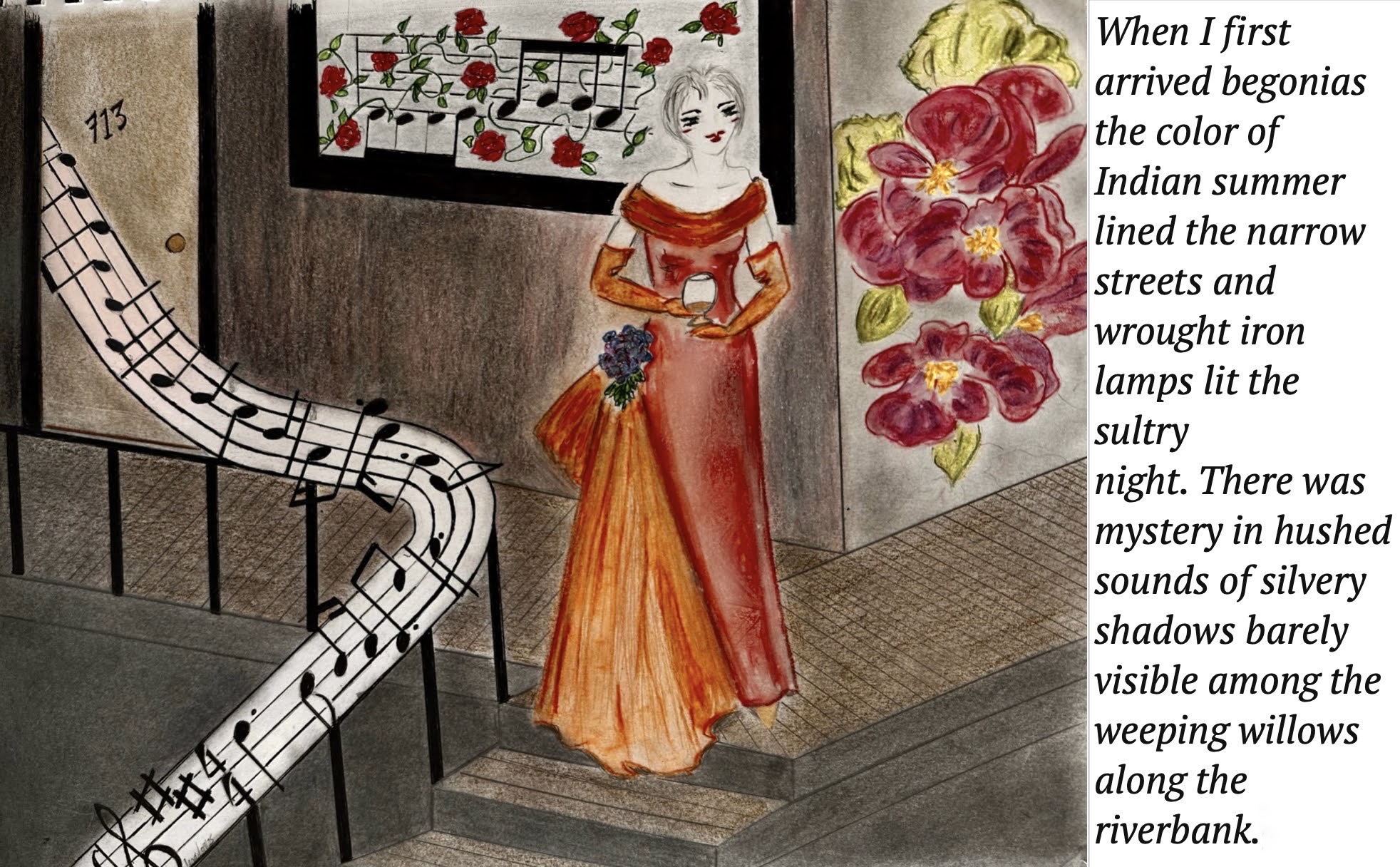
The walls are thin and the wood floor is bare. Music drifts upward, slips under my door, “La Vie En Rose”, the sighs of desperate lovers , their bodies pressed against one another.
At my mirror I braid silver thread through my hair. Should the Frenchman return I am wearing the dress he likes. Last night he signaled with a stone at my window .
He has taught me how to say I love you and other endearing terms in his tongue. At the hollow of my throat I dab a bit of the perfume he bought for me in Berlin. I’m not sure that is true but I like the scent.
He wants me to follow him but he is not my kind. The weak can not survive love that is bound to die nor can they forgive.
Holly for contributing your luscious poems to this collaboration & to Gigifor being the hallway model (where the music notation is actually the first 5 bars to La Vie en Rose).
In America it was the Gilded Age, in the United Kingdom it was the Victorian era and in France it was La Belle Époque.
Dahlings, Welcome to the 1880’s
Inspired by Tissot’s fashion prints of the era, Art Gowns has designed its own gowns, and gone back in time to show them off. Made possible by Venus and the moon, we went through the the Tangle-Heart and moved backwards 137 years.
Rebecca, the first to land in 1888, went about setting up a fashion show at Le Chat Noir. Her palazzo pants, carefully hidden by the period’s draping fabrics, allowed her to move around without arousing suspicion.
The venue was a one night extravaganza at La Chat Noir in the Montmartre district of Paris.
Thought to be the first modern night club, it was opened on 18 November 1881 and closed in 1897.
NOW, Here’s Rebecca!
Thank you, Rene!We have a thrilling show tonight, so let me get right at it, and present les beaux modèles de la Belle Époque!
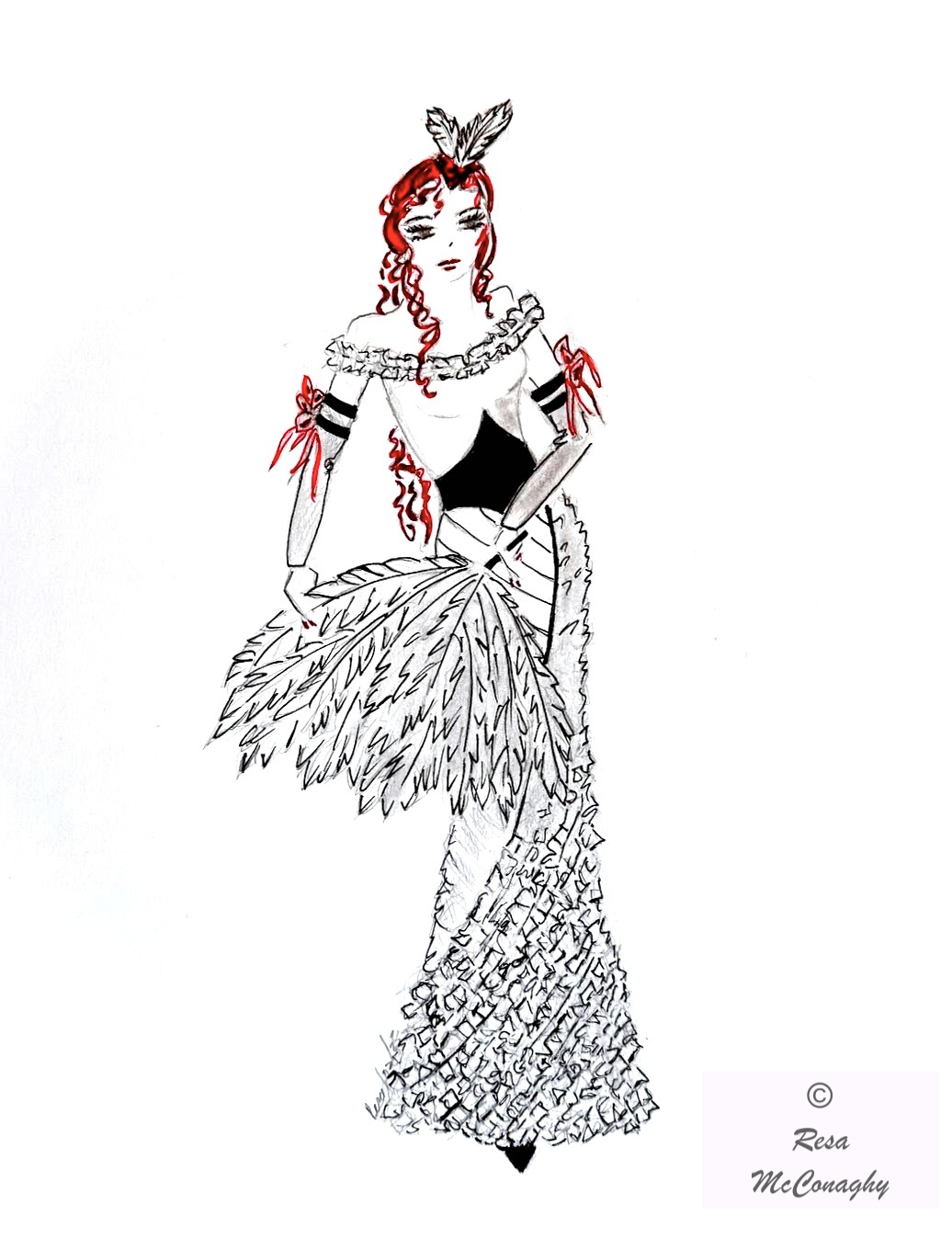
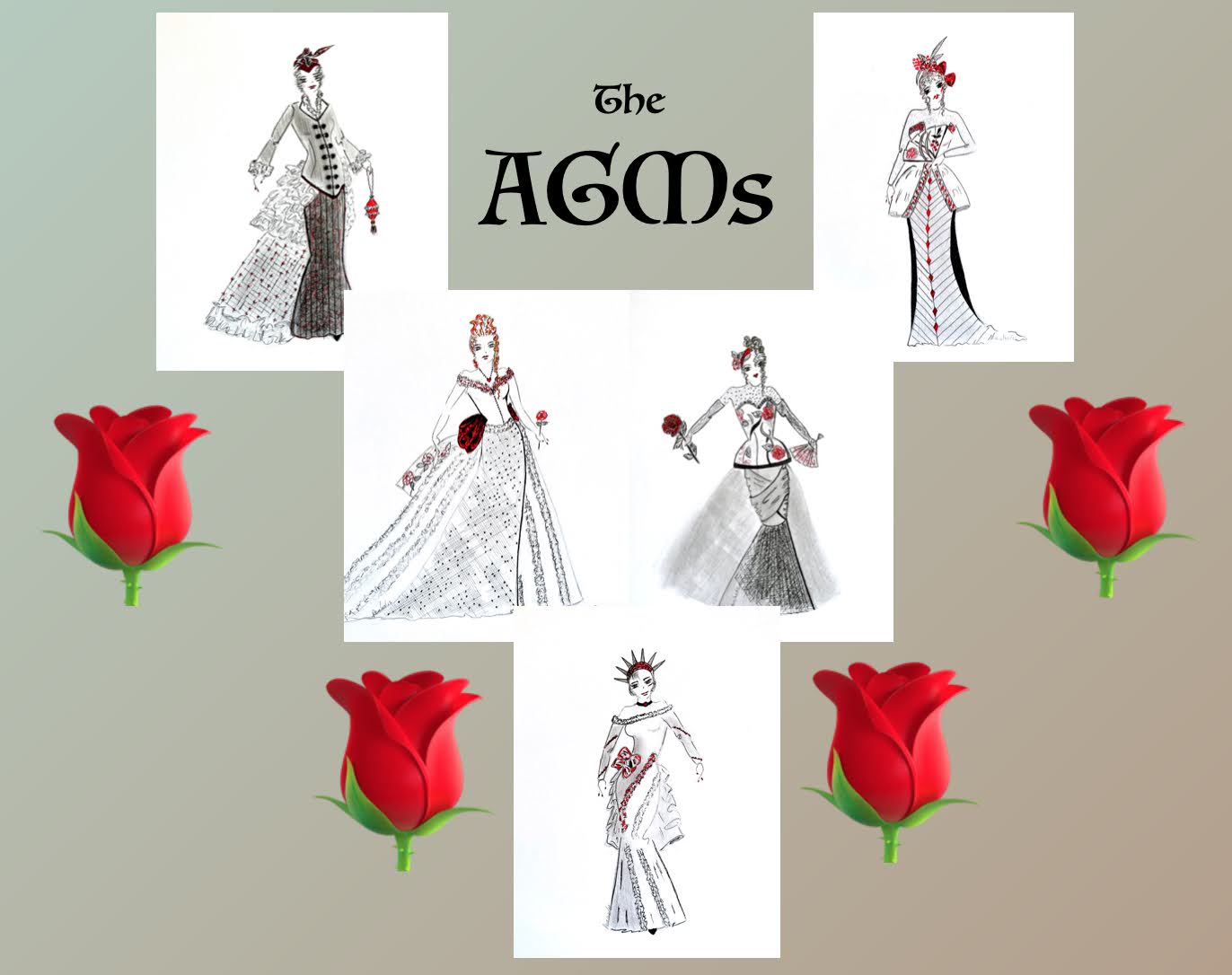
First out on the stage is Modèle de Robes d’Art, Shey.Shey is dressed for afternoon tea or “gouter” as known in Paris. Her fan’s print is inspired by the new Japanese aesthetics.
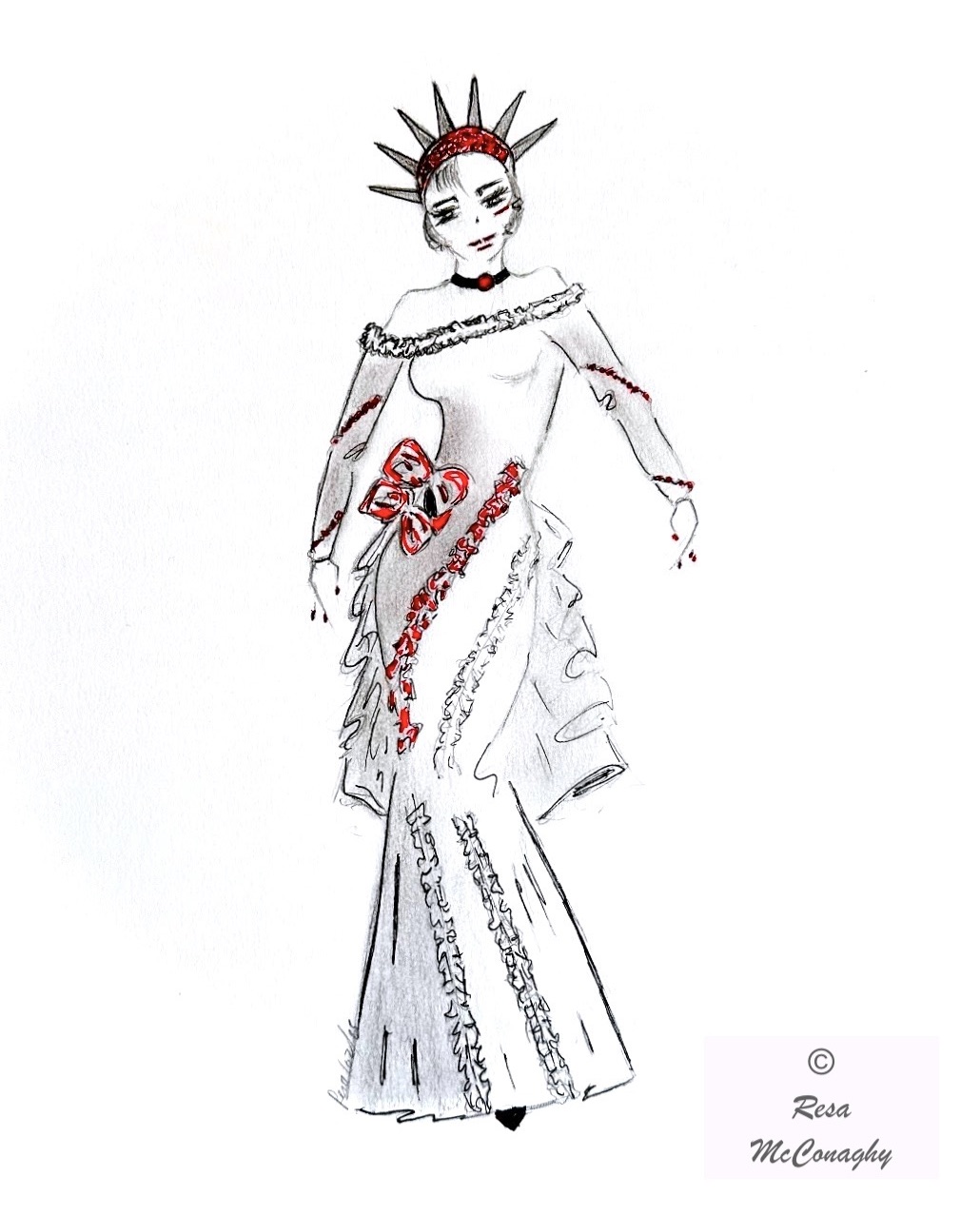
Next out is Gigi dressed for a night at the theare! Her asymetric ruffles play second fiddle only to her Statue of Liberty inspired diadème.
Now, back from her gown change is Mademoiselle Rene with a very Special announcement!
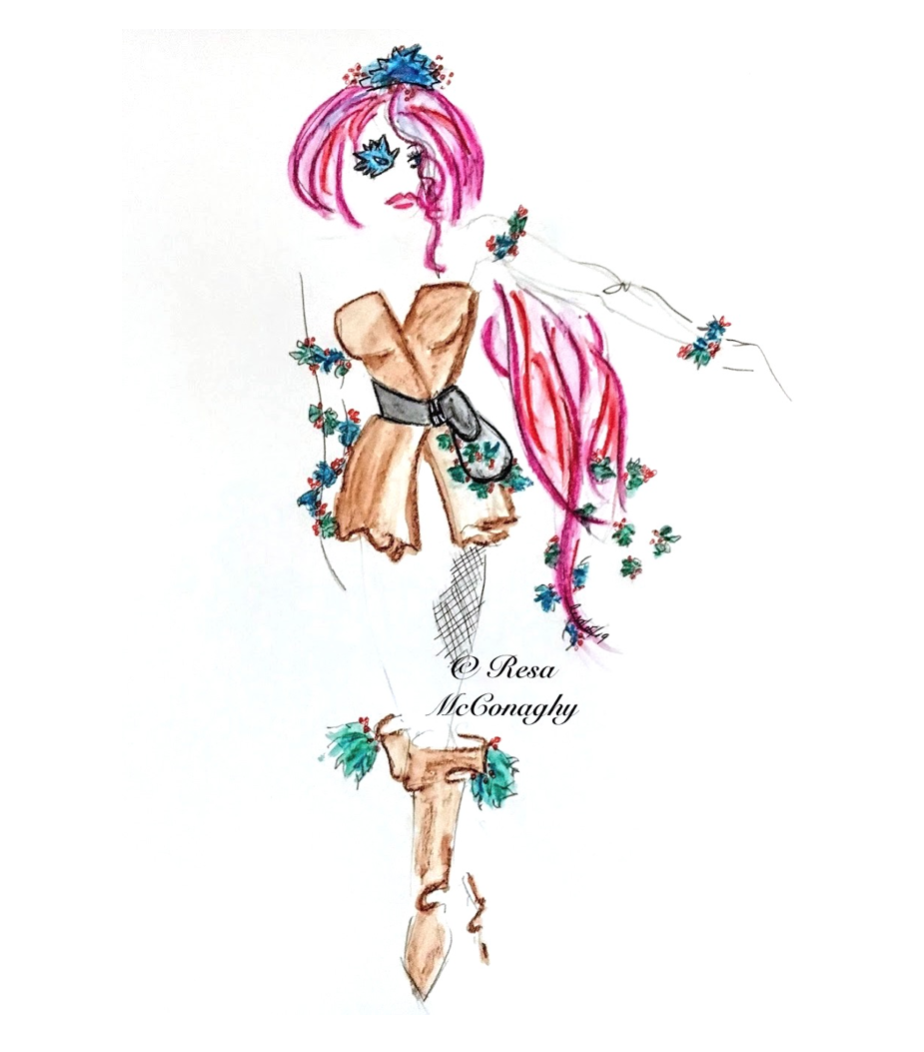
Thank you, Rebecca! Mes Chéris, all of us at Art Gowns put our design hats on and created a special La Belle Époque Super Hero outfit for Princess Blue Holly. Art Gowns presents:
Princess Blue Holly in la Belle ÉpoqueSuper Hero Outfit
What an honour! Thank you to all! This is a momentous outfit! I love the boots, and they only take a half hour each to button up.
It must have been very difficult to be a female Super Hero in the 1880’s. So much beautiful fabric would make flying a bit of a challenge. Snagging would be an issue and the corsetry is somewhat confining when delivering the martial arts moves.
Check out the Freedom difference between 2025 and 1888! ……. aaaand back to Rebecca!
Thank you Princess Blue Holly! You look simply marvellous. That is one special outfit.
Perfect for taking the carriage to the fashion shops, Dale wears a travelling jacket of pinstripe twill, with brocade fishtail skirt completed with a voile tail under a ruched and layered silk bussel. A dainty reticule is the perfect accessory.
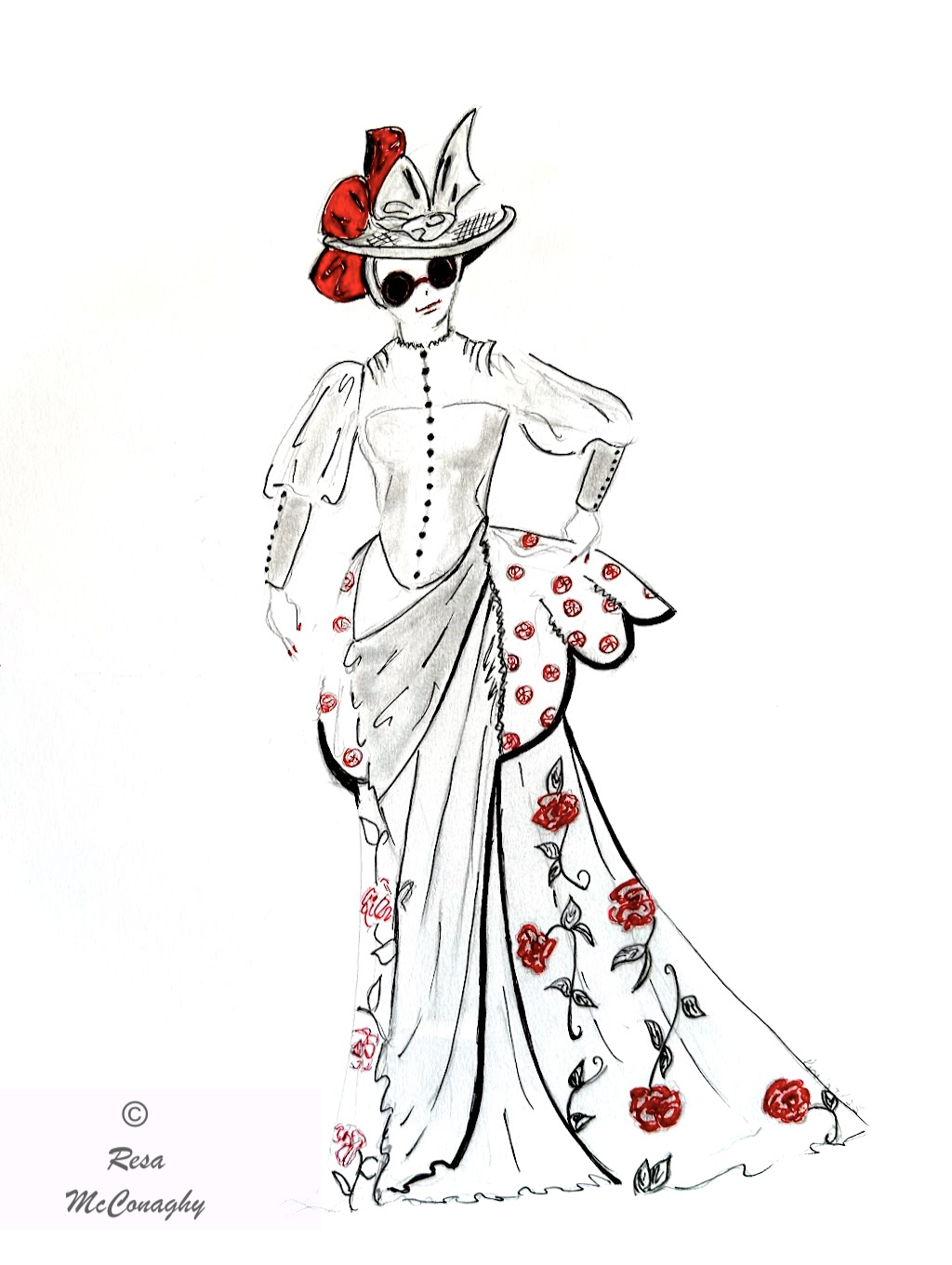
It’s a sunny day and Rene is back in another costume change. This is a miracle considering all the buttons she had to do up, as the zipper was not invented until 1917. She is off to the museum with a rose detail parasol and rose reticule.
It’s “dinner at eight” and the opera forModèle de Robes d’Art, Marina. A rose print corset top with a panière effect from the waist to hips is a lovely accentuation to the fitted fishtail skirt.
Holly is off to a fancy party in white silk with red ruffle corset top and a skirt of silk Swiss dot. A lush red bow sets off the rose detailed bussel and tail with ruffles on the inside and out.
I’m sad to say the show has come to an end, buts let’s hear it for Mademoiselle Rene, who shall bid you adieu.
Mes Chéris, bon soir! We hate to leave, but it’s time to return to the future! Please enjoy Arabesque No.1 by Claude Debussy, while the beaux modèles de la Belle Époque make their departures.
No one saw when the AGM’s made their way back through the Tangle-Heart as contrails. All landed safely in the Bosque by Tim’s.
However, as Rene began her journey to the future she encountered a strange energy.
She landed back at Tim’s in Rebecca’s Black Bamboo, but she wasn’t herself, nor all there.
No one was worried! All were sure Princess Blue Holly would save her.
However and unfortunately, as you and I know, Rene IS Princess Blue Holly!
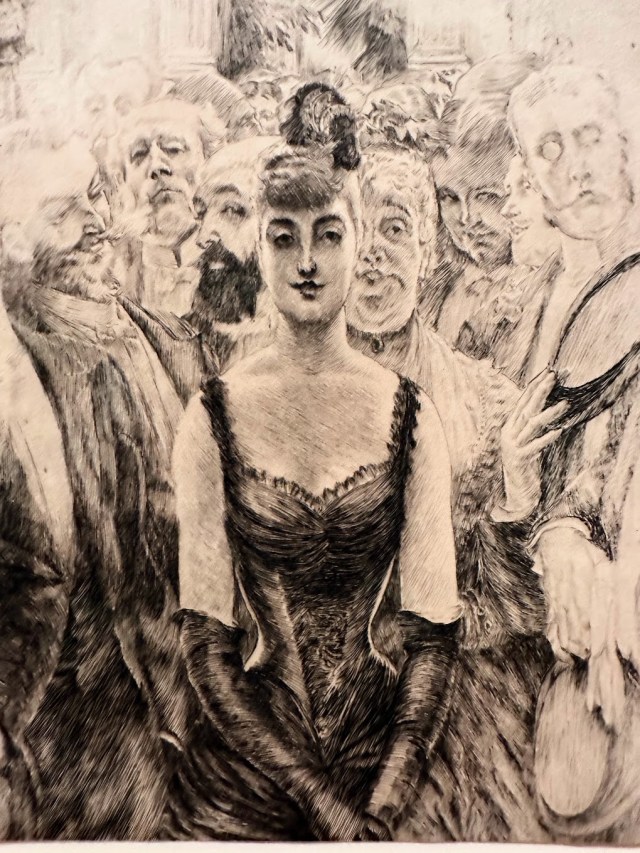
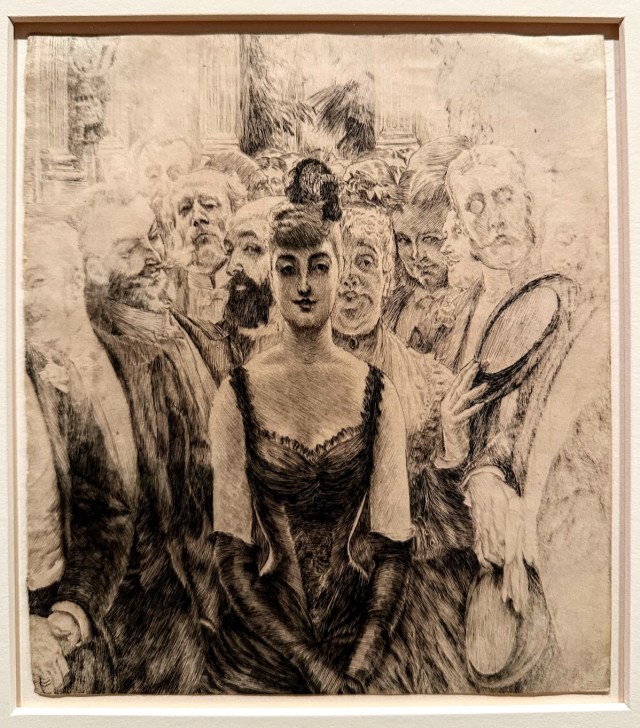
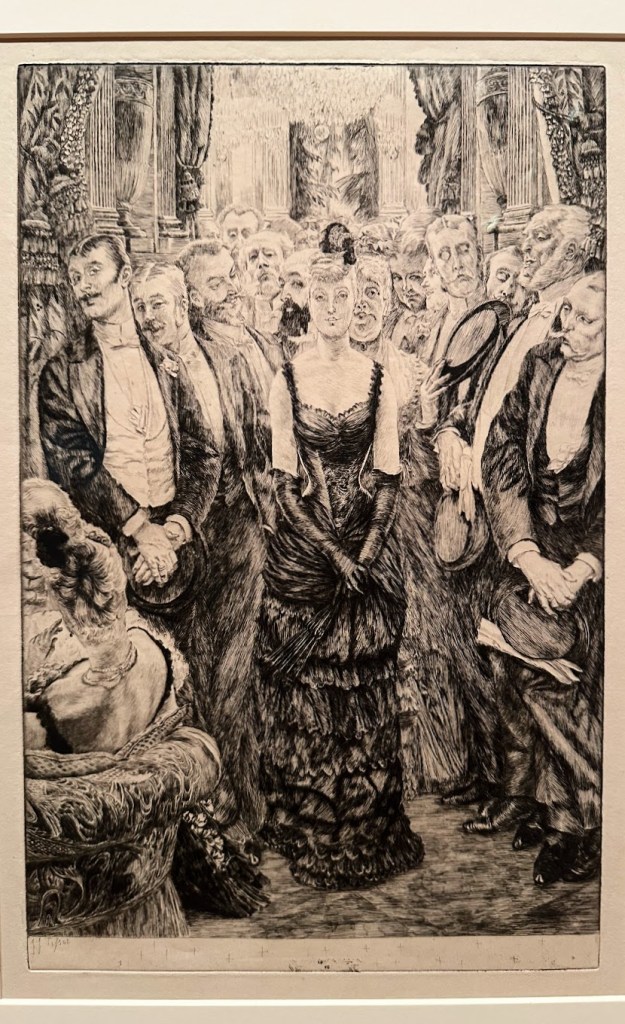
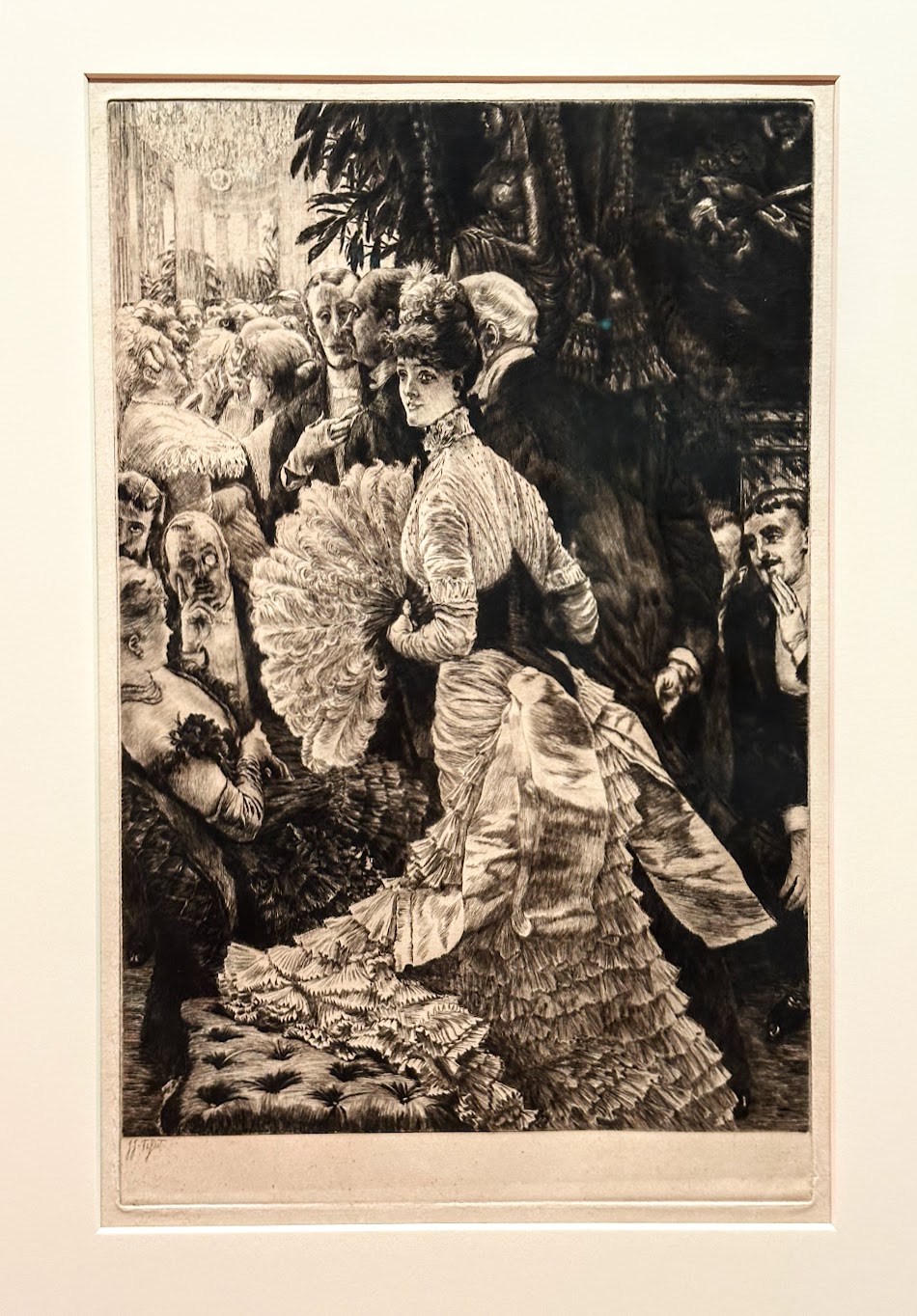
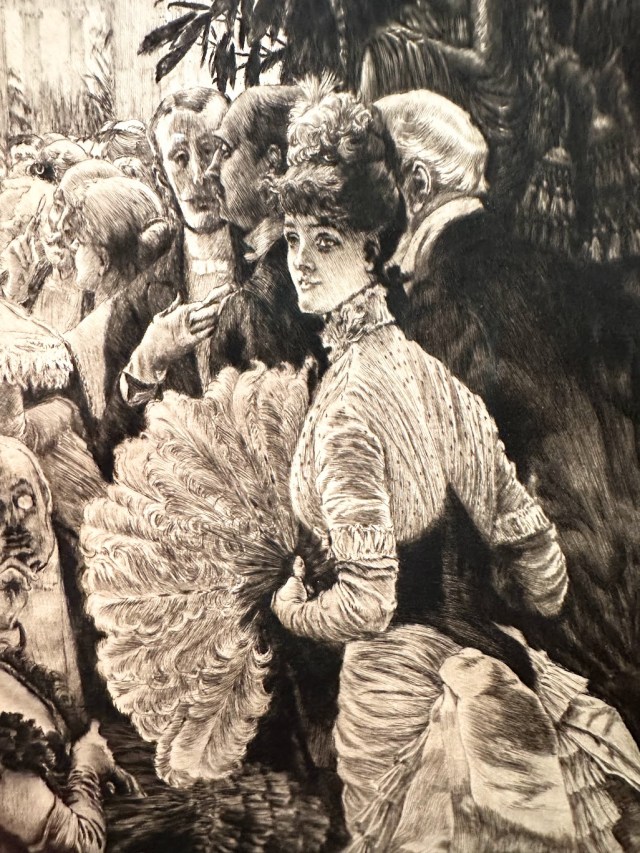
Tissot, a name I hadn’t heard much. Then the AGO announced an exhibit featuring their collection of 2 oil paintings, 1 watercolour and 30 etchings on paper.
A Most Enchanting Day at the AGO
The Fashionable Beauty (1885)
There were several variations of the “Fashionable Beauty”
This one was from the hip up.
Some were more whispy, some more dense
Camera on portrait stage setting
In the last decades of the nineteenth century, James Tissot portrayed women within the contradictions of the period.
Political Woman (1885)
Modernity via the speed of travel, fashion and commodity culture is juxtaposed with the constraint of women’s every day lives.
Flaunting the “Masculine” Realm
The Newspaper (1883)
A well dressed woman reads a newspaper. The fashionable Japanese-influenced wallpaper lining the wall informs of her engagement with the outside world & knowledge of trends.
Fashion magazines and novels were appropriate for Victorian women.
Newspapers were linked to men, as they symbolized factual knowledge and interest in global politics. Although, the image below depicts another reason a woman would read a newspaper.
Without a Dowry (1885)
The above image portrays a young woman and her mother in a Parisian park. The black clothing suggests they are mourning a male relative, and are without a dowry. The daughter sits in an available position, while the mother searches the newspapers for marriage offers.
Dreaming (1881)
More About the Artist
“Best known for his paintings of fashionable figures, Tissot began his career in Paris. While he turned down Edgar Degas’s invitation to exhibit with the impressionists, he shared the groups desire to portray scenes of modern life in an innovative style. He moved to London in 1871 after fighting in the Franco-Prussian War, and became a popular painter of Victorian scenes, particularly those showing young women in typically modern moments, before returning to France in 1882.” – Art Gallery of Ontario
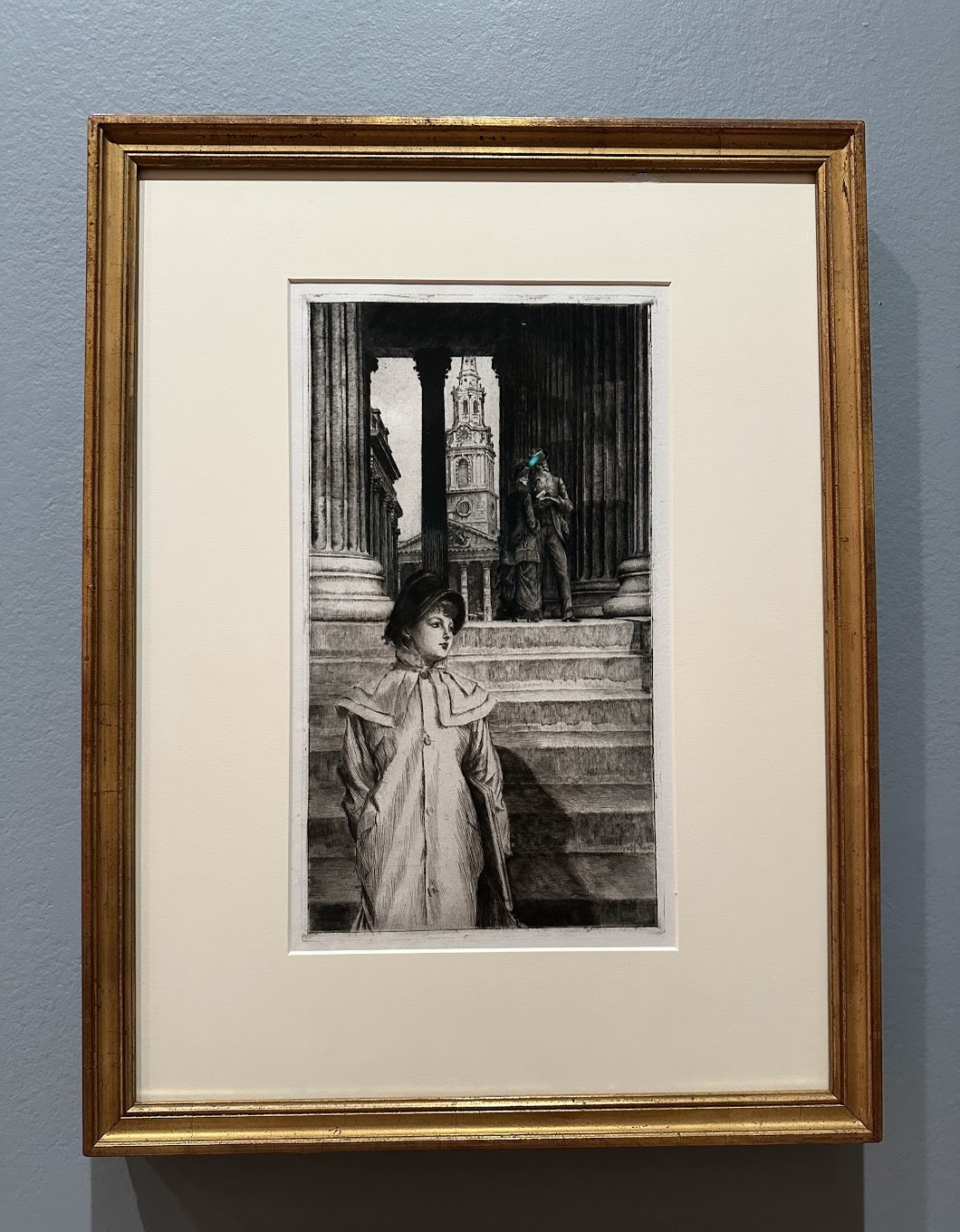
Portico – National Gallery, London (1878)
Moral Ambiguity, a Central Theme
Sunday Morning (1883)
A well dressed young woman walks to church holding a bible. Her raised eyebrows and tentative gaze pose the question, does she need to atone for her sins, or is she nervous about being late for service?
Horizontal women’s bodies were lubricous from a voyeuristic perspective.
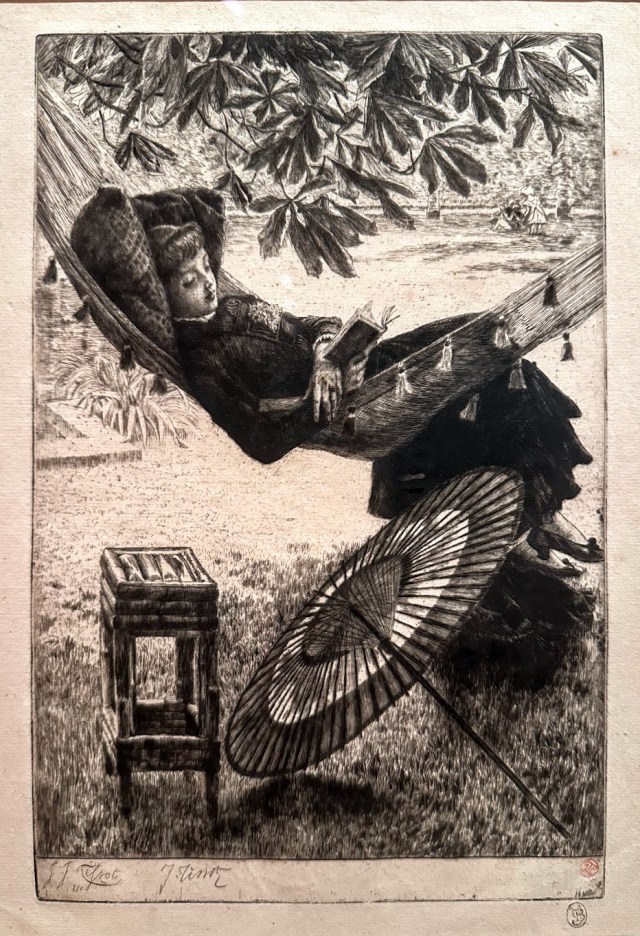
Slumbering female figures had erotic connotations in the Victorian Era, especially in semi-conscious states like dreaming or sleeping.
The Fan (1876)
Now discredited – The below woman’s twisted hand was indicative of the pathological disorder – hysteria. This “chic” female disease was considered fashionably feminine and modern.
Sleeping Woman (1876)
The moral ambiguity of Tissot’s images was integral to their popular appeal.
British critics claimed they were too, risqué, too French.
The Hammock (1880)
A Personal Fascination
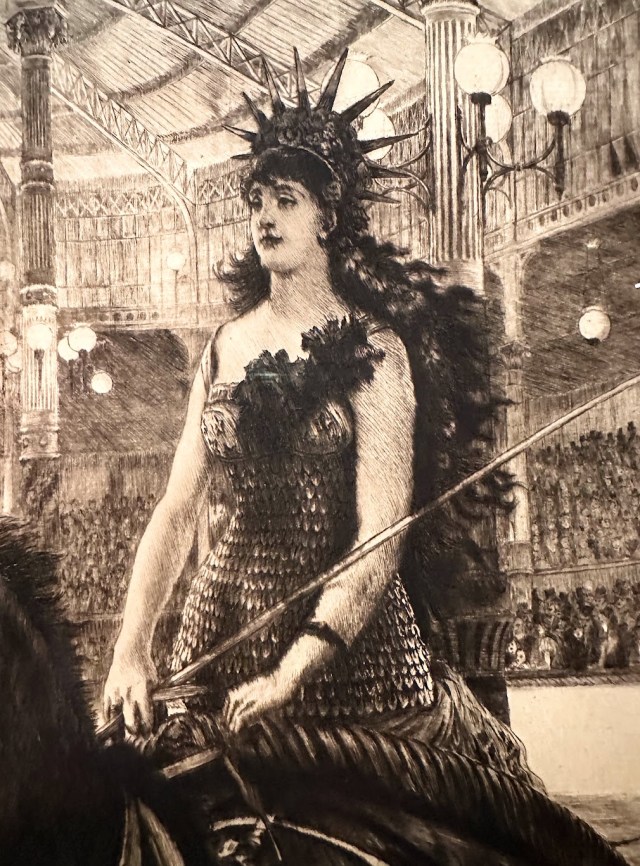
Other than the title, I know only that the etching below is in the Hippodrome (ℹ︎ Met Museum site). I was mesmerized by it. All that skin makes the costumes seem so modern and the Statue of Liberty crowns were piquing.
The Ladies of the Chariots (1885)
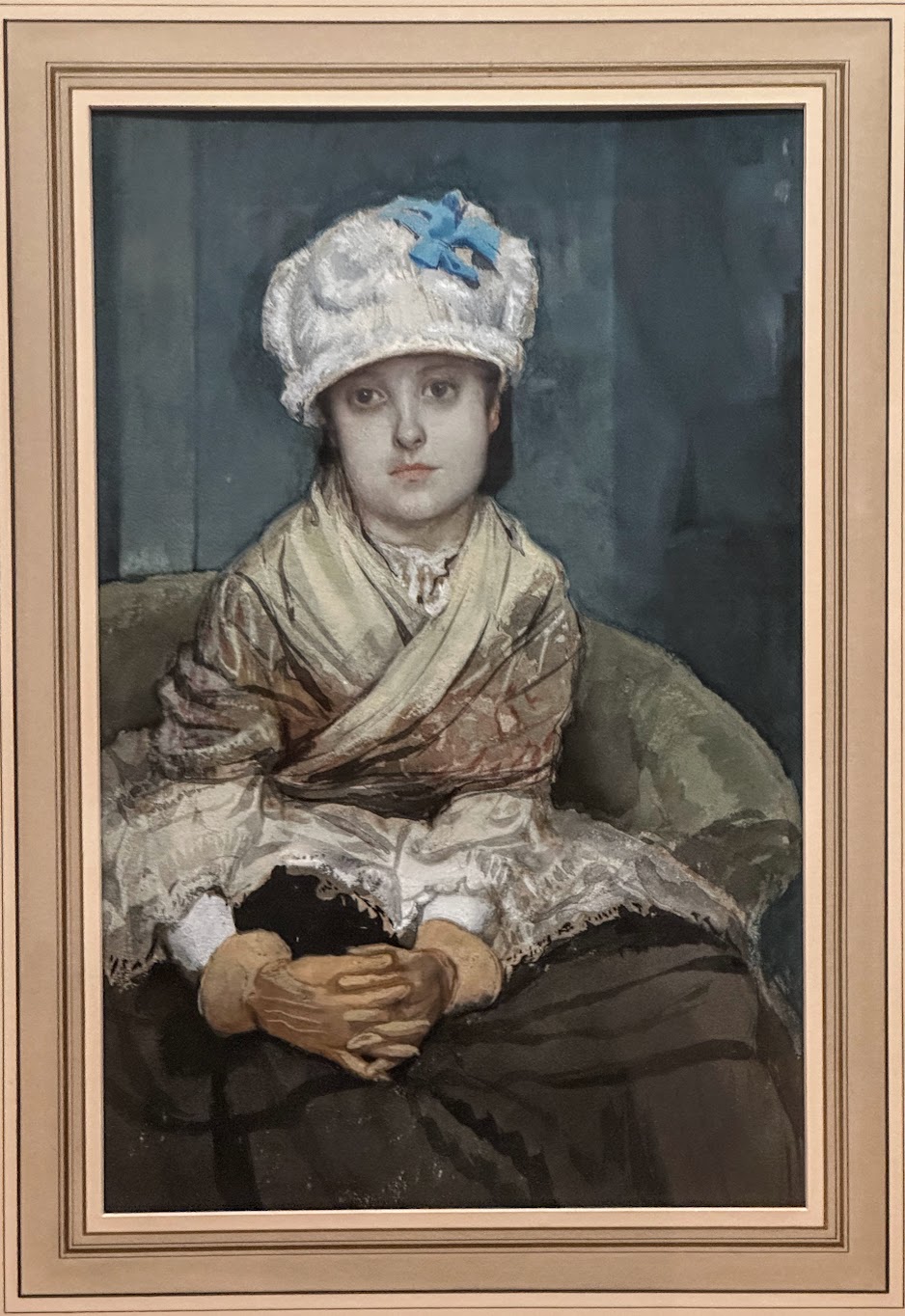
I can’t get everything into 1 post, so there will be a Tissot – II. In the meantime, I leave you with a shot of the 1 watercolour with gouache on paper.
Waiting (late 1800’s)
The young girl’s bored stare, pale skin, under eye circles with oversized bonnet and gloves (highlighting weight loss) suggest tuberculosis.
“Consumption” was coined a term, as it consumed patients, and ate away bodies.
The plan was to read an advance copy of Detour on the Eternal Road, do some drawings of Sam and do a pre-release promo post. Well,I “took a wrong turn in Albuquerque“, hit a detour and missed the print release.
So the road trip, of a post lifetime, passes through Albuquerque? Well, no, but it does pass through 1881!
Resa – John, Detour on the Eternal Roadis set in the past, present and possible future of earth’s history and in the possible eternality of existence. You animate eternity’s goings on with non-haloed, wingless angels helping to guide souls to their eternal home. The adventures are informative, but mostly harrowing. Yet, through “it all”*, the message remains uprightly positive. I’m not talking about the ending, per se, but the body of your story. Is this purposeful, or unconscious?
John – I have always carried a positive attitude regarding life. It is no surprise to me that this comes through in my writing even in the most dire of circumstances. You mention the ending which I don’t want to spoil for folks is an example of this positivity. It does rain a question about how much responsibility each of us has to take for the existence of evil on this Earth.
Hello! I’m Sam. When not on the road guiding souls to their eternal home, I’m at home on my cloud.
CLOUD WEAR is a custom wardrobe designed especially for me by Resa, who at this point remains earthbound.
Resa – Do you, or did you ever have a crush on Sam?
John – Sam is an agglomeration of every woman for whom I have had the honor of having feelings. Of course, I love her.
PRESENTING – CLOUD WEAR
1. Windy Day (sun dial on wrist) - 2. Grecian Ode - 3. Rock'n'Roll Angel - 4. Fortune Teller - 5. Dream Away - 6. Honey7. Surprise! (all blue beads and earrings made from dew and raindrops)
Resa – Without preaching any religion, you metaphorize good and bad/evil with god and the devil. In the story our protagonists, Sam and James angels, are presented moral dilemmas. What say you to the idea that I think you are speaking to man’s “better angels”?
John – I think you have figured out the fact that I believe there are angels that walk among us. I also believe we all have inside of us the ability to behave as if we have been anointed with title ‘angel.’ On the corresponding side we all can be perfect devils at times. The control of the dominate characteristic is left up to how we were raised and our perception of what constitutes goodness.
Resa – So John, this is the third book in the Eternal Road series. I’ve read the first two and this one seems, in its fictional light, more politically predictive than the other books. It seems a pejorative on the future, on behalf of mankind’s progeny. Can you speak to that?
John – Since my books are written in the present tense it might appear as if there is a perjoritive view as the reader moves through the action. Quite the contrary the story attempts to provide human kind with a tool that can be used to continue the species forever. Yes we have to look at nuclear war as a possibility, but the essence of the story which is repeated is that all mayhem is preventable.
The one pejorative view that I will raise my hand to is the increasing dependence the average person has on Government. I believe in the government being representative of the people and not an entity that exists for itself.
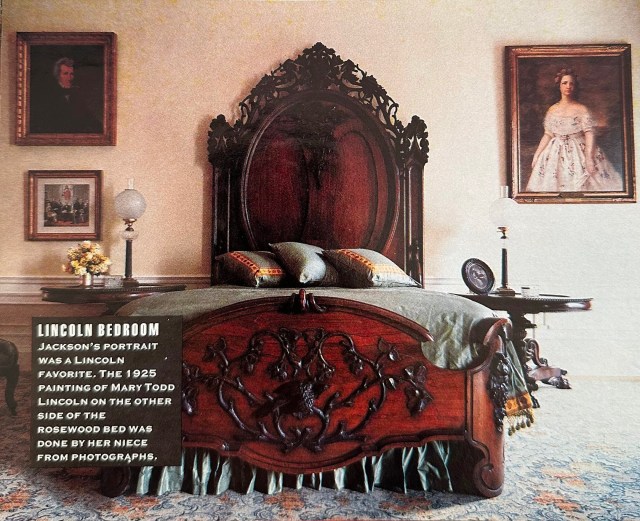
“Lincoln’s Bedroom” in the White House.
What does this have to do withDetour on the Eternal Road? We go to the White House?
Yes, but which wing and what rooms ?
Below – A Made to Scale Replica of the East Wing
The replica is 60 feet long & 20 feet wide. The Artists, Historian John Zweifel and his wife Jan, took 25 years to complete it. It includes all furnishings. The clocks tick, flags wave, phone rings and TV’s work.
Looks fab when you enlarge it!
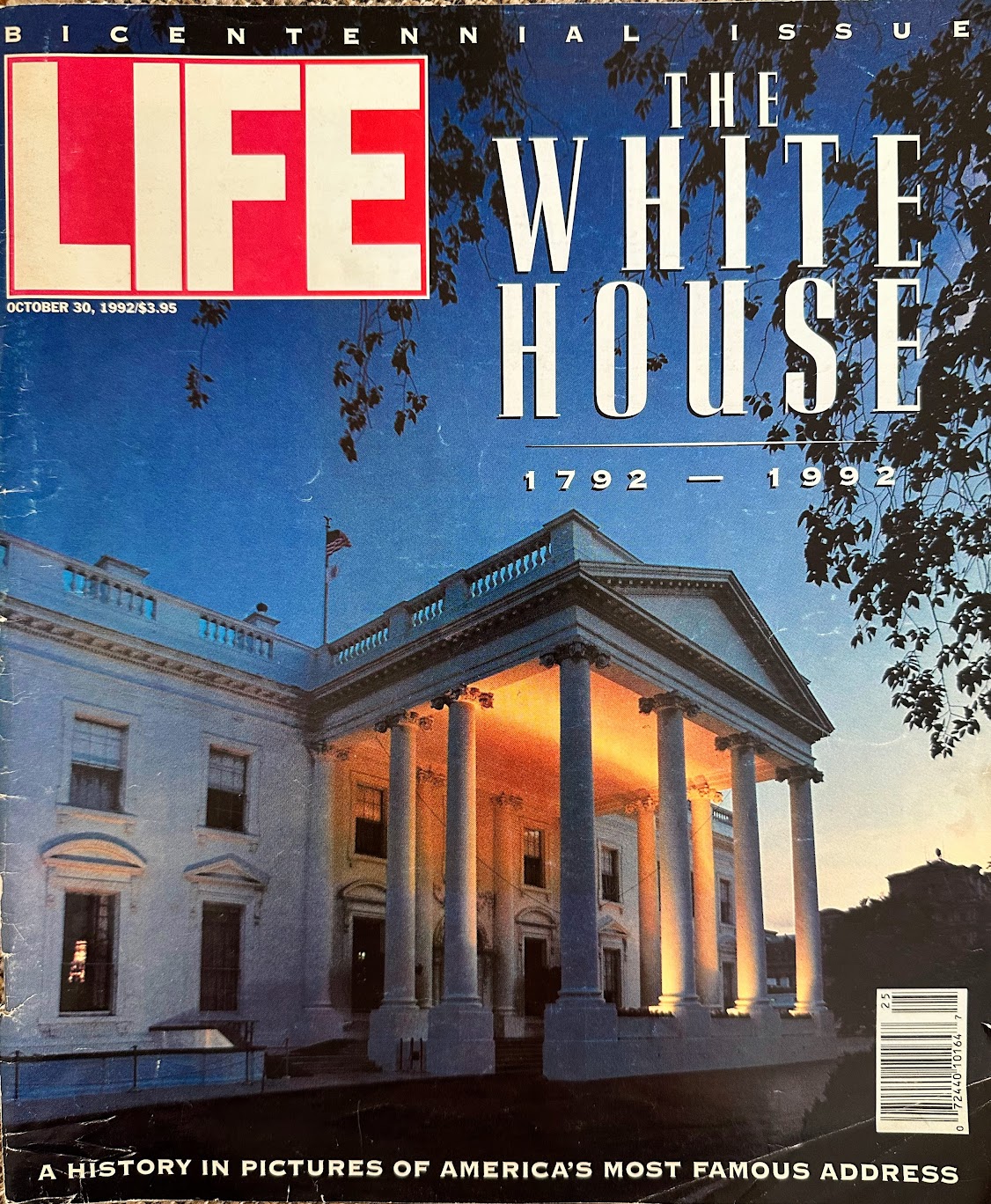
On Its 200th Birthday in 1992 –This to scale replica of the East Wing of the White House was presented in a special issue of LIFE magazine.
1 - First Lady's Dressing Room
2 - President's Bedroom
3 - Family Sitting Room
4 - Yellow Oval Room
5- Treaty Room
6 - Lincoln Bedroom
7 - Lincoln Sitting Room
8 - State Dining Room
9 - Red Room
10 - Blue Room
11. Green Room
12 - East Room
13- Library
14 - Map Room
15 - Diplomatic Reception Room
16 - China Room
17 - Vermeil Room
On the Left: Legend to all 17 rooms in the East Wing
I think you can enjoy this book without reading its predecessors. However, certain questions will come up, such as this question I asked John after I read the first book.
Resa – “Eyes are mentioned on almost every page, mostly due to travelling, but I could not find the colour of Sam’s eyes. I also searched brown, blue, hair…no luck. Thing is, I was thinking of drawing Sam as an angel, maybe no wings. This way I could do a gown.”
John – “You are not crazy. You won’t find a color of Sam’s eyes since I very seldom describe the characters in terms of physical attributes. My reason for doing this is I would rather the reader form an image in their mind of what the characters look like. So you can make her eye color whatever pleases you. She is more your character than mine since you invested your time reading the book. “
So, if you are thinking of jumping straight to book 3, you might want to read a few of the Amazon reviews on the first 2: Eternal Road &The Last Drive.OR read my Out-of-the box reviews.
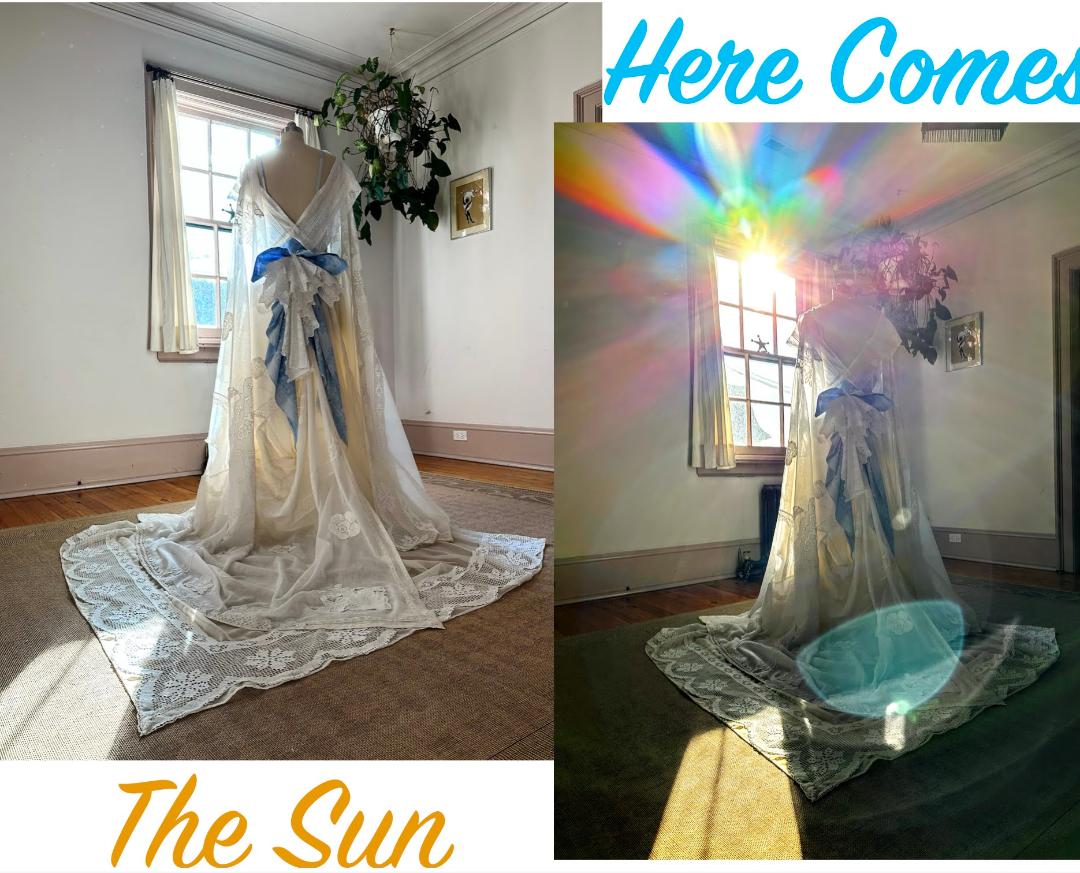
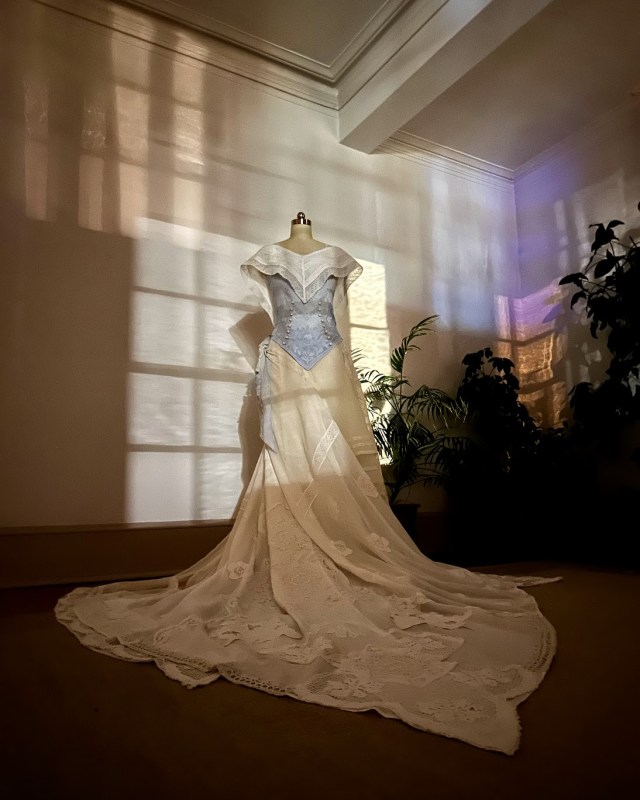
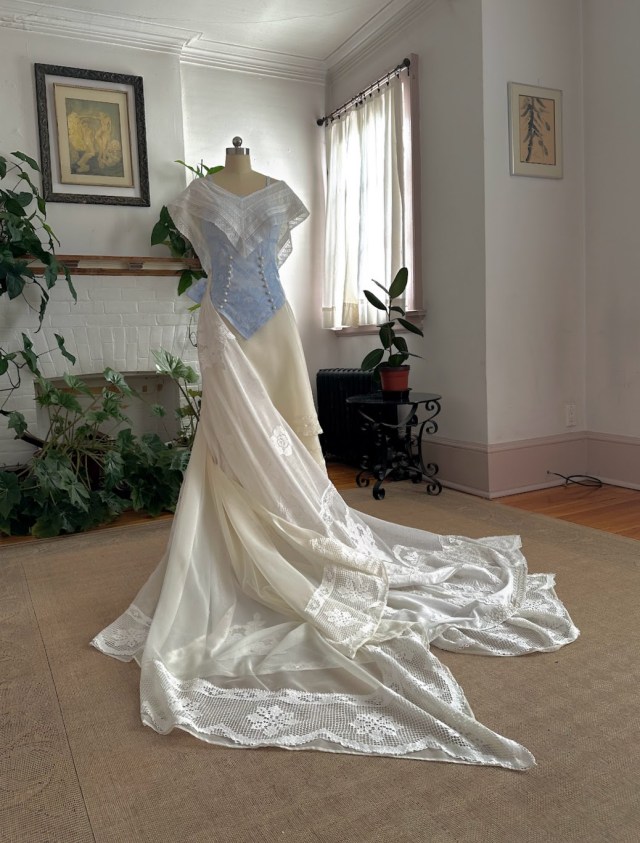
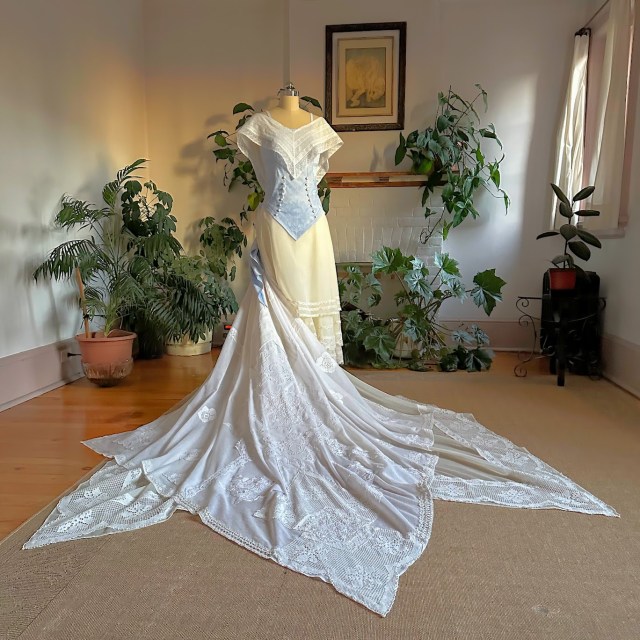
Linens & laces inherited from great grandmother & grandmother to mother then her, became all mine; an Art Gown to share.
Her beauty holds memories of Victorian times, and the bright light of many tomorrows.
Victorian Sonnet is dedicated to Diana, her great grandmother Emilie, her grandmother Truly (Caroline), and and her mother Tineke (Dutch nickname for Anna Martine).
Sonnets from the Art Gowns
Structure
Iambic pentameter – 5 feet to a line – 4 lines to a verse – 3 verses & a couplet
Rhyme scheme – ABAB, CDCD, EFEF, GG
Third verse volta
I
Dear Diana your lace and your linen Great grand mother, grandma, mother then you Woven treasure fair sent passed on to begin Romance dance a dress white and blue.
Lace held, fabric draped inspiration gold Creation libation confusion strewn All threads gay with gathers theirs to unfold Ancestry, a love light shimmering through!
Yet should something arise break then the spell To find magic's construct tattered and torn Ere rendered fore tendered tossed into the swell Became fragments merely blithely left lorn.
Our memory painted lingers in mind, Inherited Victoriana's time.
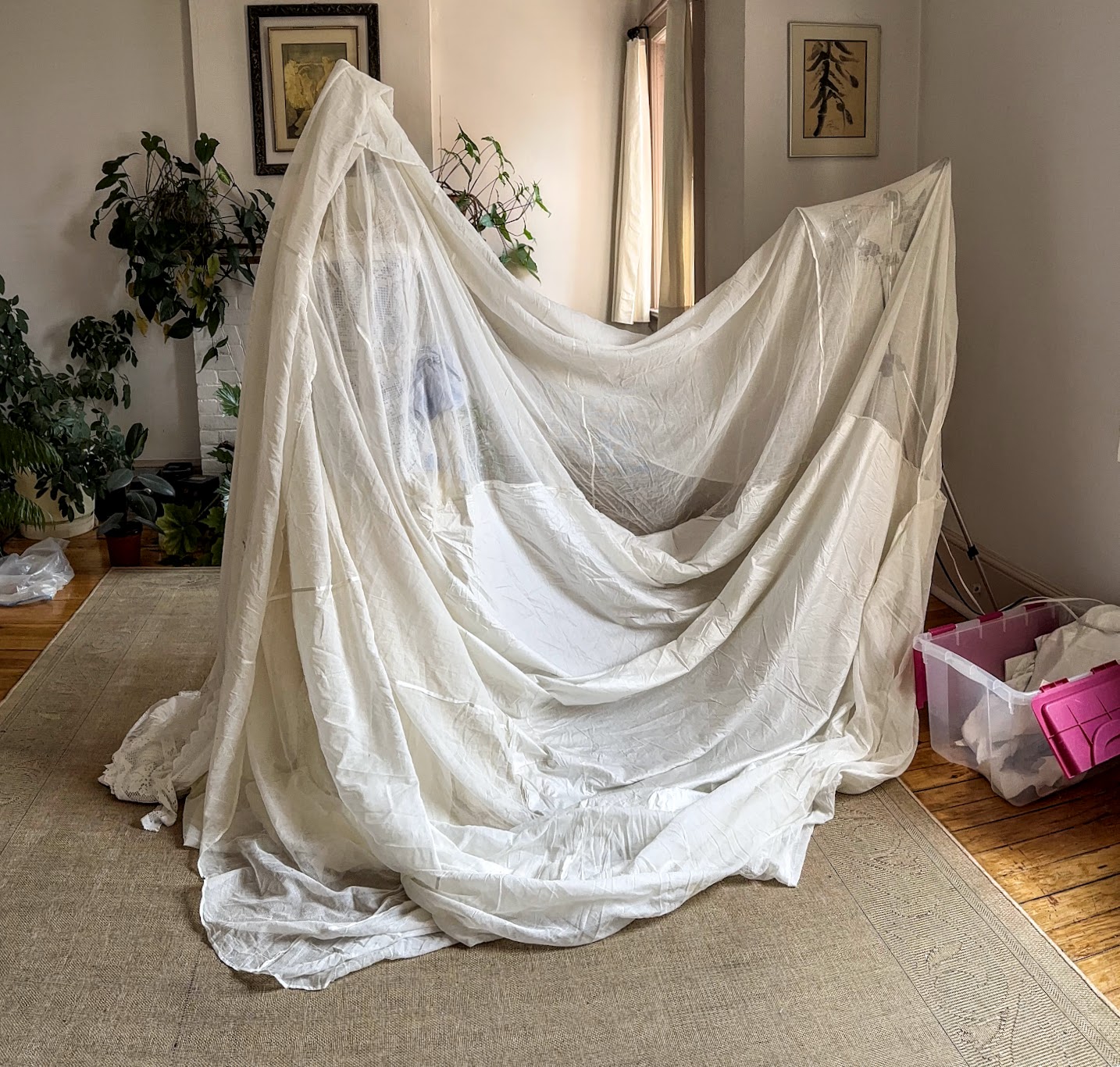
When the fabrics arrived, I threw the lot on top of Lilac Fan Dance. There was also a fabulous mosquito net with cotton top.
There were various lace yardages2 delicate bed jackets
A huge lace tableclothLarge assortment of doilies & table covers
When the time came to begin, there was so much lace and linens, I needed to spread them all out.
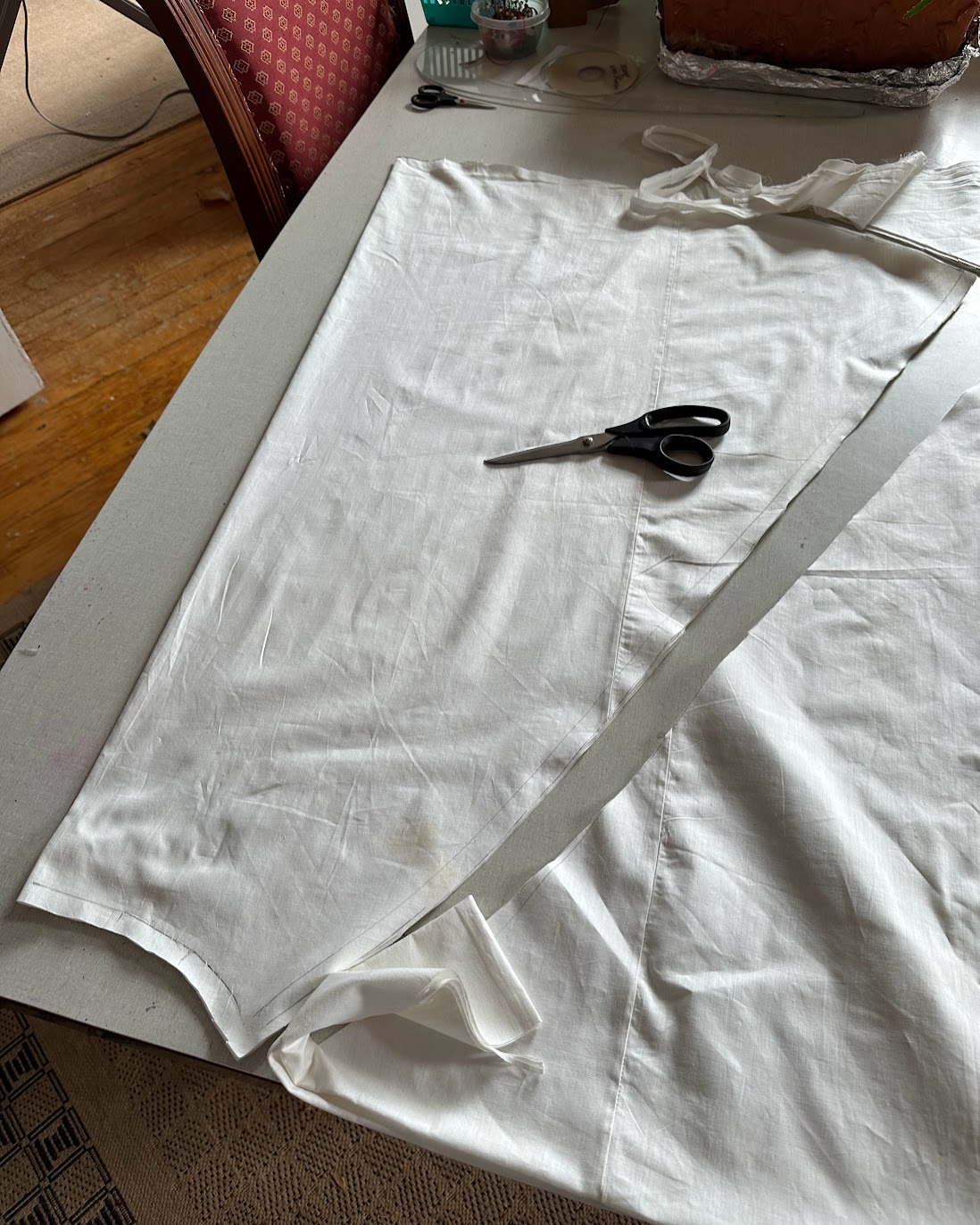
All laces and fabrics were hand washed, and tested for tensile strength.
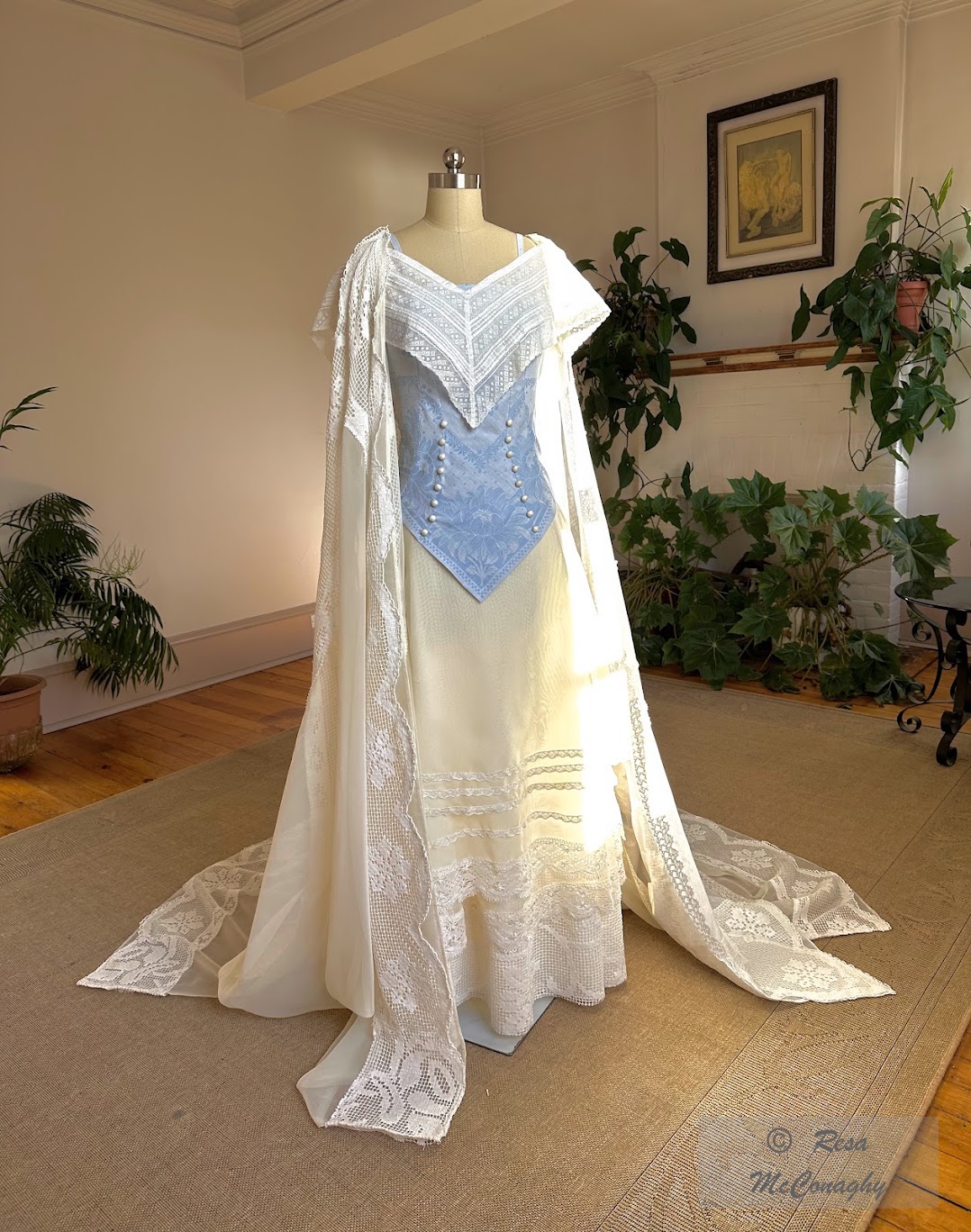
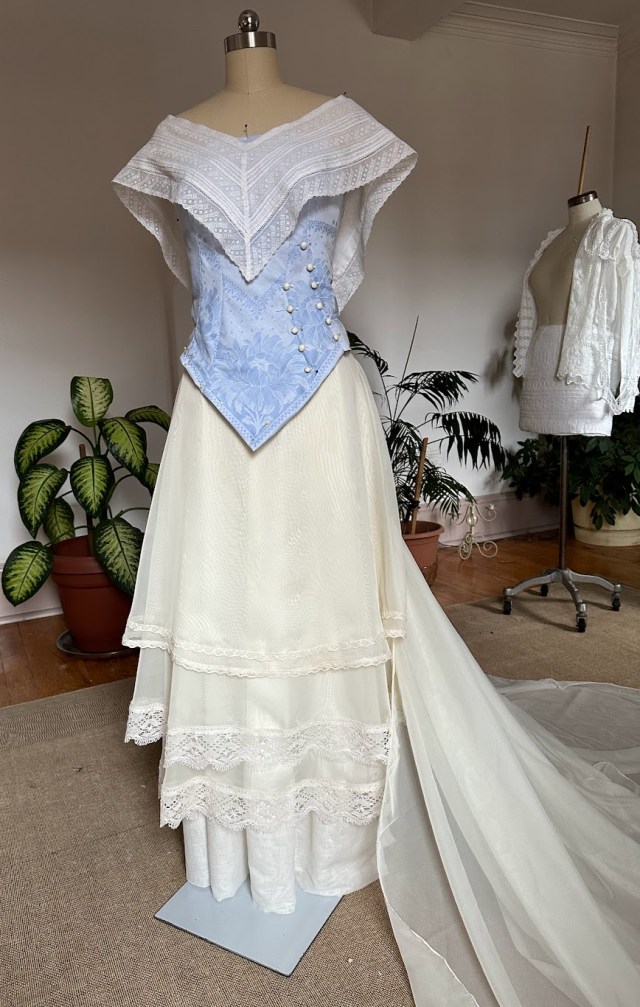
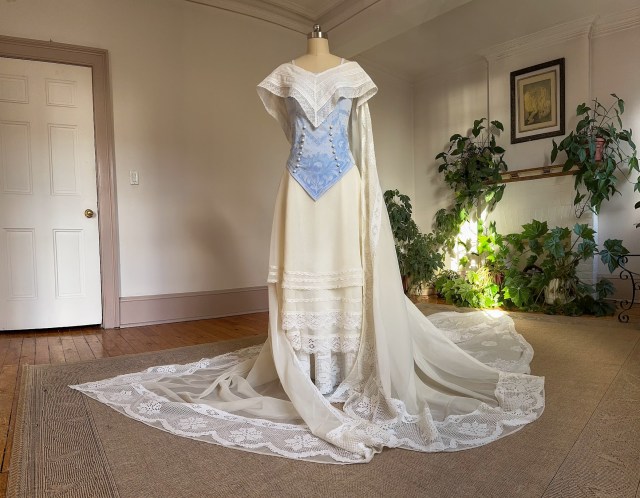
A bertha collar was formed from a bed jacket’s trim and lined with mosquito net.
An underskirt was cut from the cotton top of the netting.
Mosquito netting was added to the underskirt to make it full length. Lace cut from the lace tablecloth was sewn on top of the netting.
A blue linen jacquard tablecloth was formed into a corset shaped top with straps into a plunging back.
My friend Kat gifted me a new Judy, so I transferred the gown to her. She also sent massive yardage of new, but cut into, winter white synthetic curtain sheer, found for a pittance at the good will.
After washing, the sheer was cut into a 3 tiered overskirt, and trimmed with the lace yardages. The sheer makes a solid backing that fortifies the antique laces.
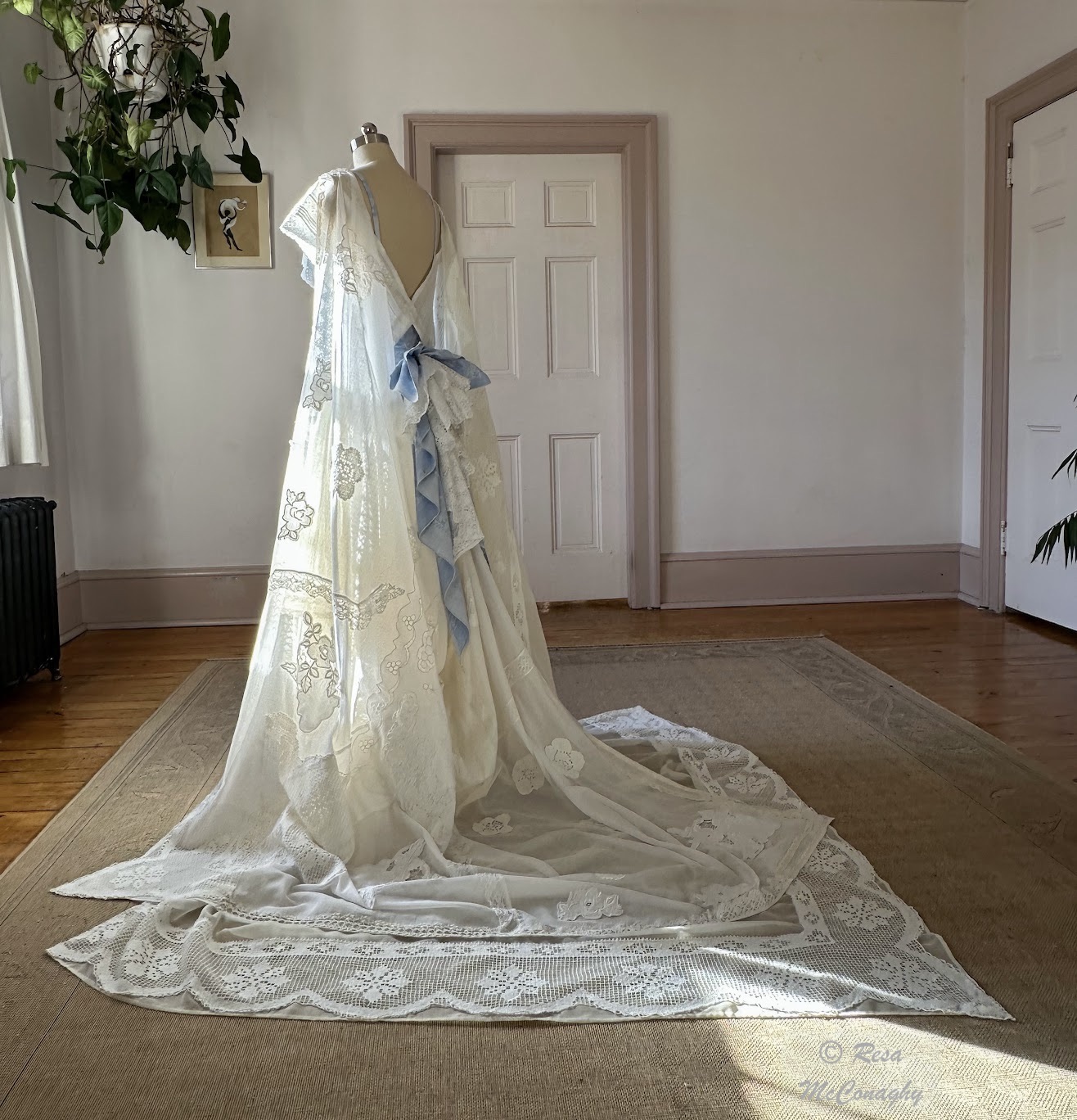
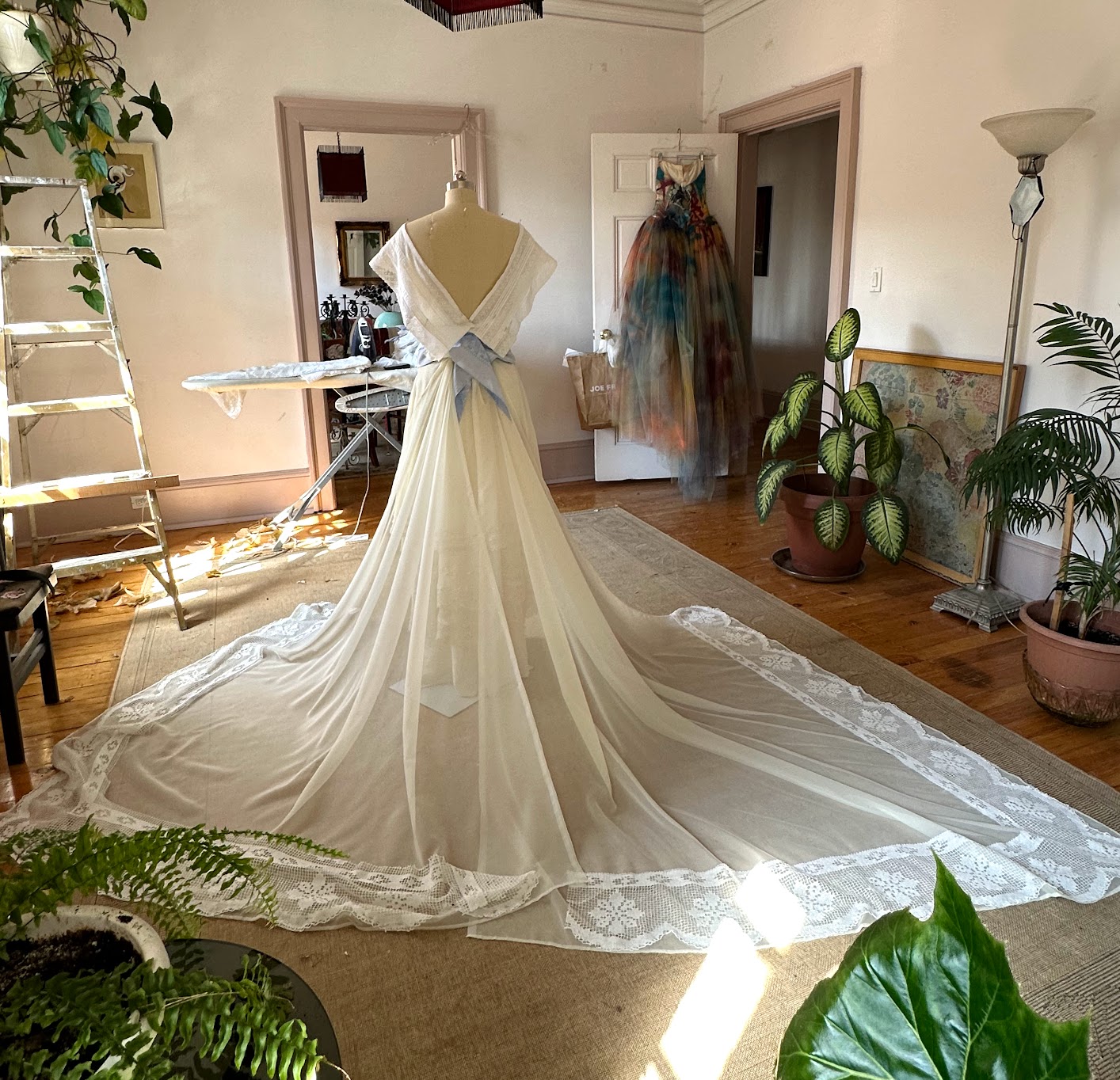
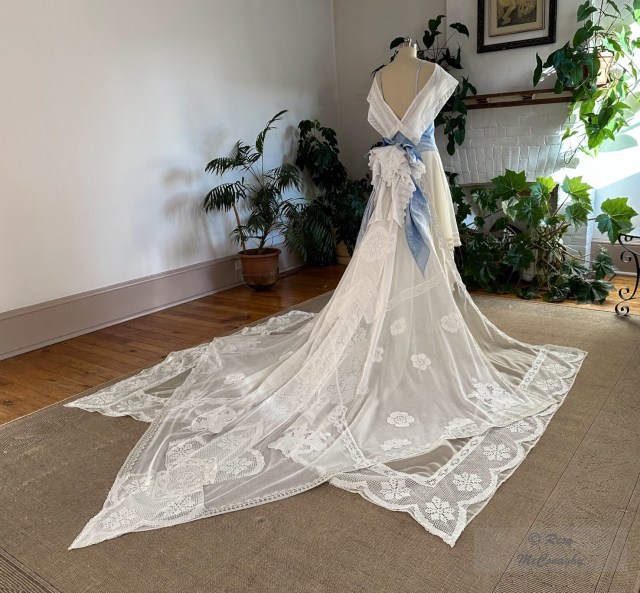
Two side tails were draped in bias from the sheer, then trimmed with edges cut from the lace tablecloth.
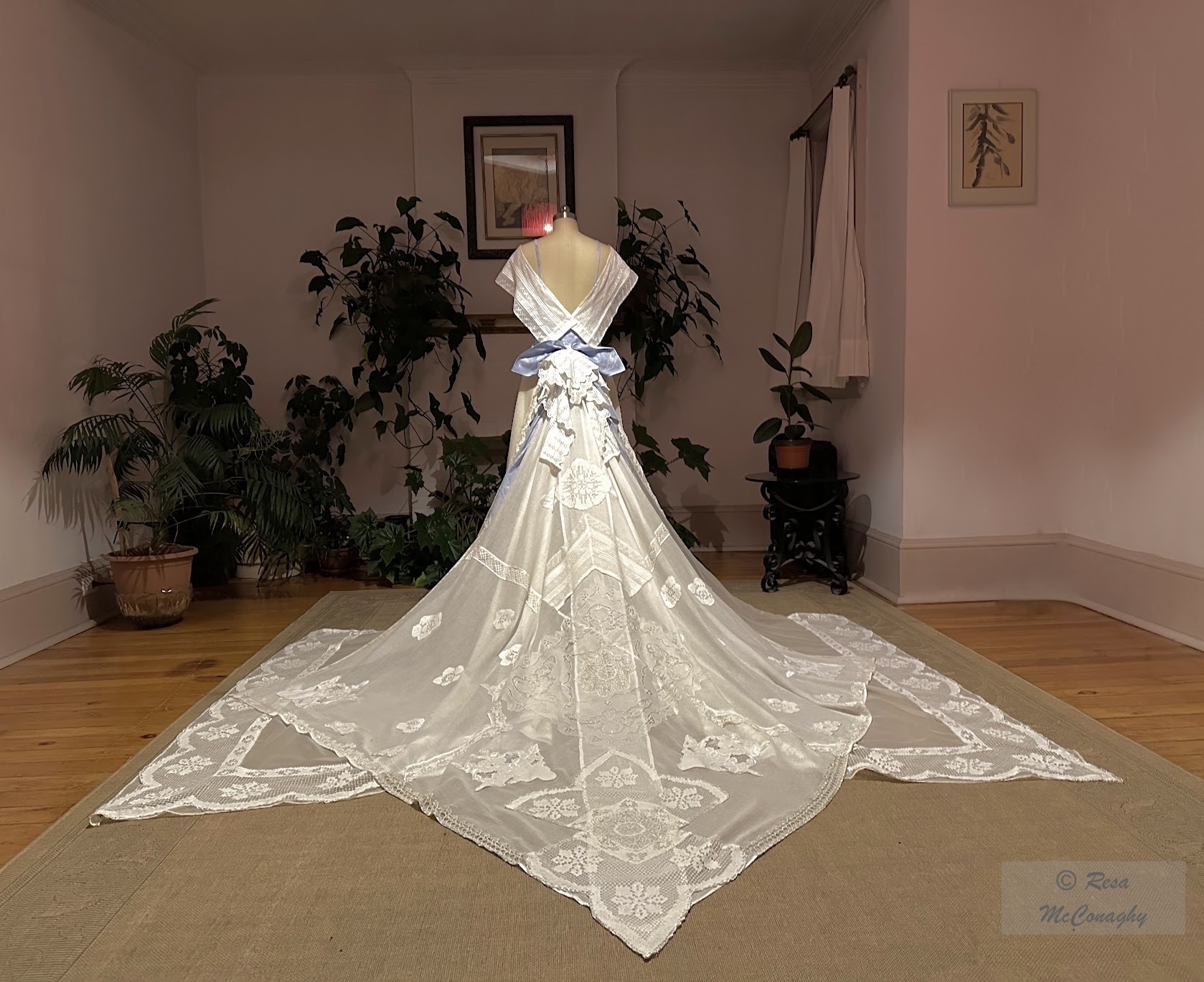
A third centre tail was draped from the mosquito netting on bias. This tail was trimmed with the last of the lace yardages. It was then filled in with geometrically placed doilies, table covers and bits of cut up lace edgings.
A bussel was formed from blue serviettes that matched the bodice’s tablecloth, and eyelet lace trim from the second bed jacket.
Vintage hand covered buttons adorn the bodice.
Voilà! Victorian Sonnet
She’s so beautiful, I went overboard taking pics.
OUTTAKES
Serendipity
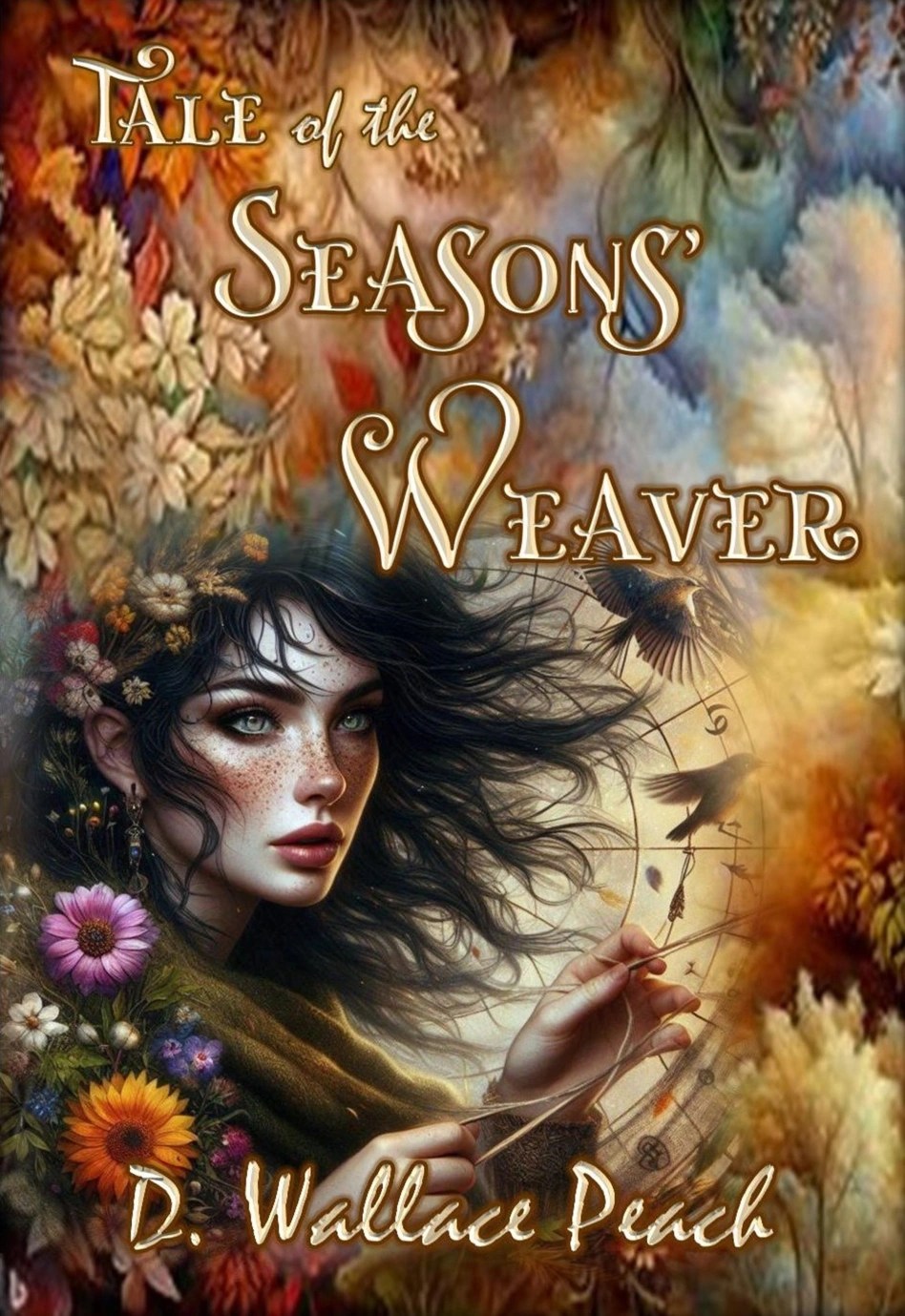
November, 2023 – The 2 boxes arrived, from Diana. Lilac Fan Dance was still in the making. I knew Diana was mid book. In May, 2024 Victorian Sonnet was begun. 6+ months later, the gown and Diana’s book – Tale of the Seasons’ Weaver – were finished, more or less at the same time.





























































You must be logged in to post a comment.